Wani Nazir
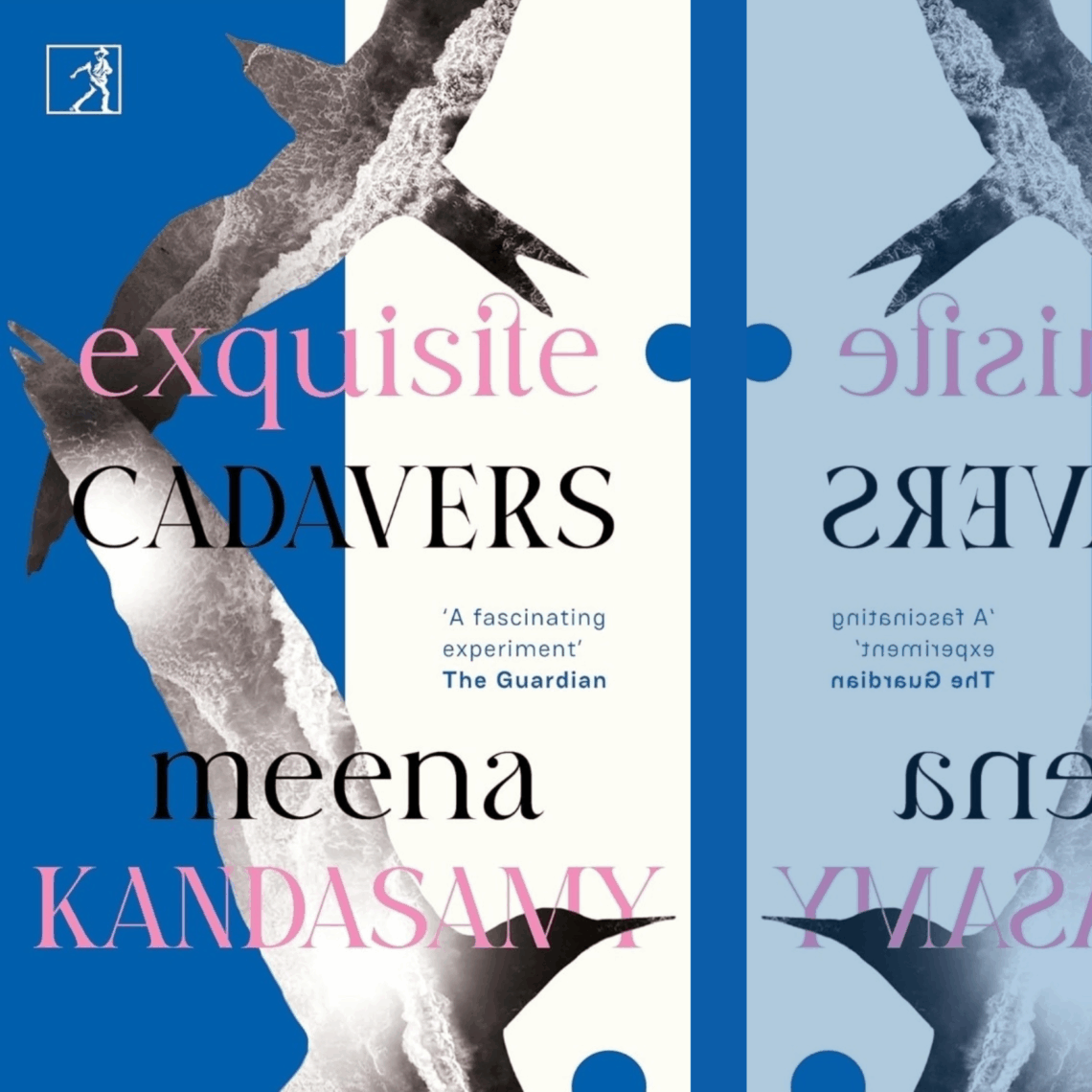
You know that strange feeling you get just before you start reading a book? You are still in your own world and not quite in the story yet. Then, all of a sudden, the book’s life is mixed up with yours. Meena Kandasamy’s Exquisite Cadavers does this on purpose. The book is like a double life: it’s part novel and half something else; it’s part made-up and part genuine. Kandasamy starts the book by saying, “This project started as a reaction to the reception of my second novel, When I Hit You: Or, A Portrait of the Writer as a Young Wife. I had been frank and forthcoming in telling the world that the book drew upon my own experience within a violent, abusive marriage. I was also clear, as an artist, that the book was constructed as a novel, a work of auto-fiction.”
You are stuck between what’s genuine and what’s made up right instantly. It reminds me of what Barthes said about how the parts of himself in his book are simply words and not truly him. And Woolf was right: even if you want to be honest, your life story inevitably gets a little mixed up when you write it down.
Kandasamy’s interesting notion is that she doesn’t allow you grow used to the kind of book you’re reading. She writes about a made-up pair, Maya and Karim, right next to her own diary entries. It is somewhat akin to Italo Calvino’s If on a Winter’s Night a Traveller, where writing and reading collide. But here, it’s more angry and about being a woman and politics. One moment you’re in Maya’s head, and the next you’re hearing Kandasamy talk about critics, racism, and Tamil poetry. She isn’t using the traditional tactic where the writer disappears and you lose yourself in the story. Instead, she shows up, displays herself, and leaves the seams visible.
Take Maya. We see her as, “What can window sills betray: not the tight top-knot of a sad woman who rests her elbows on them and counts the slow passing of the hours.” Like the people in Jean Rhys’s works who spend a lot of time at windows daydreaming, she is melancholy and waiting. But Kandasamy doesn’t let it become too mushy here. Maya is more than just a sad woman. She has the added stress of being an immigrant, dealing with race, and fighting for control in her marriage.
The writing doesn’t sit still either. Sometimes nature is like a big metaphor: “It rains with a vengeance; the sky an angry spouse keeping score. The seagulls sound needy, quarrelsome, crying for pain-relief. The promenade is deserted, shops have been shut until the next tourist season, life has halted, everywhere is pared down.” Here, the weather stands for marriage problems, and the sky is like an abusive husband. It is kind of like how Sylvia Plath turned weather into feelings in Ariel—wind as attack, the moon as competition. But Kandasamy also makes it political: the empty shops remind us of borders, money, and being forced to leave home.
And love? She breaks it down, not in a mushy way. “Maya knows Karim, knows the love he sends her way: a drizzly-drizzly love, a confused-restrained love, a smokedust-smarting, lullaby-soothing love. Devoid of melodrama, boring as backdrops.” I hear echoes here of James Baldwin’s Giovanni’s Room, where love can get you high and trap you at the same time; but here, it shapes your life. Kandasamy writes, “One has to breathe fire in order to breathe life into love. These jolts, this insistent thrashing is what it takes to get to its jolly, jumping heartbeat.” The words jump and jolt, too, showing how hard love is to keep alive. Love isn’t a safe place; it’s a fire.
The way she plays with fiction is great as well. Kandasamy’s got some sharp words for critics: “Such is the domino effect of abstract discourse: these critics carry forward his work, give it lustre and texture, lend it their white-white seal of approval so that he, animal-hearted African, desert-stranded Arabian in their eyes, can be let loose into the world, allowed to forage for the story he is after.”She’s saying how Western experts take work by writers of colour, slap labels on it, and act like their approval is the only thing that matters. It is like Edward Said’s Orientalism, but angrier.
Then she brings in Tamil poetry: “In Tamil poetics, each of the landscapes corresponds to one inner universe. Mountains are associated with the lovers’ meeting, forests with waiting, and seashores with pining. That is where I plan to transport my characters.” She is putting Exquisite Cadaversin line with old, respected art, but also turning it into something new. Like Derek Walcott using old stories to talk about Caribbean history in Omeros. By bringing in Tamil poetry, Kandasamy says she is part of that history, but she is not stuck following Western rules for novels.
But she always gets back to her own story: “When I wrote something based on my experience of an abusive marriage, I did not have the headspace to factor in advance how it would play out.” She is as open as Maya Angelou, even Toni Morrison in The Bluest Eye, turning her own pain into something we can all think about. Morrison said writing is about showing what happened, and Kandasamy does that, but with more anger.
Her anger shows in how she talks about marriage: “The trigger for the next conflagration stealth-stalks the couple, glowing acid yellow like autumn twilight. Their anger is encrusted with the undying embers of previous fights.” It is not too far from the never-ending fights in Elena Ferrante’s works, but Kandasamy’s words are harsher, turning home into a battle zone.
Then this shows up: “This book does not belong to my father, my father does not belong to this book. Somewhere else, sometime else.” Almost like Virginia Woolf’s A Room of One’s Own, but edgier. She is saying no to being owned by men, separating art from family.
Who you are is always changing in this book. “Karim has also seen that her projections are gender-fluid—she does not always see herself as the central female character as much as she sees herself as the wronged character, the right character, the crusader character.” Like in Woolf’s Orlando, where gender moves around, and you can be lots of different people. It is like our talk about gender today, where fiction tries things out that aren’t quite okay in real life yet.
Kandasamy deals it as something you learn, get from others, and fight against: “I had picked it up the way some immigrants pick up a local language, arriving with no knowledge, closed to its influences, and one day, suddenly realizing a secret, native fluency.” It is like Vladimir Nabokov becoming a master of English, or Joseph Conrad. But Kandasamy doesn’t make it sound easy; she knows that languages from colonisers can hurt, and being good at them is complicated.
Some lines are like wisdom from women’s studies: “As a woman, if your existence is reduced to one part of your body, how do you feel whole again? I carry this disembodiment everywhere. Like a contagious virus, I pass it on.” This could be next to Simon de Beauvoir or Judith Butler, but it is not just ideas, it is real pain.
She also shows how the media looks down on people: “A gesture of conciliation is put forward: Could you do a documentary on women who wear the hijab? You could compare the women here who wear it and the women in Paris where you’ve spent some years.”It is like they always want women of colour to be experts on their culture. Like people expect Zadie Smith or Chimamanda Ngozi Adichie to “speak for” everyone like them. Kandasamy says no.
Maya has to deal with race too: “Maya, before the fallow, flaming terror of being with an Arab man, knew another life. Mixed-race, passing for white, zipping past border gates.” Borders, passports, pretending to be someone you are not: the book sounds like Baldwin, or Mohsin Hamid’s Exit West. Later, when people find out where Karim is from, the stereotypes come out: “When they learn he is not an Arab from one of the Kingdoms of Petrolistan but from North Africa, their imagination is catapulted towards tabloid-thinking.” The simple, racist ideas in the news become something the couple has to carry.
She is always breaking herself apart: “A splintered self is being demanded of her. Unclear how to proceed, she resolves to shut out the world. She shrink-wraps her vulnerability, becomes all rustle and shine, so see-through she is opaque.” Getting close to Hélène Cixous, who talked about writing as a woman, broken, hard to read, against what men want.
Kandasamy makes fun of our tech world: “Can a husband be contained within a search box? Can these searches be customized to satisfy society?” It is crazy to think we can use computers to figure out people, but it makes you wonder.
Maya and Karim are always fighting: “Karim and Maya; Maya and Karim. The one to whom you are forbidden to assign rivals, not even in jest. The one who does not shy away from making an example of a gnat.” It is intense, like in D.H. Lawrence’s Women in Love, where people are obsessed with each other but could kill each other too.
Now and then, it is funny and strange: “In Sombre English Fashion, her romantic thoughts tend to fixate on immortality—an overlooked contribution from Shakespeare to the national psyche—combining banality with melodrama, and include the likes of: When I die, I want to be buried next to you.” Both funny and sad, like how Milan Kundera makes love both normal and deep.
Kandasamy questions her own work: “As all of this unfolds around me, I feel conflicted about keeping Maya and Karim in the safe cocoon of domesticity.” She thinks about letting them into the real world, the scary world, the world of history. The book itself is asking questions.
Even language moves around: “The chiding, quarrelsome tone that he carried over from Arabic, the snaking subclause-ridden sentences he constructed in French.”A sentence is like a piece of culture, a way of talking is like a home. Again, Nabokov, Conrad, but knowing who has the power.
Memory can be weird: “That memories can be summoned at short notice, she knew. That when they made their gaudy visits, they didn’t take kindly to being dismissed or banished easily, she knew too.” Like Marcel Proust, but angrier, not just sad.
The idea of writing is strange: “Some days, the writing that I am doing now seems like the equivalent of pressing Ctrl+Z a thousand times. Undo, undo, undo.” Writing as undoing, trying to fix the past. Like a modern take on getting things off your chest.
The novel gets close to freedom: “It is a question that will not let her be unless she speaks the words it needs to hear: let me go, let us see what comes afterwards.” Like Leo Tolstoy’s Anna Karenina, or Edna Pontellier in Kate Chopin’s The Awakening: asking to step away, to find out what is out there.
Exquisite Cadavers is good because it doesn’t try to be perfect. It’s not only a story or a story about Kandasamy’s life. Western critics don’t only want an “immigrant novel” or something else entirely. It’s beautiful and political, broken and strong instead. It is like works that don’t fit in a box: Woolf’s The Waves, Morrison’s Jazz, Calvino’s games, Plath’s Ariel, Baldwin’s complaints, and Rhys’ stories of being an outsider. That’s probably the point: novels aren’t about choosing between stories and ideas, or beauty and politics. It’s about bringing them together and letting them fight.
Kandasamy leaves us in the middle of the conflict. She wants us to be okay with things falling apart, to accept that we don’t know everything, and to deal with things that aren’t done. With everyone watching us, countries closing their borders, and people in charge, that sounds like something we need to do, not just something to do with art.

A postgraduate gold medalist in English Literature from the University of Kashmir in Srinagar, Wani Nazir, from Pulwama, India, is the author of the poetic collections, …and the silence whispered and The Chill in the Bones. Presently working as a Senior Lecturer in the Department of Education, Jammu and Kashmir, he has been writing both prose and poetry in English, Urdu, and his mother tongue, Kashmiri. Wani has poetry and prose in Kashur Qalam, The Significant League, Muse India, Setu, Langlit, Literary Herald, Cafe Dissensus, Learning and Creativity – Silhouette Magazine, The Dialogue Times, and elsewhere.




How magnanimous!
The exquisite selection of your words with the pure intention of describing the book. The insightful depth of your understanding of the book curates inquisitiveness in readers to dive into the worlds of the author. A fine pleasure of reading, your review rendered.