Sadie Kaye
I know I’m not a bad parent because it’s 4.03 am and I’m whispering The Pied Piper to my daughter so as not to wake up anyone else. If anyone else wakes up, then the day has officially started and I’m far too tired for the day to start now. It’s so early, my hair hurts. At the back of my head, I have this wild fantasy of my daughter drifting back off to sleep with a smile on her face, creeping back to my own bed and then everybody waking up at some crazily late hour – 5.30 am or something.
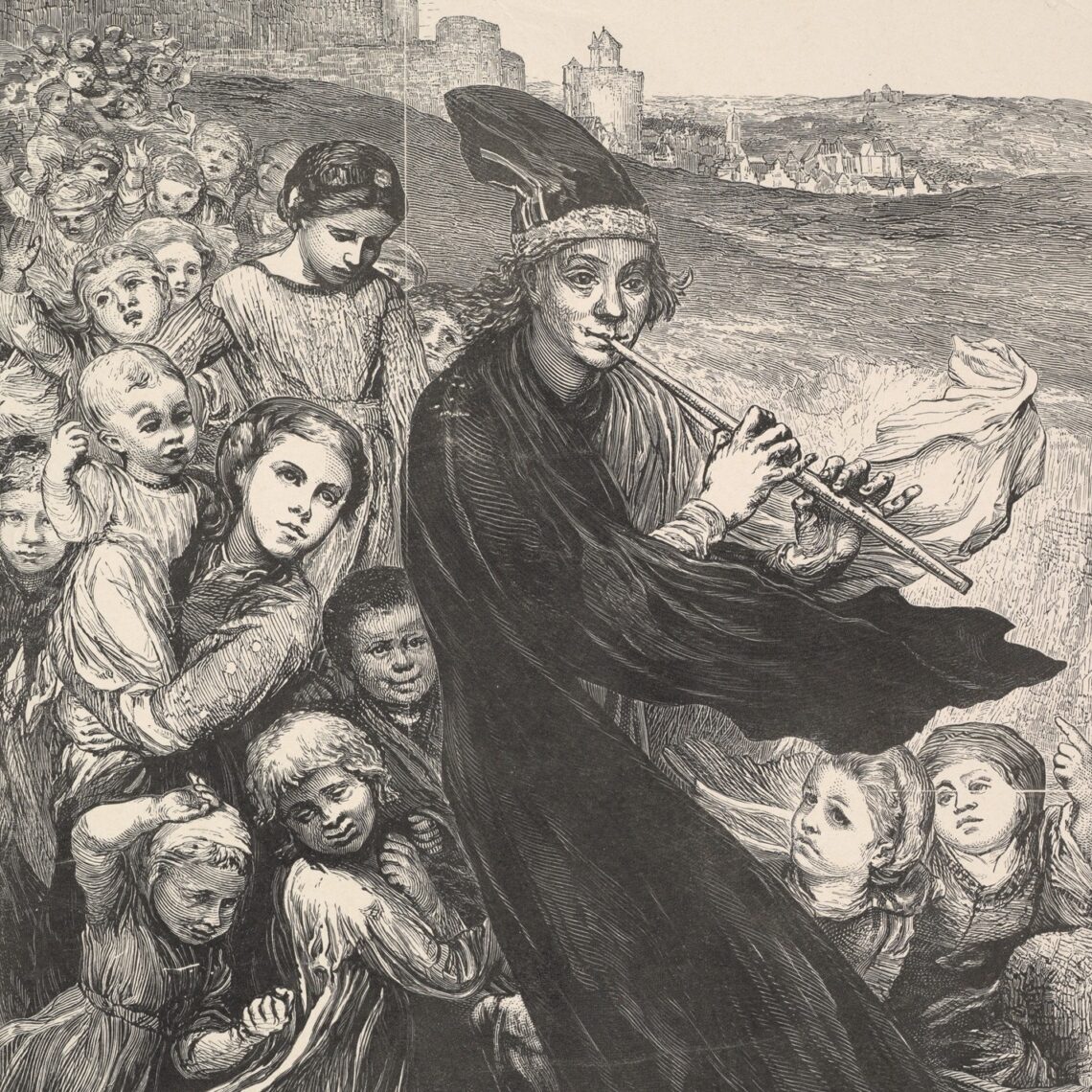
I finish reading The Pied Piper and stare at the cover. It’s always been a story I hate. Maverick pest control expert kidnaps and presumably murders one hundred kids to get back at the Mayor of Hamelin for non-payment. It has all the ingredients of a classic children’s story: Germans, rats, contract frustration and infanticide. But I don’t go back to sleep. By 7 am I’m on the MTR taking my daughter to the dentist. She’s brought The Pied Piper along for the ride.
It’s been years since the mask mandate was lifted in Hong Kong but some people still wear them on the MTR. I can’t because Daddy insisted we barbequed ours in a sacrificing of the masks ritual. He even put on his apron. The light had sloped off early, as eager as we were to light the chemical-infused blue touchpaper on arson disguised as ‘fun’. What were we hoping for? All the incendiary thrills of a Beijing Olympics opening ceremony condensed down into a HKD330 bucks box of paper masks. Daddy lit the barbeque and lined them up on the grill, an origami Manhattan skyline waiting for 9/11. But when the flames came, it was more Al Bundy than Al-Qaeda. In fact, pouring milk onto Rice Krispies would have given us a more visceral thrill. But I digress.
A mother wearily berates her young son for swinging on the handrail. She’s wearing a mask, but her son isn’t, which I find quite intriguing. Usually, families are either masked or unmasked. I pick up that her son’s name is Qian and if he doesn’t climb down right now they won’t be going to Ocean Park. Qian narrows his eyes, clearly weighing up if he’ll have more fun on the rides at Ocean Park or the handrail. His decision made, he continues swinging. His mother looks at me and we exchange parent-looks. [Parent-looks: a secret glance language that is universal and knows no linguistic or cultural boundary, capable of instantly conveying anything from sympathy to disapproval.]
I give her the classic ‘sympathetic close-mouthed-smile with head tilt’. She gives me the ‘sometimes I intensely dislike my own offspring fluttering eye-roll’. Qian loses his grip, falls to his knees and starts wailing. He sounds like a chainsaw. It might be the worst sound I’ve ever heard. I try not to give her the ‘currently, I’m not that keen on your offspring either eyebrow-rocket’ look.
My daughter, happy reading The Pied Piper and oblivious to the evident pain of another mini-human, says “I like this story, don’t you, Mummy?”
“Yes,” I lie and beam at her proudly. She’s no angel but right now, she’s giving Qian a masterclass on MTR etiquette.
“Is the Piper the hero, Mummy?”
“Yes darling,” I say sotto voce in an effort to encourage her to lower her volume, which is suddenly drawing a lot of attention now that Qian’s mother has pulled her unruly son onto her lap and he has stopped crying. “He’s the hero of the story.”
“But do the children all die, Mummy?” my daughter bellows.
“Not all of them, darling. Look, the little lame boy survives!”
“What does lame mean?”
I suddenly feel feverish in the sub-Arctic airconditioned carriage. “Umm, well, he’s disabled, he has a poorly leg, that’s why the book calls him a cripple.” I shift uncomfortably from one buttock to the other and mouth ‘sorry’ to the disabled man in the wheelchair opposite me. He raises one eyebrow but doesn’t smile back. “Now, let’s practice our peace and quiet, shall we?” I encourage my daughter.
“Does it hurt him, Mummy?”
“Who? The Piper?”
“No, the cripple.”
“I don’t like that word, Florence.”
“It’s your word.”
“No, it isn’t!” I shriek. “It’s the book’s word.” I curse my mother-in-law, the Snide Sniper, for soiling my daughter’s innocent mind by bringing this satanic book into our house disguised as a Christmas present. I choose my next words carefully. “I like to think that he probably doesn’t have any feeling in it.” The disabled man opposite me rolls his eyes.
“Why did the Piper take the children, Mummy?”
“Because the Mayor didn’t pay him.”
“Were they the Mayor’s children?”
“Umm? Well, it doesn’t say, per se, but probably not the Mayor’s children, no.”
“So, he killed other people’s kids?”
I sigh for such a long time I might be deflating. “Yes.”
“But he’s the hero?”
“Yes! Maybe he was just really, really tired and the kids were getting on his tits?”
“What?”
“Did I think that or say it?”
“Said it.”
“Sorry.”
Qian’s mother stands and grabs her angelic son’s hand. On their way out she pulls down her mask, smiles sympathetically and gives me the unmistakable ‘frown-line-torpedo-I-find-wearing-a-mask-helps-me-cover-my-blushes-when-travelling-on-public-transport-with-my-son’ look.
I can’t fault her logic.

Sadie Kaye is a writer & performer from Hong Kong. Her humour, fiction, rants & reviews have appeared in the South China Morning Post, Cha, The Hooghly Review and various anthologies. She’s a writer & producer for Contro Vento Films and Art Editor for The Apostrophe. She can be found at https://sadiekaye.tv.
Featured Photo: The Pied Piper of Hamelin, print, Henry Marsh, after John La Farge (MET, 21.65.4) from Wikimedia Commons



Your humorous writing is one of a kind Sadie! Please keep going.
Love this story and considering to share it with my students after a small bit of tweaking of the naughty words!
To help me convince my school we should share this story I looked up AI’s analysis of why this is a great story and I couldn’t agree more!
1. Mastery of Tone and Satire Students often struggle to move beyond literal writing. This story uses satire to look at classic fairy tales through a modern lens (e.g., calling the Piper a “maverick pest control expert”). It teaches students how to use humor to critique established norms.
2. Non-Verbal Communication (The “Parent-Look”) The author brilliantly describes a “secret glance language.” For Form 1–3 students, analyzing these descriptions is a great exercise in “show, don’t tell.” Instead of saying “the mother was embarrassed,” the author describes “eyebrow-rockets” and “fluttering eye-rolls.”
3. Hong Kong Cultural Context The story is highly relatable for local students. Mentions of the MTR, Ocean Park, the South China Morning Post, and the post-mask-mandate culture provide a familiar setting. It shows students that their everyday lives and “boring” commutes are valid subjects for creative writing.
4. Vocabulary and Nuance The text introduces sophisticated concepts in an accessible way, such as:
Irony: The daughter being “well-behaved” while discussing a horrific mass kidnapping.
Ethics: The debate over whether the Piper is a “hero” or a villain because of a business dispute.
Social Etiquette: The “sub-Arctic” air conditioning of the MTR and the awkwardness of public conversations.
5. Critical Thinking: Challenging the Narrative It encourages students to question the stories they were told as children. By highlighting the dark side of The Pied Piper, it prompts students to look at literature with a critical eye rather than accepting a story just because it is a “classic.”
Thanks for the lovely comment, Sandra. Of course, we’d love it if you share the story with your students. Please do credit the author, Sadie Kaye, and The Hooghly Review.
lo9kfu