My first brush with food fairies was in the nineties during my childhood in Asansol, a small coal mining town on the fringes of Bihar and Bengal. No, not the street food hawkers of today. The food fairies I’m talking about didn’t poke holes in small fried puris and thrust dust laden mashed potatoes inside of it before dipping the quail egg lookalike in tamarind and chilli water. Or worse still: split opened buns – toasted on a tawa with butter thrown in as an after-thought; and then stuffed these with bhujia and served the Frankenstein with tamarind chutney. No, they didn’t resort to such measures. The food fairies I knew as a child, curated ingredients carefully, had a unique process of preparation and prided themselves on being artisans.
The dosa-wallah who did the rounds of Asansol in the afternoons had whipped up a God-like image. He brought South India to us. Very few families could afford the train tickets from Kolkata. And there weren’t any from Asansol. So when the dosa-wallah entered our locality pushing his cart on four wobbly wheels – his signature staccato burst of steel spoon banging against the gargantuan iron tawa at the perfect rhythm: ting, ting, tting ting, tting, ting – it was a clarion call to us and our mothers. This staccato signature tune had to be unique because the ice-cream wallah – poser that he was – competed to emulate the same tune with his spoon ringing against the ice-cream scoop.
But as far as our mothers were concerned, the ice-cream seller sold tonsilitis and fever for the kids; the dosa-wallah sold freedom. Freedom for the mothers from their own runny dal and curried sabzi. Freedom for us, kids, from the afternoon siesta forced upon them. Not to mention the unbridled gossip with neighbours while waiting for dosas to be prepared.
Nineties Asansol didn’t have movie theatres which mothers could visit without dads. The few decrepit theatres were frequented by coal miners and factory workers and no women ever ventured to those alone. Shopping malls were a good decade away and television web series, light years away. There wasn’t much disposable money for kitty parties; only a few potluck lunches, but everybody was bored with everybody else’s food. Tear-jerkers on Doordarshan like Buniyaad or Humlog were the wheelchairs mothers had to roll on. The afternoon dosa was the energy pack for these wheelchairs.
Dosa King had no plates to serve his fare. We used to run out, gather around his pushcart, placed the order for the family, ran back in, got steel plates and steel bowls and ran out again, lest our share of the steamy golden crisp ones were handed to our neighbours. Requests of “Oh bhai, chutney ta beshi diyo” was a common refrain from us. Chutney katoris ran dry while sambhar katoris remained flooded. Biharis and Bengalis couldn’t handle the overly-tangy sambhar but gorged on the thick white coconut chutney.
Plates were balanced carefully up the short flight of steps to our first floor apartment, through the veranda (balconies hadn’t been invented back then), across the drawing room (the living room hadn’t been invented either) and finally onto the dining table. Unlucky were those who had to carry smoking plates and brimming katoris up to the second floor. Buildings seldom had a third floor; thank God for small mercies.
On the other end of the spectrum was Madan da, the “sweet” guy. He sold Bengali sweets, handmade by him. Several of these weren’t available in sweet shops back then, and nearly none of these are available in the sweet hypermarts of today’s Bengal.
Mecha sandesh, dry bode and lobongo lotika were his flagship product lines. Madan da didn’t have a pushcart like the dosa king or the ice-cream pretender, he went around with an aluminium deg wrapped in red cloth, balanced on his frail shoulders. He walked around the mohallah mostly in silence, called out “Mishtiiiii” in a deep baritone when he felt like it.
Though there was no “ting tting tting”, and “Mishtiiiii” wasn’t bellowed out in rapid intervals, Madan da had no trouble marking his presence. For one, he started his rounds after others had called it a day, at about five in the evening. Grocery and food delivery apps being a time machine away, evening was the time when people visited grocery stores and sweet shops in person, and Madan da had no trouble at being spotted. “Madan da, please go to our house; tell Rita I sent you, half a kilo bode please.” “Madanda, you’d run out of Lobongo Lotika last time, you have today – yes? – please go to our house in half an hour, I’ll reach by then.” That’s how sales happened. Madan da knew most houses, most names, even the close relatives who visited from Dhanbad or Kulti or even Kolkata.
Some hailed Madan da from their windows or verandas:
“Aaj kya hai Madan da?”
“Ei bonde r lobongo lotika ar mecha sandesh, kya dega?”
Madanda knew if someone had enquired, there would be a sale. It was only a question of what and how much. Once enquired upon, he would enter the enquirer’s veranda, heave down the aluminium deg, unwrap the red cloth and neatly folded it aside, and slowly slide the cover of the deg. If it was our veranda or our neighbour’s veranda, we would rush out to peek into the depths of the deg and swirl into the sweet universe of tens of lobongo lotikas forming brown envelopes along the circumference, with the gold-red bonde piled up in the centre and the golden-white mecha sandesh sitting atop the pile.
Mecha sandesh were made from gathia powder, kheer and ghee, and were coated in a crisp sugar syrup shell. They had a sugary disc at the base which made them look like UFOs.
The bonde was the original variant of today’s boondis, but dryer: gold and red spherical balls, smaller than both mecha sandesh and lobongo lotika.
My personal favourite was lobongo lotika – a crispy, flaky flour pastry parcel filled with sweetened reduced milk – kheer or khoya – and coconut, securely sealed shut with a single clove, deep-fried, and soaked in warm sugar syrup. It looked like an envelope, half the length of our palm and glazed brown in colour. Its crunchy goodness was a ten out of five. There were no artificial colours, no nonsense of “pure desi ghee” – it was ghee, period. And no chemicals. Back then chemicals were only found in chemistry labs and in the foul smelling smoke of Carew distillery. Biting into a lobongo lotika would ooze out its juicy kheer and one had to be careful not to spill it on one’s clothes.
The pickle gang chose the brightest and sunniest of afternoons to visit. Right after the dosa-wallah, and before Madan da. These were the groups of Bihari women who sold pickles. Chilli pickles, mango pickles and jujube pickles were their forte. They also sold ripe Indian jujubes which could be used to make pickles at home or eaten as is. They called these “achari kul”, kul being the Bihari-Bengali word for jujubes. Their call of “achari kul achari kuuulllll” still rings in my ears on quiet summer afternoons.
The pickle gang went around in groups of two or three but never competed with each other. Rather they pushed each other’s products as much as they pushed their own.
These women were tall, their brown faces criss-crossed with a hundred wrinkles which disappeared into a toothy smile once my mother would make a purchase. They wore colourful Bandhani print sarees with the pallu pulled over their heads. It was to keep out the sun and maybe a feeble attempt to adhere to their conservative caste.
Pickles spiced up our simple summer lunches, with the loo wind blowing like a banshee outside. My favourite was the sweet chilly pickle made from Indian jujubes. To think that such coarse and rough women could prepare such delicate sweet pickles was a wonder.
Much later, on reading Midnight’s Children, I remembered the Asansol pickle women and felt goosebumps.
I was sent off to Chennai for college. And surprisingly nobody sold dosas on pushcarts there. Maybe because there were dosa shops in every corner of the city. I lost all appetite for it.
Plus the dosa-wallahs of Chennai spoke in Tamil and pretended not to understand me when I asked them not to make them so tangy.
So being in Chennai, I missed dosas, or rather the dosas whipped up by the Dosa King of Asansol.
I moved to Bangalore after marriage but didn’t really get the chance to taste the local food. Maybe because my afternoons were snatched away by office on weekdays and shopping malls on weekends.
We moved to Singapore and soon after sub-prime crisis rocked the world and recession hit us like a ton of bricks flying in through the window. And we had our first child. Thanks to the newborn, the bleak years went by without us noticing much of it. And my quiet stay-at-home weekend afternoons returned.
I used to sit by the window on weekends after putting our daughter to sleep, and strained my ears to hear the calls of hawker uncles and aunties in their sixties or seventies, calling out “bakkwah” or “curry puff” or “sandwich ice-creams” from the street below.
Bakkwah – “dried meat” in Hokkien – is dried pork, barbecued in a sugary syrup and cut into thin square slices. It is a close cousin of the American pork jerky. It was the heritage food of choice during the Chinese New Year when there were kilometre-long queues outside the famous stalls that sold these. Locals would buy it by the kilos. But for the rest of the year, sales were slow and food fairies sold it door-to-door on pushcarts.
Singapore’s middle name is curry puff. Succulent chicken chunks, fork-tender potatoes and sliced boiled egg wrapped up in a buttery layer of pastry. They looked like samosas but with the shape of a semi-circular seashell, their edges folded in. Curry puffs from Old Chang Kee stalls had been my breakfast, lunch and evening snacks, and sometimes dinner too.
I knew the modus operandi to buy these from my Dosa King days – grab a tiffin box, close the door lightly, rush down the stairs and buy a handful of curry puffs and bakkwah and rush back up. But Singaporean food fairies were chatty and asked me about India. Especially the bakkwah sellers seemed to be amazed that I ate pork. To them, all Indians were vegetarian. When I pointed out that fish-head curry stalls were run by Tamils, they waved it off with a “They all Singaporeans now La!” Ultimately I gave up trying to explain where I was from (Kolkata, never even tried Asansol), and how we were die-hard non-vegetarians and boasted of a large settlement of Cantonese people. They’d have stopped listening by the time I had reached Kolkata. And there was always the risk of my daughter waking up, so I too had to curb the story-teller in me.
My wife was excited when she heard the ice-cream sandwich sellers and ran out with me to get them in the evenings. These were simple two-dollar slabs of ice-cream in four or five flavours – vanilla, mango, strawberry, chocolate and blueberry, wrapped inside an untoasted bread. Sometimes wafers were offered if the ice-cream uncle had had a bit of extra cash to buy them but we always refused and took the bread, lest he ran out of wafers for other customers.
The food fairies hadn’t been a major part of my life, but they’d made my life bearable and interesting in the age of no TVs, no mobiles, no social media, and returned to me on lonely afternoons in distant lands, far from home.
If only I’d been Saleem Sinai, I’d have summoned these food fairies on my lonely afternoons, which are getting lonelier as I age.

Bodhisatwa Ray ‘Bodhi’ writes literary fiction; his short fiction has appeared in The Bombay Review, Spark, Out of Print and Muse India.
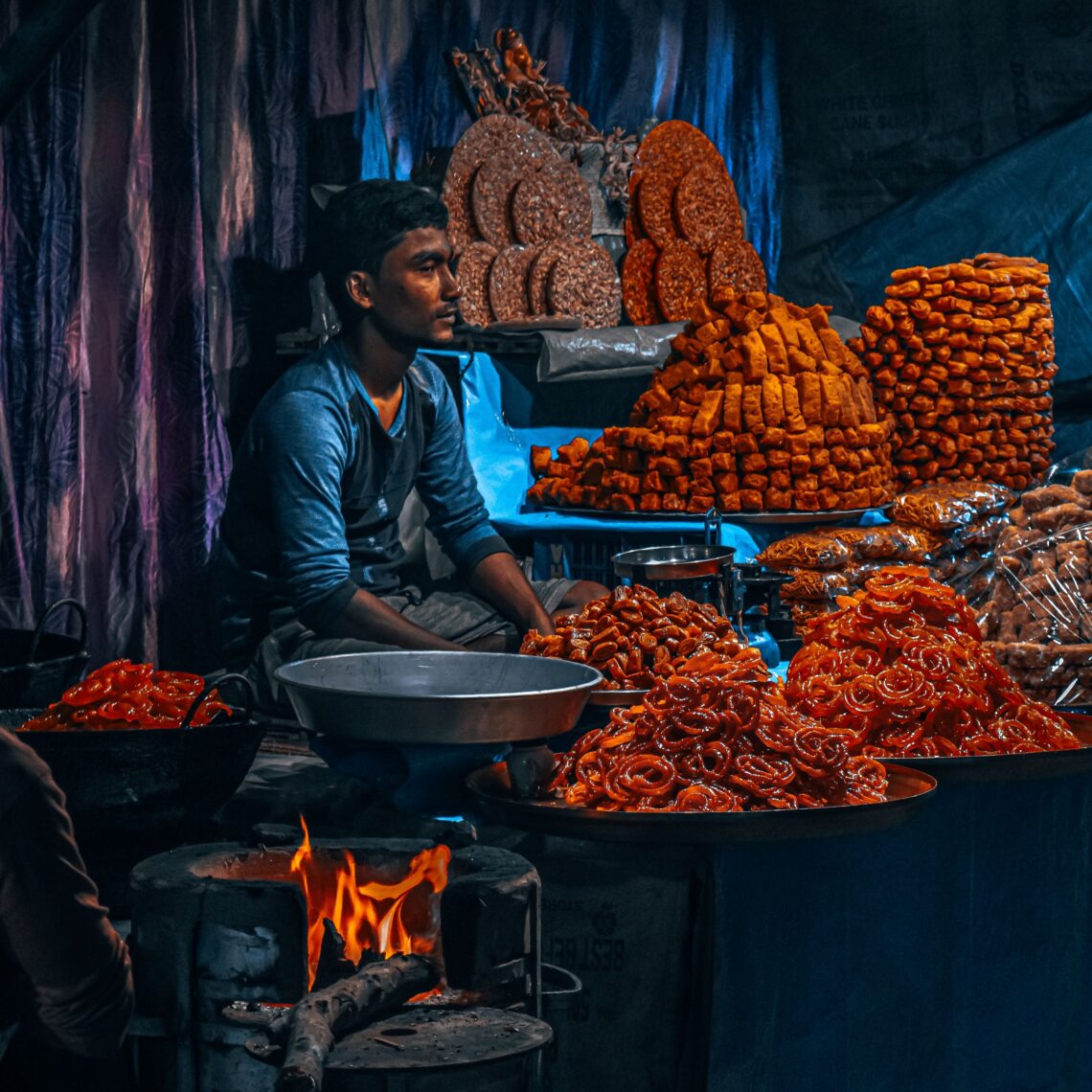
Featured photo by Tanmoy Pal (Pexels)