Inside the front gates of the temple a Chinese tourist was advised on footwear. Uncomprehending at first and immediately apologetic after. Barefoot within the perimeter was required.
After our circuit upstairs a group of police in high boots managed to stop themselves at the side entry before encroaching onto the red paving. Tall, thick-set chaps kitted out like stormtroopers—Rani thought it understandable after the riot in December.
Barefoot was a step above the more common bare-headed. A panama, however, presented no problem, even inside the temple itself.
On the upper level an older, fat-bellied attendant showed a younger not once, but three times, how the bell was rung. It hung overhead almost within reach. You pulled firmly on the horizontal, like this. Ding Ding Ding Ding.
There did not seem to be precise numbering or phrasing, the pealing continuing a long time.
Back at ground level Rani led the way around a pillar that in a number of niches housed various black gods. Mars. Venus. Satan—
That brought a pause.
Satan, Rani?
Yes, Satan too was beneficent, if one had good karma. Psychic power for example could come through the agency of Satan, Rani explained.
It took a few minutes to tease out the matter. Rani’s English was excellent; the problem was often the accent. The planetary gods and Indian astrology in question.
After half an hour an unexpected question came from the guide.
— How do you find it? Rani, politely, somewhat anxiously, it seemed. The messiness, the lack of order was off-putting, possibly?
Oh Rani! No. That was the very thing. That was above all what created the remarkable effect.
The music of course was wonderful, pipes, drums and added recording. The orchestration was familiar from the evening passes of the Kallang temple, Sri Manmatha.
Surprisingly contemporary, rousing and raucous for the purpose of worship.
In a side annex a group of players provided accompaniment for a vigorous carting of a Shiva lingam on a small litter, carried on two long poles. Four or five men either side rushed the god briskly across the floor in zigzag, to-and-fro. The forcefulness was startling. It was odd that there was no gathering to observe the spectacle in this secondary building. The matter had not been mounted for show.
The faithful fasted through Maha Shivaratri, the Great Shiva Night, so the tea, coffee and food on offer was preparatory fortification. People sat on steps, in nooks and across the paving tucking in, a good proportion older women in colourful saris, walking among whom gave an effect something like the other side of the looking-glass.
Soon after the bells had begun we marked ourselves with ash, Rani on both forehead and throat. One had assumed sandalwood, or perhaps thulasi, if there was such a tree.
No, not quite. Rani stated the matter plainly: this was cow dung. Thick, almost granular ash produced from the dung of a cow.
Following which came the holy water. Unlike zamzam in Islam, from the everlasting spring beside the Kaaba, the great Hindu blessing was traditionally given by cow urine. Diluted, possibly.
Left palm beneath the right collecting the liquid, which was brought to the mouth and then onto the top of the head. In the Ayurvedic tradition, the benefit of cow urine was well-known.
Another question arose from the red bindi, which Rani went without. The bindi signified a married woman. In addition, the point marshalled the focus on god. Traditionally, widows did not wear the bindi.
The composition of this too was interesting. Turmeric was the base. Vivid yellow turmeric when lime juice was added and the dish placed in the sun turned deep carmine.
It was the bathing of the Shiva lingam that was the central part of the festival. In the days prior, Ari at Dunlop Street had said that through the evening and night Lord Shiva would be bathed one thousand and eight times.
We sat to the right of the altar, between the niche for Shiva’s wife Sakti and the players behind. For the niche where the Shiva lingam stood we had only partial vision, not much more than the corner on the right where the priest officiated. Two large screens either side of the hall showed the fuller action.
A lucky elderly couple was seated on raised chairs directly before the niche, a privilege won by some substantial donation to the temple, Rani explained. Sri Sivan was the largest Hindu temple in Singapore, conveniently located a ten-minute walk from Haig Road. In over two-and-a-half years the turning at the sign on Sims Avenue had never been taken before.
The bathing of the black lingam had also been seen from the footpath of Sri Manmatha. For a newcomer almost totally ignorant of Hindu ritual, it was quite something.
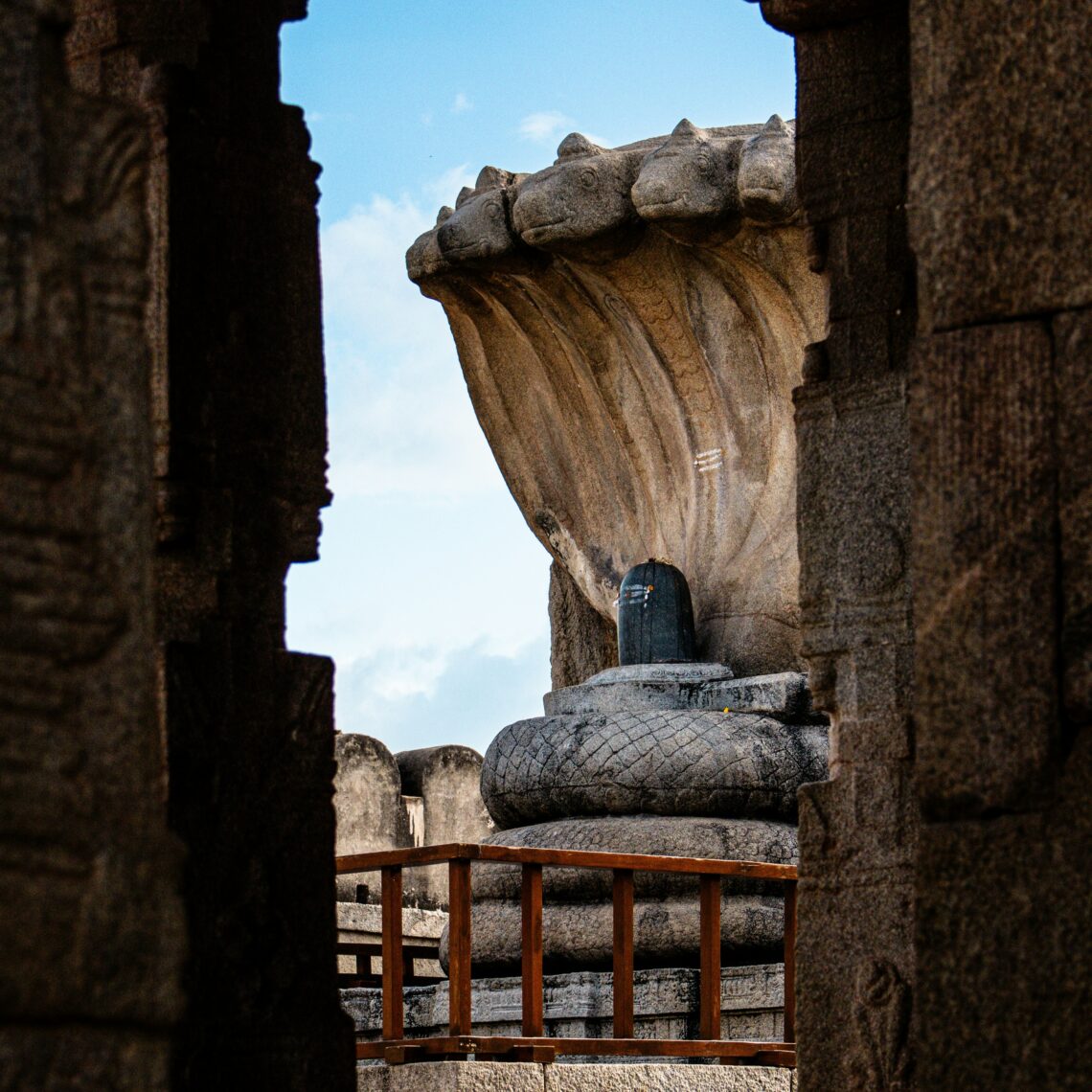
Milk, honey, sandal, turmeric, flame, flowers, diced fruits and ash, among much else passed over the small raised black stone in numerous ablutions. Rani confirmed Ari’s figure of 1,008.
Leaves laid atop the stone a number of times were soon washed off by the liquid. The texture of honey and one or two other substances was clear from a distance. Like the turmeric, the honey left a thick cover over the lingam, a thorough coating.
Toward the end of the first phase, when the heavier liquids were used, the young bare-chested priest stepped close to the lingam and like a child at the beach, or playing in the snow, drew human eyes, nose and mouth on the surface.
The god had come alive, explained Rani.
The human figuration was nearing the end of the ritual, of the first phase at least of the adoration of the god, during which there was an upping of tempo by the players. There was no pause between the pouring of the various unguents. One bucket followed another, then leaves, more buckets, leaves again and wreathes and flame. A candelabra came near the end, bathing the stone in brilliant light.
In the last phase of the first sequence a larger swelling again of the music created a stir among the congregants.
As the finale approached a wave passed over the women alongside the central barrier, a movement in unison like that of a flock of birds winging to one side. Some of the women began to rise to their feet. More followed. Soon the whole body had risen and hands were being lifted toward the altar, turned and brought back to the women’s faces.
The women covered their faces in something like a bathing motion. One woman brought her hand to one eye and then the other separately. For a few moments hands covered the whole of faces. Rani explained the people were gathering to themselves the blessing from the god.
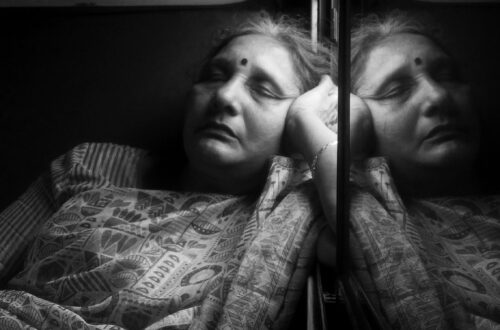
The countenances of the women particularly were captivating. Before the mass of older women in the attitudes they adopted by the altar, an outsider was left floundering somehow.
Many of the women sitting along the central barrier appeared well-to-do, the gleam and lustre of their cloth suggestive. Many were pilgrims from India, Rani suggested.
The faces they showed was difficult to describe. This was not quite adoration; there was nothing beatific. You never saw such expressions in a Western city—not in a contemporary city—whether in a church, or anywhere else. Quiet, steady hopefulness was evident. One or two women peered as if from underneath an obstacle somehow, bending their heads and turning up their eyes. One or two of the younger showed glimmers of smiles of the sort one would not have expected at a religious gathering; not any of the elders.
There was no keenness or sharpness in the looks; no prayer evident. One or two of the older women moved their lips a little.
The Mother-worship was clear, but in the old mothers themselves here. Wrong way round it seemed, the old women enacting the worship of which they themselves ought to have been the object.
After Shiva there was a movement across to Sakti in her niche on our side. Shiva represented knowledge, mind, intelligence, according to Rani. Sakti, power and energy. Again some surprising inversion.
In the booth across the road later, after a vegetarian meal under one of the tents, some of the legends of Shiva were pictured in a series of posters, with commentary below.
Rani was frank about the suggestiveness of the lingam. It took her a moment to find the English term.
Organ. The male organ. Phallic worship was inherent in the long, peaked black stone.
As we slowly made off along Second Avenue hundreds of pilgrims formed queues both for the temple entry and the food stall, foreign workers mainly after their labour.
We were lucky to locate our footwear. With the workers the male presence now evened the gender balance.
A yoga practitioner and teacher, Rani had reservations about so much noise and spectacle. Rani made an excellent guide.
In Sanskrit the god was Shiva. Tamil closed the vowel, said Rani. Sivan. (Mantra and mantram was another example.)
The Dravidian South was pure Hindu India, according to Rani. Northerners lost something of the faith in their regions.
At the book stall opposite Rani recommended Vivekananda, a small little booklet of his Message, purchased by a donation to a children’s home. There was some spirit in the teacher’s words from the opening paragraph.
“My ideal indeed can be put into a few words and that is: to preach unto mankind their divinity, and how to make it manifest in every movement of life.”
And few pages on: “If you look, you will find that I have never quoted anything but the Upanishads. And of the Upanishads, it is only that One idea, strength. The quintessence of the Vedas and Vedanta and all lies in that one word.”
A memorable introduction to the Hindus.
Sri Sivan Temple, Geylang
Singapore 2011-26


An Australian writer of Montenegrin heritage, Pavle Radonić spent ten years living in SE Asia, where a disproportionate number of his publications originate. Recent work has appeared in Action, Spectacle, Sagebrush Review, QU Literary Magazine & Hobart Pulp. (Denver Quarterly & Post Road Magazine forthcoming.)
Website: http://axialmelbourne.blogspot.com/
Featured Photo by Sameer Srivastava on Unsplash