It was in the summer of 1989 in the predictable and insular environs of small-town Bengal that the ghosts first arrived. They arrived with practiced elegance, not all at once, but one story at a time, stories being their embodied transport across centuries and fractured geographies. I remember the billowing motion of a pale pink curtain caught in the drift of April breeze and fragrant frangipani blossoms. The amber incandescence of a sixty-watt light bulb held inside a cloudy glass dome casting pale grey shadows on the cream walls of our dining hall as I sat in front of an untouched bowl of rice, absorbed in the meandering play of light, shade, and colour strung to the cadence of my father’s voice.
Their names came to me, saturated with the peculiarities of their spectral ontologies, indices of their complex lives, or should I say afterlives — nishi, the predatory and seductive night dweller and consummate impersonator using the sound of a loved one’s voice to lure; brahmadaitya, the benign upper caste tree dweller, caste being typically carried over and reinstated into the metaphysical realm, harmlessly heckling unsuspecting passers-by with acrobatic lunges across the branches of shady Peepal trees; kanahulo, invariably the most terrifying of the lot especially to a directionally challenged child, the haunter of public spaces, invisible ghosts that would invade your psyche and derail your internal compass till you ended up disoriented and far from your destination, meeting probable death in a ditch or a river; petni, women who died single and whose ephebic spirits languished at the cusp of innocence and desire; aaleya, friendly water spirits whose guiding phosphorescence was vitally connected with the community’s dependence on water bodies for livelihood and transport; skandhakata, headless ghosts eternally questing like Plato’s half-souls for their lost heads; mamdo-bhoot, the graveyard inhabiting ghosts of Muslims, ciphers of the legacy of subcontinental communal coexistence, both harmonious and tense.
In these names I was introduced to complex histories encoded in the form of compressed allegories: of phobias surrounding the uncanny nature of that which is familiar and intimate — the disembodied voice of a family member at once known and suspect in its sheer dissociability from the physical person, of anxieties around death’s levelling and subversion of social hierarchies, of the possibility of the productive interplay of agency and dispossession in women’s negotiation with gendered norms, of fears surrounding one’s own mental susceptibility to self-estrangement and self-annihilation, of the loss of native spaces through the incursion of new forms of modernity, technologies, and new arrangements of power.
Not just names and tales, what came to me that summer of my fourth year was a discovery of the particular manner in which the forbidden, repressed, and disavowed aspects of our lives intersect with and find lodgings in narrative formats. An understanding of how the omnipresence of the supernatural in this repertoire of desher barir golpo (stories of the homeland) was not accidental but a testament emblematised by the literal coincidence of the two senses in the Sanskrit word bhuta: both the past and a spectre (or in its Indo-European root, a being in its primordial assertion of the pure act of existence), of how almost all stories that hinge on retrieving lost archives are haunted by the peculiarly fraught and fractured nature of such archives existing in the elusive, unstable threshold between disappearance and reappearance, invisibility and visibility, absence and presence, gesture and speech, memory and history.
What is the shape of the spectral? If the ghost is a recursive figuration, a site of illegitimate occupation and untimely return, a trace of untranscribed experiences and ephemeral lineages crystallised in the ambivalent melancholia of an incorporeal form whose human moorings are both asserted and compromised by the paradoxical coexistence of death and its refusal, what then is a ghost story? A haunting of a haunting — the desire to anchor history’s unspoken, endangered, spectral vignettes in an equally phantasmic medium of narrative textuality: ghost stories originating in the rituals and experiences of specific communities and tethered to particular landscapes, embody a contested terrain marked by on the one hand erasures of local and indigenous memory, and on the other, cultural practices of archiving and retrieval.
The ghostly inscribes history under the sign of loss. It is a metonym for the temporal instability undercutting forms of experience and expression that fall beneath the register of official discourse through alienation, collective amnesia, physical dislocation, political violence, and cultural deracination. The spectre, a figure for this fractured relationship of a society with time — for narrative hauntings seldom point to a strictly individual point of view — is doubly oriented. It is what dies, is forced to disappear and retire to the margins of memory and representation, and it is also at the same time what resists this displacement through a logic of multiple recurrences.
It did not occur to me to contest the scientific validity of such occurrences. These were not mere fantastical tales spun out by an ingenious father to humour his restless child. Over many years the stories became a permanent fixture accompanying the consumption of food, yet they did not slip into the easy stereotype of superstition. The ghost stories of pre-partition Bengal that I grew up hearing belong to an epistemic order in which the demarcations between the symbolic and the literal are easily blurred. Such narratives demand an alternative interpretive approach, one that eschews questions about verifiability and rational truth, and instead reframes the supernatural as a zone of metahistorical possibility, one that stages an intervention into discursive regimes of truth formation within which official histories are written, by foregrounding the potential of counterfactual expressive forms to accommodate those heterogeneous modes and figures of cultural expression that remain in history’s margins.
The ghosts that peopled my ancestral village of Mymensingh in erstwhile East Bengal were no less real for being disembodied or differently embodied, an integral part of the physical and phenomenal landscape, seeping into the community’s social and linguistic habitus, as custodians of specific, unexplored life narratives, becoming interlocutors of the living in new, fluid relational structures that were not foreclosed by the normative constraints of family or the law, and eliciting in the course of these encounters, the same range of affective responses as their human counterparts.
In examining the politics of dissemination of and listening to the intangible heritage embodied in stories, that constituted the scene of this childhood storytelling, it is the implication of the very act of narrative transmission that now strikes me as singularly powerful. What did it mean for my father to tell these tales, to offer a fragment of autobiographical memory and early childhood, creatively refashioned with insertions from myth and folklore, and affectively invested with the traumas of loss and displacement? And what did it mean for a child at a geographical and cultural remove, to absorb these pieces of a vanished time in an age of globalisation and neo-liberal capital? What kind of historiography was mobilised by my father’s oral narratives of the supernatural, of village hauntings, personal encounters with the spectral, travels through haunted topographies, in which recollection mingled with performative re-enactment, nostalgia and mood-inflected fact, the tropes of fantasy and adventure, those accessories that make anything told to children instantly accessible to them, permeated objective description?
My father’s stories almost always went from the intensely personal to the broadly communal. The adventures of two brothers clad in khaki shorts and singlets, as he would describe himself and my uncle, would pan out into stories about neighbourhood gatherings, competitive sports and the aspect I particularly liked, a detailed catalogue of the routines, objects, habits, and activities that made up my grandfather’s household. One autumn night, and autumn with its ritualistic invocations of cosmic forces, its celebration of mythic temporality and autochthonous cults, seems to have been a patently spectral season in the riverine estuaries of my ancestral village of Mymensingh, my father, as he recalled in a story I would often get him to repeat, heard my grandmother calling my five-year-old youngest aunt who was sleeping next to my father, himself all of seven. She called twice and the little girl without stopping to discern the plausibility of someone calling out to her at the dead of the night, responded. My father loved recounting this part, partly for the role of gallantry in which it cast him, of how he instinctively divined something unnatural in this beckoning even though there could be no shadow of doubt that this was the voice of their mother, accurate down to every detail of intonation.
The nishi daak is nearly synonymous with life, or, faithful to its etymology, nocturnal life, in East Bengal. A particularly embittered ghost, the nishi preyed on unsuspecting sleepers, calling them out of their homes with the force of mimesis. The nishi never calls more than twice: the trick is to wait for a voice beyond the second call. For unlike the ghost with the borrowed language, the loved one whose voice the nishi appropriates, possesses the human capacity for inexhaustible language use. No one knows for sure what happens when you respond to the spectral daak. There’s a theory that when you do, the spirit binds you in a delusion of seeing: the victim begins to see the loved one in question and is led entranced into fatal peril.
The individual’s reciprocation turns into an apparition, the response is what materialises the other person, the affective and social ties that occasion a recognition of and response to the other’s voice is what the nishi cannibalises. In this story my father got up as soon as he saw my aunt unlock the door and step outside as if following an invisible summons and gingerly shadowed his sister as she crossed the threshold and went out into the fields. The freshwater pond near my grandfather’s house was full and deep in that season, and my father saw her abruptly move in its direction. With great theatrics and vocal inflections, my father used to narrate the climax: of him running towards his sister, calling out to her and grabbing her by the arm, finally jolting her out of her trance of which she had been left with no memory. This second authentically human beckon could break the spell and drive the nishi away.
Even as a young child, I was struck by the complexity of this particular kind of possession. By the way in which the voice, as the fundamental site for human singularity, a synecdoche for what is most distinct and personal, the quintessentially anthropomorphic register or “a deep vitality of the unique being who takes pleasure in revealing herself through the emission of the voice” as Adriana Cavarero describes it, could simultaneously become the site of depersonalisation and counterfeit, and was vulnerable to being colonised by something radically anti-human.
I was struck by the choice of that basic tenet of human sociality, the rudimentary call-and-response pattern that underlies those qualities of responsibility, reciprocity, and recognition that define us as social beings, our humanity linked closely with the attunement and orientation of the self to the presence of the other — as what could also become compromised as the vehicle of death and destruction in the nishi’s manipulation of it. I was fascinated by the ambiguity that seemed to colour the question of familial attachment and human intimacy that rendered the subject open and susceptible to harm and injury — the knowledge that made the spectre impersonate those closest to the victims. I thought, as I managed to gulp a few spoons of dinner, of that precise moment of intervention when two voices and two bodies contended for attention, and rescue often depended on the victim’s split second, even subconscious ability to discern the real from the virtual, the embodied voice from a spectral replay, of the significance of the touch of the interlocutor that would wake the person, tactility remaining beyond the ghost’s bodiless purview. I would think of all those who did not have a vigilant rescuer, and how easy it was for an entity like the nishi to beguile the lonely, bereaved, and melancholic.
As a grown-up, I have wondered about the layered nature of stories like those of the nishi in which the proximate and the alien intertwine, and the ghost itself becomes concurrently a figure from local legend, a living presence whose mode of existence cannot be equated with material and organic life, but one that still stubbornly inhabits the immediate experiential landscape imbuing it with a symbolic valence that takes a particular cultural geography beyond its uses in the present and underscores its palimpsestic nature as a repository of multiple temporalities, histories of settlement and expulsion, social customs and political norms. Far from vindictive, the nishi seems a trope for remainders, for unassailable contradictions and tensions animating cultures both old and on the verge of transition. But when my father spoke of the nishi in a contemporary setting far from his home, the nishi’s beckoning and impersonation were also the demands of the past, itself now displaced and ghostly. The desher barir golpo within which the ghost story would be ensconced were also stories whose meaning and status as cultural objects were irrevocably altered by the fact of forced migration and the traumatic loss of property, friendships, and ways of existence, the loss of roots. As the nishi travelled through this migratory route, taken out of its strong contextual adhesion to the land of its origin, and becoming part of a community’s inheritance of dislocation, dangerous journeying, and painful resettlement, the spectre became the beguiling, delusional yet seductive call of history itself.
In her fascinating memoir of ancestral displacement and immigration, documentary film-maker Lipika Pelham narrates an incident of haunting involving the displaced former residents of her friend’s house in Western Jerusalem. The Palestinian Christian family who was the original builders and occupants of this house return as what Pelham calls “ghosts of the displaced.” Unable to find their way around recent architectural alterations to the building, the ghosts enter a conversation with the present occupant, teaching her the proper method to brew tea leaves and even staying for tea. Pelham’s friend records these conversations which when played back turn out to be monologues. She imputes these imaginary dialogues to cultural guilt and a desire to compensate but poignantly admits the inadequacy of psychological and rational-scientific explanations to fully capture the effects of postcolonial nation formation and its attendant violence, on the material topography of the spaces of human habitation.
In the absence of appropriate conceptual and discursive rubrics with which to explain the ruptured phenomenology of daily existence under colonial and neocolonial nationalist and genocidal cartographies, the bodies of the living become direct bearers of these ruptures. Acts of hearing and response, sensory capacity and knowledge formation via the bodily senses become the new spaces for retrieval: be it the newly arrived Israeli settler hearing the voice of the dispossessed, or the first generation Bengali child in an industrial township in the early nineties listening as part of her pre-partition lineage, to the voice of her refugee father ventriloquising in the nishi’s ventriloquism, his own response through memory and language to the call of a spectral childhood.
First published in Infocalypse.
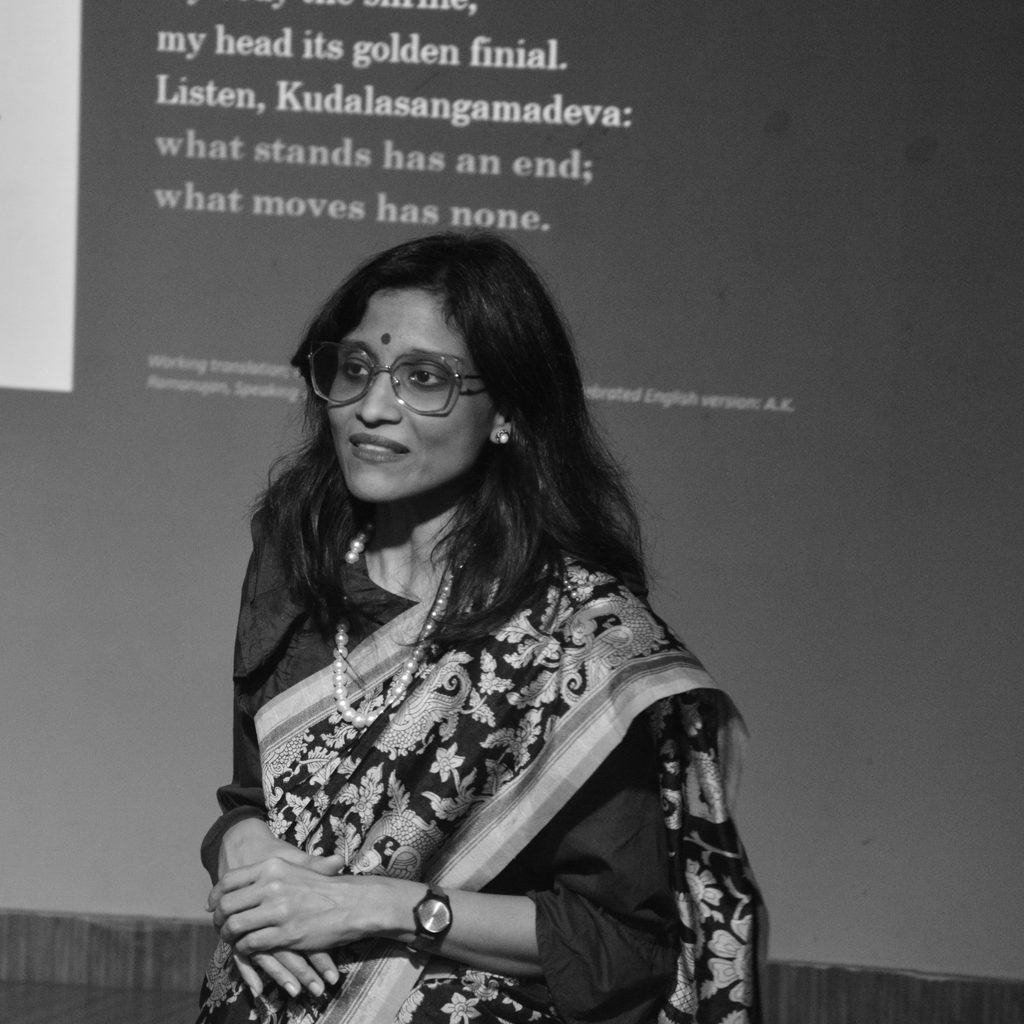
Paromita Patranobish is an educator and writer based in Bangalore where she teaches Communication Studies at Mount Carmel Deemed-to-be University. Her literary essays have been published in Hakara Bilingual, The Chakkar: An Indian Arts Review, The Hooghly Review, The Bombay Review, Infocalypse Press, Scroll, Firstpost, Cafe Dissensus, and The Assam Tribune. Her monograph titled Excremental Landscapes is currently under contract with Taylor and Francis, UK.
Instagram: @paromita.patranobish
X: @PPatranobish
Photo by Catalin Pop on Unsplash