Oormila Vijayakrishnan Prahlad
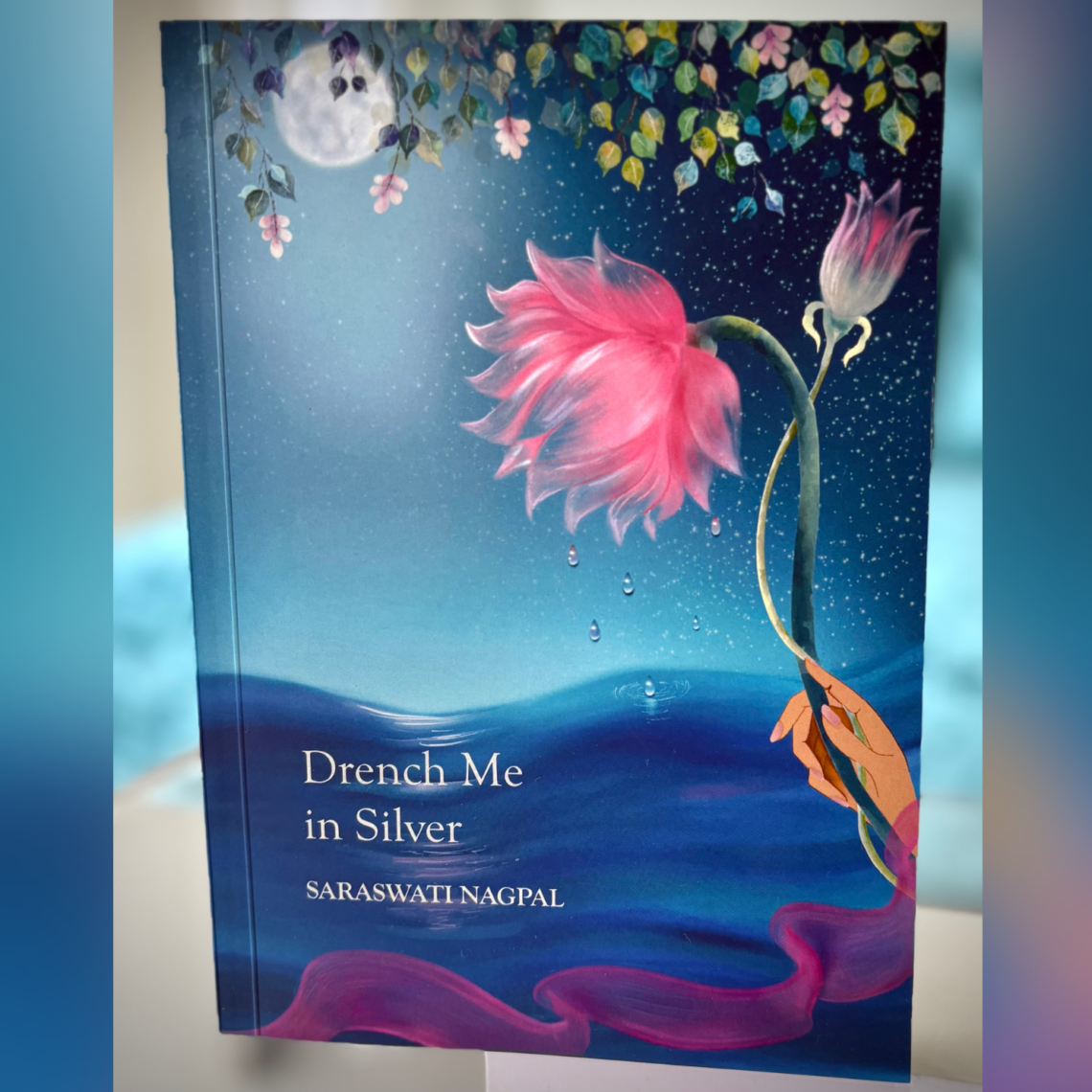
It is raining heavily here in Sydney. I am sitting in a covered section of the yellow courtyard at a writers’ residency in Woollahra, surrounded by a native garden and a camellia bush just about to flower. And I am reading a collection that brims with water, nature, and the vagaries of weather. The serendipity feels almost unreal. And yet, Saraswati Nagpal’s Drench Me in Silver makes it seem believable.
Nagpal is a poet of transnational identity. Named after Saraswati, the Hindu goddess of music, learning and knowledge, and shaped by a childhood in the Middle East, she is a polyglot who has authored graphic novel retellings of Sita and Draupadi. This is her debut poetry collection, and it announces a very exciting voice. It introduces a distinct sensibility that glides smoothly between the personal and the mythic, giving adequate scale and weight to both dimensions.
The poems are grouped into six parts: Memories of Rain, Parched Earth, Drizzle, Cascades, Cloudburst, and Petrichor. Nagpal weaves the extended metaphor of water throughout, making it carry both metaphorical and spiritual weight. Rain becomes a protean, ever-morphing symbol in her poems, standing for love, cleansing, rebirth, memory, and benediction. The arc is deliberate. The reader is invited to accompany Nagpal on a journey through inherited memories, the barren landscapes of loss, and eventually the path towards growth and peace. By the time we reach the scent of earth after rain in Petrichor, the catharsis feels fitting and beautiful.
At the heart of Nagpal’s collection is devastating grief. Every section holds the death of Nagpal’s mother in some measure, with tenderness and poignant lyricism. Her mother’s name, Poornima, means the full moon, and the moon recurs throughout the collection in its literal form as a celestial body as well as the lingering shape of her absence. But these poems move beyond elegy and tribute-paying. In ‘Persephone’s Lament’, Nagpal inverts the myth by becoming the living daughter who looks for her mother in the underworld. In what I found to be the collection’s most arresting poem, ‘The Lake of No-Love Swallowed Us’, she and her brother take on piscean forms, their mother’s loss making them “ghosts to each other / in Death’s cold womb,” while above the water the world carries on in sunshine and joy that feels almost alien and incomprehensible to them. This grief, portrayed as submersion and suffocation in an underwater world, feels extraordinary.
The collection comes full circle in its final poem, ‘Denouement in Citrine’, where a father, daughter, and son sit at a restaurant table with an empty fourth chair. The image says everything: “I clasp this moment, a citrine charm for the future. / In the empty chair, where the light pools, I see you smile.” It is a compelling example of restraint and narrative control.
While Nagpal explores grief and fully allows herself, and the reader by extension, to feel it, her writing is distinguished by remarkable restraint. Her imagistic style is clipped and polished; her sensory details make the familiar strange and vice versa. In the Best of the Net nominated poem ‘Chai’, the brewing of tea becomes a close examination of the trauma brought on by Partition, the chipped sugar pot lid a synecdoche for a spirit “sliced / by a line on the map.” While it appears, on the surface, to be a poem about everyday domesticity, hiding beneath is a cesspool of violence and injustice. And ultimately resilience. ‘Libation for Mother’ works in a similar register. She explores what it is to hold a departed loved one in muscle memory, in the way her daughter stirs a pot, adds ginger, lifts curry leaves to her nose. “You who I am becoming, / in vivid cadence of genes, / molten echo of memory.”
The collection’s treatment of heritage is equally devastating. In ‘Daughter of Sindh’, Nagpal traces the painful parts of her ancestry through the violence and tragedy that followed Partition with the utmost restraint and beauty. Her foremother’s homeland, apportioned to Pakistan, saw generations “ripped from heartland by flourishes of Mountbatten’s fountainpen.” There is ambivalence here too—Nagpal calls herself a “turncoat, traitor” for writing in the coloniser’s tongue. The poem embraces Hindi, Sindhi, Sanskrit, and English simultaneously, exploring how life exists in spaces between this thronging of languages.
The collection also has a rich spiritual and mythological core. It is alive with deities and references to the Hindu epics. ‘Sita Sings the World Green’ is a bold reimagining of the beloved goddess as elemental force, freeing her from victimhood and passivity. ‘Women in Myths Are Tumbling Out of My Closets’ is packed with a galaxy of female archetypes from across cultures and traditions. There are goddesses, crones, female authority figures, women warriors, women whose voices are allowed to ring “like ten thousand / stars singing in orbits of love.” In ‘Forge’, the experience of childbirth becomes a mythological ordeal presided over by Ishtar and Aranyani. The female body is shown as simultaneously cosmic and mortal flesh. Nagpal allows the women in her works to thrive. They exist in power, authority and agency.
If there is an occasional unevenness in the collection, it lies in poems where the density of image accumulation can occasionally tip from resonant to decorative. But these are very minor reservations in a debut collection that consistently succeeds at doing what the best lyric poetry sets as a goal: to put a spotlight on what is overlooked, to immortalise what time would otherwise take away.
It is still raining here in my courtyard, and I can smell the petrichor. I am still in Saraswati Nagpal’s dream cosmos. And I can tell you, I am happy to linger in it.
Drench Me in Silver (Black Bough Poetry UK, 2025), Saraswati Nagpal’s Forward Prize-nominated debut collection, can be ordered from Black Bough, and on Amazon in India, UK, USA and Canada.

Oormila Vijayakrishnan Prahlad is an Indian-Australian artist and poet whose works have appeared in Cordite Poetry Review, Black Bough Poetry (UK), The Salons and Poetry Sydney collaborations and numerous other publications. She has been nominated multiple times for the Pushcart Prize and Best of the Net. The author of Patchwork Fugue (Atomic Bohemian Press, UK, 2024) and A Second Life in Eighty-eight Keys (micro-chap, winner of The Little Black Book Competition, Hedgehog Poetry Press, UK, 2024) her second full-length collection is forthcoming from 5 Islands Press in 2026. She is the inaugural Writer in Residence, Woollahra Libraries. She lives and works in Lindfield, on traditional Gammeragal land.