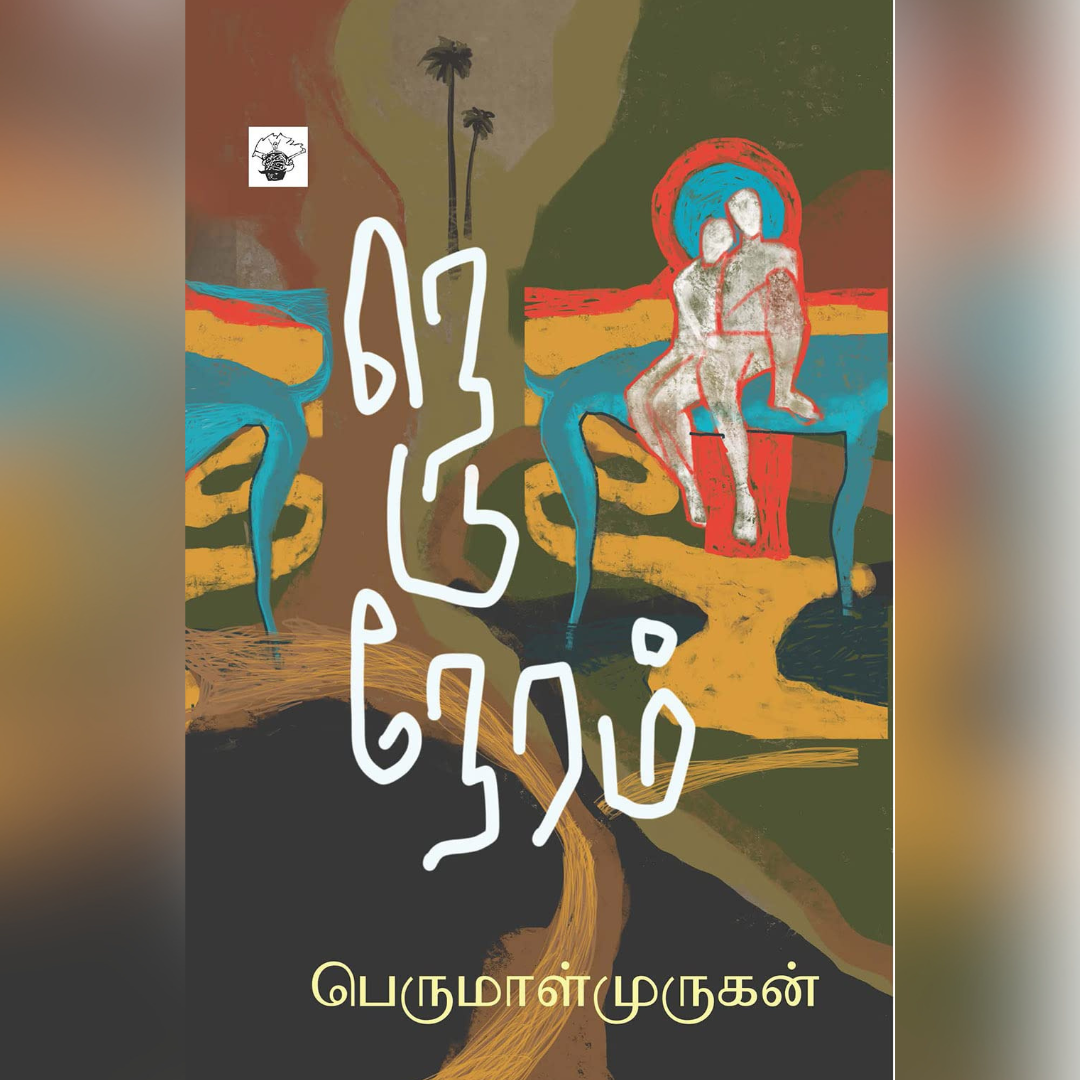
There are only two stories, John Gardner once wrote—a person goes on a journey, or a stranger comes to town. Perumal Murugan’s Neduneram (A Long Time) is both. Murugasu leaves home to find his mother, Mangasuri, who has walked out after three decades of marriage, leaving behind only a note that reads, “I have spent a long time in here.” The same journey brings him back to his roots, where he arrives at his native town, as a stranger. Set against the unprecedented COVID-19 lockdowns, the novel traces journeys that are both inward and outward, moving sometimes forward and sometimes backwards in time, until every character is forced to face what they have spent their whole lives running from.
A Journey Forward and Within
The lockdown is more than a backdrop in the novel as it functions as an external pressure that makes both journeys possible. On one side, the unprecedented confinement forces every character to sit with themselves and reflect on their lives. On the other, their yearning compels them to act. The novel is told almost entirely through Murugasu (25), who is curious and unsettled, and the world shapeshifts around him as he moves through it. There is a churning within him, between what he has been told and what he is beginning to see, that gives the novel much of its texture.
Having returned home after resigning from his job in Veerasuram, he learns that his mother is gone. The inward journey begins here, with his father, Kumarasuran, who opens up for the first time. Kumarasuran grew up without a father, and his uncle paid for his education and looked after his needs. He becomes an English teacher, and makes the school the centre of his world. When the time came, he repaid his uncle by marrying his daughter Mangasuri. It was a wedding arranged so quickly that no one gave him a proper reason. He shares about his parents, his love interest, his teaching life, and even discusses sexual desires with his son. Despite this openness, he says very little about his wife, Mangasuri. These conversations ignite a sudden curiosity in Murugasu about the native town he barely knew, the grandmother he had hardly visited, and a world that his mother would have walked into.
The outward journey begins when Murugasu sets off for his native village with his friend Megasu. The road offers more than he expected. He meets children thrilled at the sight of a motorbike, a local physician who refuses to take payment, villagers who sleep together in temple premises and talk through the night, and a woman who has no human connections but birds. He drinks toddy for the first time, and watches new landscapes and lifestyles and slowly begins to see a world that had always existed beyond the edges of his monotonous life.
Almost every conversation, every detour, and every person he meets on the road leads him a little closer to his mother. Though, she never appears directly in the novel, she is present throughout through other people’s memories. She first appears through the father, then through the grandmother, and finally through her childhood friend Manjiyamma. Interestingly, in his search for his mother, what he finds, before he finds her, is himself.
When Can We Ever Love Without Fear?
At its heart, Neduneram is a love story. Or rather, it contains multiple love stories arranged across different generations. In an interview with DT Next, Perumal Murugan describes the novel as a journey through different stages of life and love, one that encompasses generations, environments, and values. Taken together, these stories demonstrate that love in Tamil society is rarely a private matter. It is social, familial, and caste-determined before it is anything else, and the novel’s moral architecture is built upon this.
For instance, in the first generation, Kuppasuran’s marriage is defined by labour and duty. When he dies, his wife simply continues to raise her son, Kumarasuran, without any other desire of her own, as the society expected. The second generation is transactional where Kumarasuran marries Mangasuri out of debt, in order to prove his loyalty towards his uncle. They spend thirty years in the same house, but never really talk to each other. Then, in the third generation, the relationship between Murugasu and Devasuri is modern in its arrangement. They share the same house and gradually develop feelings through occasional meetings. But Devasuri parted her ways when Murugasu kissed her without her consent. Across these stories, one can notice a decisive shift in the social mores around love and womanhood. The trajectory from Kuppasuri, who defines herself entirely through her husband, to Devasuri, who holds agency in the relationship, is evident in the course of the novel.
This development is more visible with Mangasuri’s story, which is not simply a tale of thwarted love but of a young woman who was systematically denied agency at every turn. She regularly meets Madhuran, a schoolmate from the lower community of Poongkulam, in the fields, and gradually falls in love with him. She belongs to the higher Thengkulam, who do not appreciate any caste transgressions. When her family discovers her connection, the entire community responds with the full force of its authority. As a result, she is locked in, and he is beaten in public and almost killed. One cannot help but think of Imayam’s Pethavan: The Begetter (2015), where an entire village collectively decides to murder a girl who crossed caste lines, or of the honour killing narratives that continue to run through Indian life and literature. In Neduneram, Madhuran pre-empts such a caste verdict by cutting open his own stomach in front of Manga’s house. By doing so, he shifts the violence from communal to self-inflicted and somehow barely saves both their lives.
Murugan sets all of this in a fictional world, with invented communities and imagined towns. This is a deliberate choice from the writer after the controversy surrounding his Madhorubagan (2010) where he faced threats for depicting the ‘real’ rituals of a ‘real’ temple, followed blindly by ‘real’ people. Since then, his novels Poonachi (2016) and Kazhimugam (2019) followed this pattern. Each world is recognisable enough to feel true and fictionalised enough to remain untraceable. Neduneram is an extension of that tradition. Despite its fictionality, Thengkulam and Poongkulam carry the same hierarchies as any real village. The invented names do not soften what they represent, but sharpen it.
Mangasuri is married off under pressure and blackmail, and for thirty years, she lives inside that arrangement. Cut to the present, Manjiyamma tells her, a year and a half before the novel begins, that Madhuran is still alive and still alone. Six months later, once she realised her ‘duties’ were over, she walked out of the house and the family set-up that decorated it. And with her stepping out, it all comes to a point in the end. A woman robbed of her youth, her desires, and her right to live with the man she loved has walked out. Murugasu and Manjiyamma do not know for certain where she has gone, but they both realise that she must be with Madhuran.
In Chapter 52, the narrator raises a question the novel has been circling all along: “Can there never be a time when love is devoid of fear?” It is Mangasuri who answers it with her final act. A woman who spent three decades inside an arrangement she never chose finally walks out on her own terms. What outlasts the village, the violence, and the decades of silence and fear is not just love, but the determination of a woman who refused to let the society have the final word. In this sense, Neduneram is a valuable addition to the growing body of contemporary Tamil fiction that takes up the women’s question. From Kuppasuri to Mangasuri, Murugan effectively maps what it has cost women to love, to endure, and finally, to choose.
Publisher: Kalachuvadu Publications
Neduneram can be purchased here.

Kathiravan Annamalai is a Senior Research Fellow in the Department of English at Pondicherry University, with research interests spanning Social Movements, Subaltern Literature, Drama, and Translation Studies. An active literary translator working between Tamil and English, he has translated the works of C.N. Annadurai, Bama, and Imayam into English, and Langston Hughes and Zora Neale Hurston into Tamil. His forthcoming edited volume, Imayam: Beyond the Canon, co-edited with Prof. T. Marx, is to be published by Peter Lang.
Beyond academia, Kathiravan is a screenwriter whose work in independent cinema has earned significant recognition. His films — Sennai (2021), A Fly (2023), Yaazhi (2025), and The Tales of the Ukulele Man (2026) — have been screened at prestigious platforms including the Calcutta International Cult Film Festival (Sennai), the Cannes Indie Film Festival (Yaazhi), the International Film Festival of Kerala (A Fly), and several other reputed festivals across the world.
IG: @kathiravan_annamalai
LinkedIn: Kathiravan Annamalai