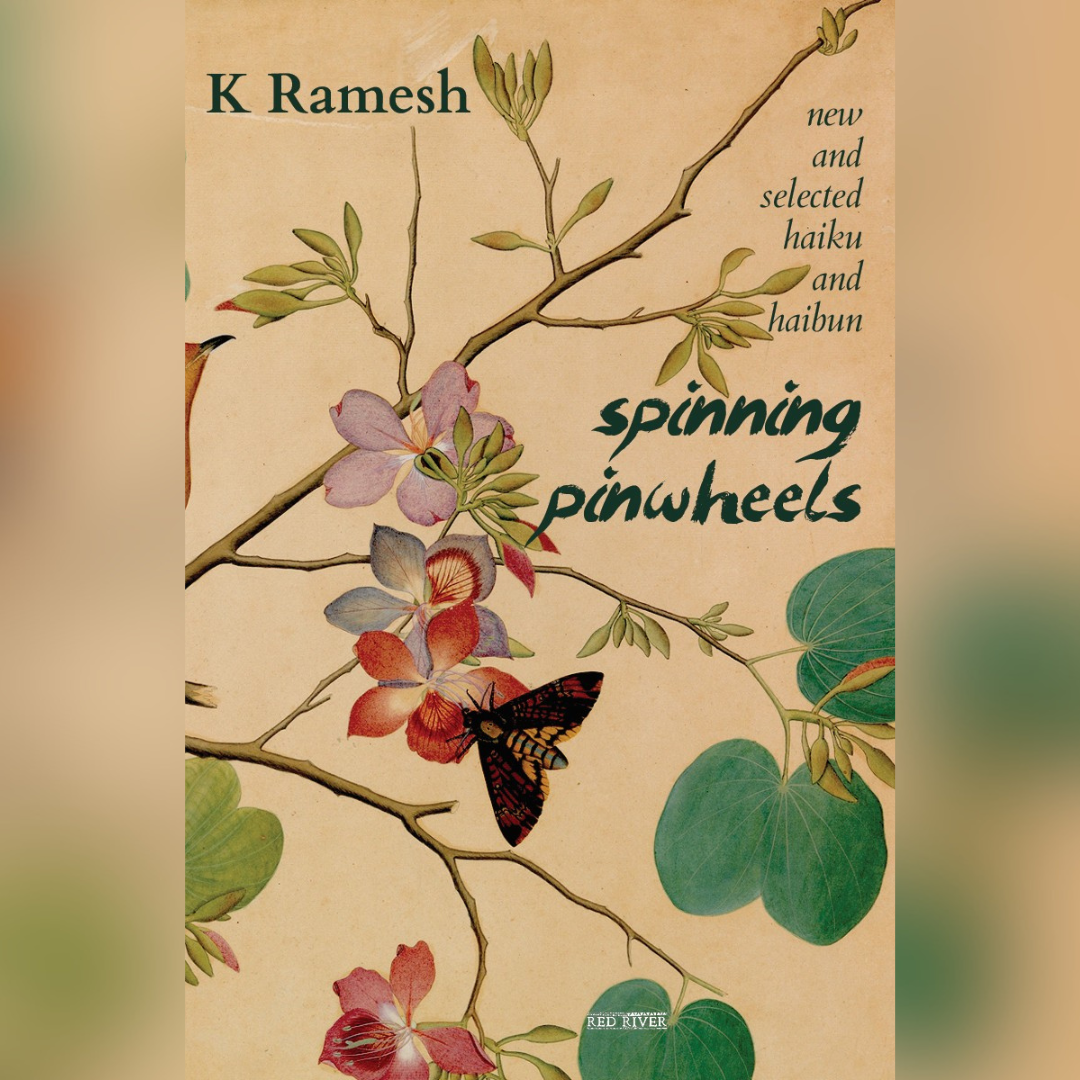
For many of us, pinwheels bring back a distinct childhood memory of an object that whirred as it caught the wind in its folds. It was one of those simple things that made our world go around. Another object that filled us with wonder was the kaleidoscope. K Ramesh’s book, spinning pinwheels, offers a kaleidoscopic view of the beauty nestling in the ordinary and commonplace, of movement in stillness and of the macrocosm in the microcosm.
K Ramesh has written four volumes of haiku over a span of more than two decades. He is a photographer and a teacher of physics, who brings a very finely attuned sensibility to his haiku. Haiku is considered to be “a whisper of a poem,” rooted in established aesthetic principles which derive from an art that was traditionally practised by Japanese masters. The haiku in the book are characterised by an engaging simplicity and unravel their layers slowly and unhurriedly.
The book contains both his old and new haiku, and comprises four segments. A collection of haibun is also included in the book. There are two haiku on each page, allowing the reader to soak in maa, the white space, pausing on the threshold of discovery and possibility. The poet invites the reader’s participation, in juxtaposing the familiar, lived experience with startling images. Consider, for instance, the following lines from the section ‘soap bubbles’:
first summer rain—
my hand outside
the train’s window
This haiku rekindles feelings of joy, when reaching out for raindrops which most readers can relate to. There’s a sense of renewal in the routine.
Another haiku which would resonate with most of us, mixes the musical with the grating everyday noises. In the midst of the eclectic offerings of dawn the poet has his hearing attuned to birdsong even as the day’s business gets started.
dawn..
amid birdcalls
the sound of a broom
The poet’s unique ability to integrate diverse elements with just a tonal shift is seen in the haiku below. These are among new haiku included in this book.
homecoming…
I get off the auto
to walk the last stretch
homecoming…
that tailor
at the bend of the road
At first glance, both haiku celebrate the familiar act of getting home. But when the poet walks the last stretch, there is a sense of reclaiming something that once belonged. This haiku has a sense of karumi—a lightness that matches the poet’s step. When the poet notices the tailor at the bend of the road, it is an assurance, a sense of certainty that nothing much has changed. The poet creates subtle shifts through visual images which correspond to different emotional states.
In ‘pebble to pebble’, the granular attention to detail persists to create a whole expansive world where much is said through minimal, pointed observation.
silence in the ashram….
a squirrel eats each grain
of rice without hurry
This haiku conveys the act of mindfulness, which is almost instinctive to the squirrel. The silent ashram, where mindfulness is probably taught and practised, is a contrapuntal backdrop for the effortless action of the squirrel.
There’s another one which tells a whole story.
her crayons…
the red one smaller
than the others
A child’s affinity for the colour red, her love of brightness, her unique spectrum, filling page after page with the way she sees the world is what is shown to us. This in turn is a tribute to individuality and latitude that children possess.
In ‘from a small tree of tender leaves’, the haiku delve into quietude, where the poet remains an unobtrusive observer.
winter night…
mother and I search
for a pill on the floor
There’s a poignancy and probably anxiety in this haiku which is captured almost cinematically. Another haiku is a snapshot of a morning ritual, delineating the assurance and the comfort of a routine.
the silence
as we drink the morning tea…
mother’s wrinkled hands
K Ramesh’s haiku and senryu speak volumes with just a few deft stokes of verbal imagery. The poet’s craft is masterful, showing the interplay of light and shade, in what is said and left unsaid. It is akin to looking at paintings of one of the old masters and discovering tonalities and details; that is ultimately the reward of attention.
The book also includes haibun which capture sensory experiences of the forest trails and backwaters, school grounds and exam halls. Quietly shuffling between many alternate worlds, the poet keeps his focus on the variety of human experience, offering a view of the depths hidden in the seemingly ordinary. In ‘Waiting’, where students are cooped in the silence of an exam hall ready to start answering papers, to shape their future perhaps, there is a scene that is enacted over the years, unchanging and serene.
outside the hall…
a cattle egret stands still
by the cow
This is a book that is to be savoured sip by sip, pausing to look out of the window to hear a sparrow chirp or watch the banyan soar in the distance. The poet shares with the reader his gift of seeing, through the haiku in this collection.
spinning pinwheels (Red River, 2025) can be purchased here.

Geetha Ravichandran is a retired 1987 batch IRS officer. She writes a monthly column for The New Indian Express on contemporary issues. She has published two books of poetry and has coauthored a collection of poems with two other poets. Her book, The Spell of the Rain Tree, was longlisted for The Wise Owl Literary Awards in 2024.




Beautiful review by Geetha Ravichandran with insight into details. It was nice to read the excerpts from the collection and their analysis.