Editors’ Note: In October 2009, Michael Smith landed in Tokyo, Japan, accompanied by a colleague and students from the British school he taught at. Having explored the capital, he hopped on a high-speed train to Hiroshima. Then the party changed boats and trains to reach the port city of Oita. This final installment sees Michael in Kyoto, and Tokyo again, before he flies back West.
Day 8
Kyoto
Today we returned to the island of Honshu, travelling by train to Kyoto City, former capital of Japan, and now capital of the Kyoto Prefecture in the Kansai region. Once more, we were impressed by the smooth elegance of the shinkansen, with wooden flooring, leather seats, and frequent signs informing passengers of locations of important parts of the entire train.


From time to time, the carriage would be visited by a lady pushing a trolley containing a wide variety of food, drink and souvenirs for sale. Most impressive, however, was how she stopped when entering each carriage and bowed respectfully to the passengers. This respectful bowing was something we had seen regularly on our tour.
However, prior to boarding any shinkansen, this deferential behaviour was taken to possible extremes by a particular railway employee with the sole job, as far as I could see, of waving off each train from the platform. Smartly dressed in blue uniform, white gloves and red flag, this person would stand by a train before its departure, presumably checking for any irregularities (being Japan, there weren’t any, of course), and then complete an elaborate series of hand gestures, finishing by pointing his flag in the direction the train had just left, before casually walking off the platform. I was left wondering, why?
Upon arrival in Kyoto, we took our luggage and sat on the pavement outside the rail station while our bus tickets were obtained. The general group consensus was that following over a week of Japanese food (personally, the proliferation of rice was beginning to weigh heavy on my stomach), we were in dire need of western food. Temptingly, across from the station was a McDonald’s next door to a Dunkin’ Donuts store. We were salivating, and could not resist the temptation. Following Big Mac, fries, and doughnuts, and with bus tickets now bought, we travelled around the city, accompanied by several Japanese students and staff who had also travelled from Oita to Kyoto.
Kyoto, originally named Heian-kyō, means ‘capital city’ and, as the capital of Japan from 794 to 1868, it is sometimes referred to as ‘the thousand-year capital’. However, after the Meiji Restoration, the seat of the emperor moved to the city of Edo, which was renamed Tokyo, meaning ‘eastern capital’ (notice the anagram). Kyoto was also briefly known as Saikyō, or ‘western capital’. The city, with a population of about one and a half million, was originally arranged in accordance with traditional Chinese feng shui, similar to ancient Chinese cities.
Considered to be the cultural capital of Japan, Kyoto is home to numerous Buddhist temples, Shinto shrines, palaces and gardens, some of which have been designated as UNESCO World Heritage Sites. The city is also home to the second-oldest university in Japan, as well as the video game company Nintendo. To begin with, however, the first things we noticed, apart from Western food outlets, were the no smoking signs embedded into the pavement, and the massive Kyoto Tower.


Kiyomizu
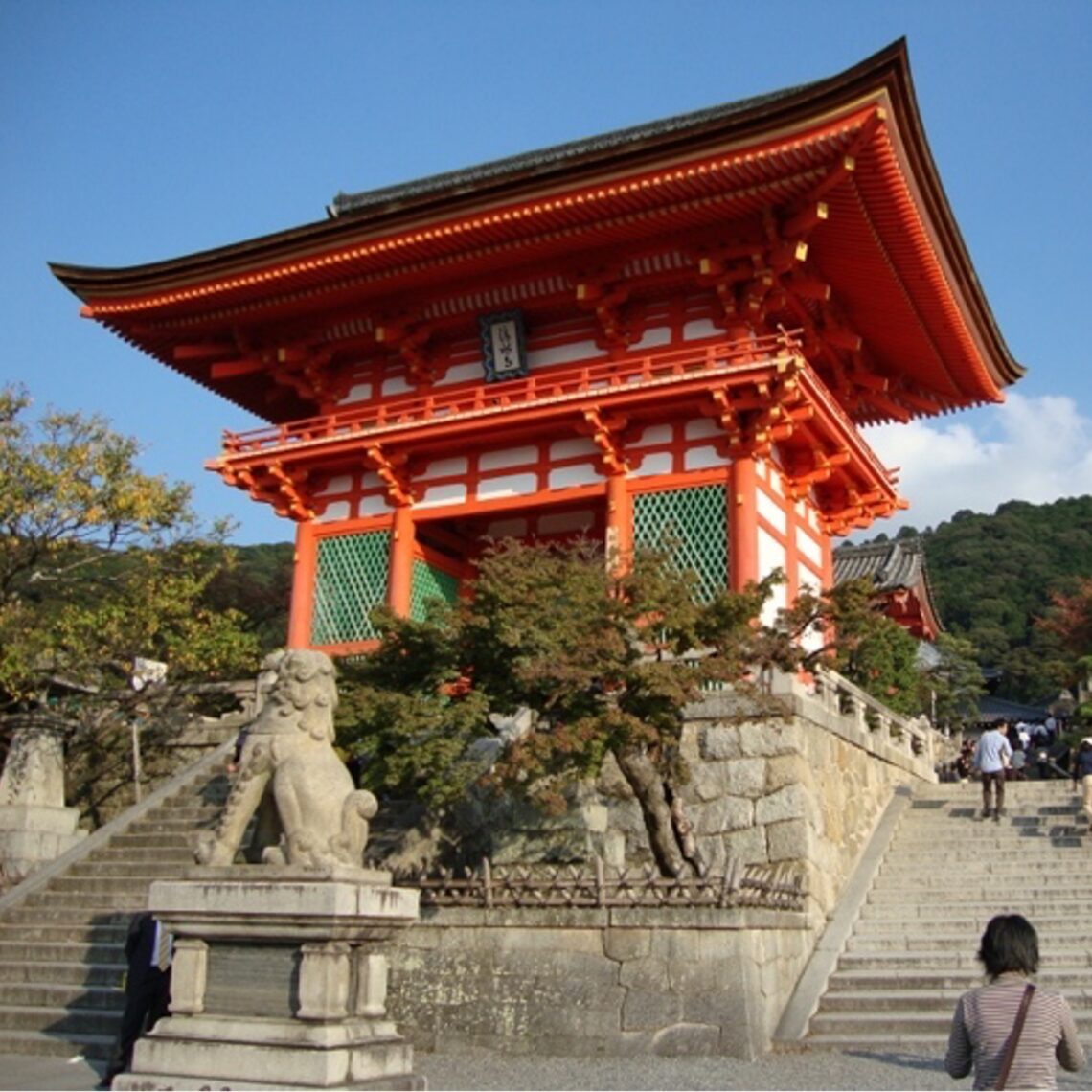
From the city center we then moved to the eastern part of the city to visit Otowa-san Kiyomizu-dera, literally ‘Pure Water Monastery’, a Buddhist temple. Not surprisingly, it is designated a UNESCO World Heritage Site (I’m noticing a bit of a theme here), and was even considered as one of the 21 finalists for the New Seven Wonders of the World.
The expression “to jump off the stage at Kiyomizu” is the Japanese equivalent of the English expression “to take the plunge”. This refers to an Edo-period tradition that held that if one survived a 13-meter (43-foot) jump from the stage, one’s wish would be granted. During the Edo period, 234 jumps were recorded, and of the jumpers, 85.4 per cent survived. The practice was prohibited in 1872 (Wikipedia).

The temple complex includes several other shrines and religious artifacts, including a display of Ema, which are small, traditional wooden plaques used by worshippers at the Kyoto temple to write prayers, wishes, or blessings. The location of this complex also offers wide-reaching vistas over Kyoto city.


As daylight began to fade, we had just enough time to visit the city’s Tea District.


The evening was then spent in our hotel with students from the Oita school. The time was split between a very large meal and several entertaining games. Most of the hotels we had used so far had been western in layout but, here in Kyoto, the furnishings were much more traditional, with a futon bed on tatami mats. In complete contrast however, the toilet was very hi-tech, including music and deodorizer to cover any embarrassing sounds or smells, and a water pressure control should one wish to use the built-in bidet function.


Day 9
Universal Studios
Today students from both schools visited Universal Studios Japan. With McDonald’s on the previous day and now a large, brash theme park, the US influence in Japan was becoming increasingly apparent. This was firmly brought home while watching the midday parade. Four months before our visit to Japan, American singer Michael Jackson had died. It had been practice up until then for Universal Studios Japan to conclude their big parade with a large American automobile carrying a smiling, waving Michael Jackson look-a-like. However, on this day we witnessed the same parade, but the finale consisted of a pink Cadillac carrying a coffin on the back seat. I was left wondering if this gesture was indicative of Japanese humour.

As dusk fell, we said fond farewells to the students from our Japanese partner-school, who were now heading back to Oita (we would see them the following summer for their exchange visit in Britain).
Our final night in Japan would be spent in a more up-market hotel (one could tell; in addition to the regular toilet features, this one also had a temperature-controlled heated seat). We had the chance to view the Kyoto Tower by night and then, remembering that this was indeed an educational visit, the students spent some time recording reflections in their school workbooks.


Day 10
Kyoto to Tokyo

Following a delicious breakfast on that last morning, and a respectful departure we thought would be reserved only for VIPs, we took taxis to the station for a bullet train back to Tokyo.

This time we would be able to explore Tokyo center by daylight, revisiting Shibuya crossing, and viewing it from the first floor of the Starbucks that overlooks this famous intersection.

I was fortunate to be able to take this photograph. A few seconds after it was taken, a Starbucks employee informed me that photography was forbidden in their café. I suspect they might grow rather tired of tourists visiting only for the view of one of the world’s most famous intersections.
Harajuku
From there we headed for Harajuku, known internationally as an area where Japanese youth can display their more outrageous culture and fashion. It seems there is little middle-ground in Japanese culture; either one strictly conforms, or one is outrageously non-conformist, and if you’re the latter, Harajuku is THE place to be.


We spent a little time doing some last-minute shopping on Takeshita-Dori East before, as dusk fell on our final day in Japan, we headed once more for Akihabara, the ‘Electric City’ for a final look at Tokyo, before taking the train to Nara Airport, and our flight back to Britain. Sayonara; Arigato gozaimasu, Japan.

In the past year, Michael Smith’s fiction has appeared in Fabula Argentea, Witcraft, Literally Stories, Microromance, Heimat Review, The Hooghly Review, Little Old Lady Comedy, and many other online literary journals. To date, he has self-published a historical fantasy called Dinner Time, two volumes in the Gruseltal series, and three collections of short stories, Fonts, Songs, and L < M, all available from online bookstores.
Website: https://frucht-schleifen.weebly.com/
Photos by Michael Smith