When I teach Macbeth, I ask my students a simple question: when was Macbeth written? Some search the web, some flip the pages of their Arden, others feel disinterested, even annoyed. Some might come up with an answer and say: “Sir, 1606.” That’s more than 400 years ago! I, assuming the teacher’s repose, reply: “No. Macbeth was written yesterday, Macbeth is being written today, and Macbeth will be written tomorrow.” Years of my personal interaction with the text, wonderingly as a student and miserably as a teacher, have led me to believe that Macbeth develops a special relationship with its readers, particularly those who happen to be, let’s say, a bit imaginative. It bleeds into the reader. When I sit in that teacher’s chair and pretend to be a teacher, I realise that Macbeth is an abyss. Teaching the text could mean exposing the self. The text reveals. I tell my students: “This is a text where Shakespeare loses himself while writing. Macbeth snatches the text and absconds. Shall we do it too?” Tom Stoppard did it.
So, when I heard that an English professor from The Sanskrit College and University was working on an alternative Bangla rendition of Macbeth and that too with her students, I knew I could not miss it. A short conversation with Subarna Mondal over the phone piqued my interest further as I learnt that her rendition was a whodunnit, with a musical-chairs scene built around songs from Satyajit Ray’s Goopy Gyne Bagha Byne. I could not believe what I was hearing because, in 2017, I wrote an entire unpublished paper on Macbeth and its alternative interpretations in which I quoted from the same song. I decided that I had to see Subarna di’s rehearsal with her students. Accompanied by my colleague, I went to see her practice session, and we witnessed how involved she was. It was fascinating. Her play, Scotland-er Svapnadeśe, was staged at her college campus. But, for me, circumstances were not kind. I missed it.
Early in September, Subarna di reached out to me and invited me to Macbeth: Ekaṭā Hatyā Rahasya, another staging of her play at the Girish Mancha. This staging was done in collaboration with Durgapur Bhimroti. I agree with Dipankar Sen from Bhimroti who, after the play was over, said that Subarna di could have chosen professional theatre actors but she did not. Instead, she chose her students and worked with them, all within a very short time. In a time when students are regularly discouraged, what could be a better answer from a professor who finds her faith in her students and works with them, gives them the space to express themselves in front of an audience? Yes, this should be enough for us not to see Subarna di’s work through the dispiriting lens of literary criticism, but to take delight in the encouragement she and her collaborative practice have offered.
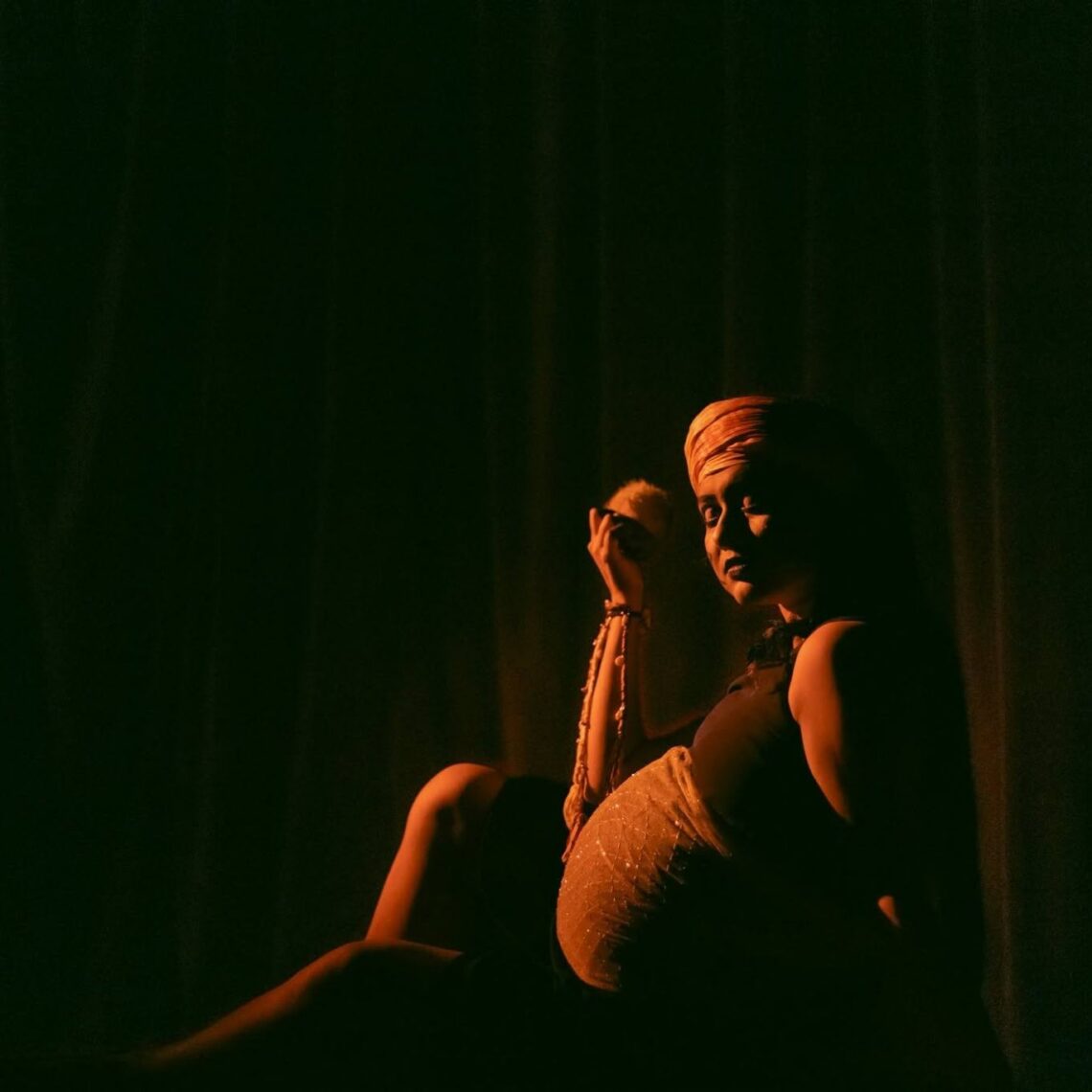
Macbeth: Ekaṭā Hatyā Rahasya is a humorous and witty rendition of Shakespeare’s Macbeth, and the execution did not dilute the Shakespearean intrigues. What if you edit out all cues that point to the culprit? No dagger-of-the-mind scene. What then? Will anyone who’s reading the text for the first time be able to tell who the murderer of Duncan is? What if Macduff is a sleuth? In Subarna di’s rendition, Macbeth is not the central figure. Unlike a Macduff screaming “Turn, hellhound, turn!”, her Macdufffrets over the murder of Duncan and its motive, and, while doing so, enters into a wild and schizoid maelstrom. Have you seen Lars von Trier’s The Element of Crime where Fisher loses his mind solving a mystery? Here, Macduff does. Beneath the humour, beneath the playfulness of the language is a case that struggles to arrive at a resolution because a resolution does not exist. As in Roman Polanski’s Macbeth, there is no end. Subarna di wrote a script that opens with the murder of Duncan and ends with the murder of Macbeth. The case continues, passing from delirium into delirium. Macduff’s sleep is murdered. Macduff visits the witches. Corruption bred on the heath of the mind collides with memory that keeps on playing tricks. The sleuth finds himself in a liminalscape. And what better language than Bangla to show how Shakespeare’s characters traverse liminalities? The witches, the porter, Lady Macbeth, Banquo—who isn’t liminal? Scotland brought onto the Bangla stage, is it not liminal? The play is also punctuated by music: “Hotel California”, music from Haider, Goopy Bagha, Bangla rap, among others. It is punk and fun and unapologetic. This is a professor’s Macbeth and it is full of alternative interpretations that are meant to provoke the audience into thinking “what is not.”
Regardless of the technical shortcomings for which I believe time and resources are to be blamed, I think that this play is a small part of a larger project. For the last five years, Subarna di has been mentoring her students for Shakespearana, performing alternative stagings of Shakespeare in a time when the stage is dying. It is inspiring to watch a professor stepping out of her role and working alongside her students with care. I believe that, while Subarna di stayed off-stage, narrating scenes, she was, alongside her students, performing the blank spaces on the stage. I bet her students never felt alone.


Prof. Subarna Mondal’s Shakespearana is an annual event celebrating the Bard’s works, hosted by the Department of English of The Sanskrit College and University, Kolkata. Follow the project on Facebook and Instagram.


Subarna Mondal is Associate Professor of English at The Sanskrit College and University, Kolkata. She works on late-Victorian Gothic literature, the Gothic on screen, body horror, and the films of Alfred Hitchcock. She is the author of Alfred Hitchcock’s Psycho and Taxidermy: Fashioning Corpses (Bloomsbury Academic). Her articles have appeared in Northern Lights: Film and Media Studies Yearbook, Palgrave Communications, Humanities, and Hitchcock Annual, and in edited collections from Palgrave Macmillan, Manchester University Press, and Columbia University Press. For the past five years she has been adapting, translating, and directing Shakespeare there. Her project Shakespearana produces alternative Bangla versions of the plays.
Subham is from West Bengal. He daydreams to be a traveller and a writer he knows he shall never be. Trees and music stir a tender sense of empathy in his heart. He wants to apologise to the trees.