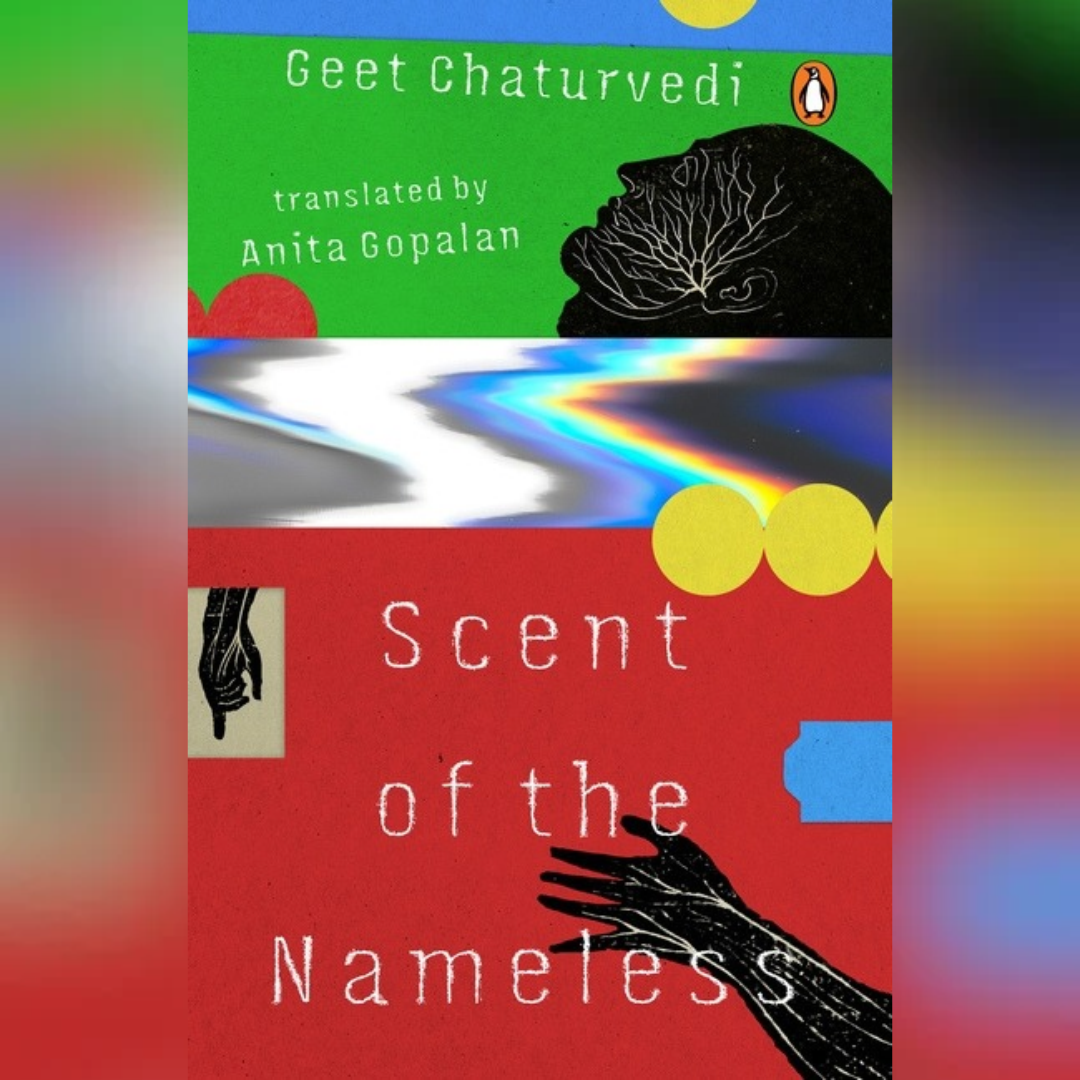
Scent of the Nameless by Geet Chaturvedi, translated from Hindi by Anita Gopalan, is an unusual, unconventional book. At its centre is an unnamed middle-class office clerk living with his wife and young daughter in a modest Mumbai apartment. His life is ordinary and predictable until a credit card introduces him to desires he never knew he had. What begins as convenience slowly becomes compulsion, and then catastrophe.
It is slow-paced and dreamlike on the surface, but beneath that stillness, there is a constant sense of unease. The unnamed protagonist seems lost, and as the story progresses, it becomes difficult to tell what is real and what may be a dream. Dreams fascinate me, so I found this aspect particularly interesting.
Debt is one of the recurring concerns of the book. There is something particularly interesting in the way it looks at credit cards and the business built around them. People are encouraged to spend, credit is made easily available, and then, when they struggle to repay what they owe, a new kind of circus starts. The book seems to look at this whole system with a mixture of absurdity and darkness.
The protagonist himself is an intriguing figure. The way he refers to his wife in the narration, as a “cook-woman”, “tea woman” or “my housekeeper-woman”, the way he almost forgets that he even has a daughter, creates a certain distance. He seems disconnected not only from the people around him but also from his own life. Frankly, I didn’t understand the purpose. I actually thought, initially, that he was talking about a househelp. Probably which is why, as a reader, I felt disconnected from the character.
I often felt more aware of the ideas, the darkness and social observations than emotionally involved with the characters. That said, there are moments when this strange, unsettling atmosphere works particularly well. One of them is when a man arrives looking for the protagonist to collect his credit card debt. The protagonist has failed to pay what he owes and has moved house, but the man has somehow tracked him down.
“He shook my hand warmly, almost too warmly. But before that he politely confirmed my name. Before that, he rang the door bell to announce his arrival. And before all of that, he had been in some deep conspiracy. And even before that, he had committed a murder.”
Then the gecko sequence:
“Why doesn’t anyone eat their prey in the light? Every predator has its own darkness —a shadowy place it takes its prey to kill it.”
Another recurring image is the smell that the protagonist feels is following him (the book actually begins with this). He washes himself thoroughly and frequently, but the smell does not go away. The smell of cow urine.
I found this particularly puzzling until I read the translator’s afterword, which helped me understand its thematic connection with Premchand’s Godaan. The afterword brought a new layer of meaning to several aspects of the story and, for me, provided much-needed clarity.
The book also contains some striking insights about money, work and inequality.
“Once again advaita returned to my mind. The world was divided into two kinds of people: those who get work done have the money; the ones who do the work do not.”
These ideas give the narrative a recognizable social reality.
This is not a conventional story with a clear arc, and I think that is important to keep in mind before reading it. The narrative moves in its own reflective way, rather than building towards the kind of plot-driven or character-driven resolution many readers may expect. It is more like a reflective account of the life of an ordinary man. The writing does have the author’s distinctive style that I have noticed and admired in his previous books.
The translator’s afterword was particularly valuable to me. It gave me a better understanding of the references and ideas behind this unconventional work and made me look back at some of the book’s ideas and perspective a little differently.
“For every ten winners, a thousand must lose.”
The translator says the above, and it is so profound. Like you have known it all along and yet never thought about it.
Scent of the Nameless, for me, was an intellectually rewarding read—one that makes you pause and reflect on its unique perspectives and deeper meaning beneath the story. Frankly speaking, it is not an entertaining book that you quickly finish in one or two sittings. It demands patience and contemplation. It is an important book both in terms of its literary prowess and relevance of the subject.
Geet Chaturvedi’s Scent of the Nameless, translated by Anita Gopalan, is available here.
Geet Chaturvedi is one of the most widely read contemporary literary authors in Hindi. Often considered as an ‘avant-garde’, he has published eleven books and his works have been translated into twenty-two languages. He served as an editor at Dainik Bhaskar for sixteen years. He has been awarded the Bharat Bhushan Agrawal Award for poetry, the Krishna Pratap Award for fiction, the Shailesh Matiyani Award for fiction, the Krishna Baldev Vaid Award for fiction, and the Syed Haider Raza Fellowship for fiction writing. He was named one of ‘Ten Best Writers of India’ by the The Indian Express.
X/IG: @GeetChaturvedi
Website: geetchaturvedi.com
Anita Gopalan is a literary translator. Her translations from Hindi include Geet Chaturvedi’s The Memory of Now (winner of the Anomalous Press Poetry Chapbook Contest), Simsim (recipient of a PEN/Heim Translation Grant and longlisted for the JCB Prize for Literature), The Master of Unfinished Things (named a notable translation by World Literature Today), and The Funeral (included in Best Literary Translations, Deep Vellum). Her work has appeared in AGNI, Asymptote, Chicago Review, Poetry International, Two Lines, Words Without Borders and the World Literature Today centennial anthology.
X: @anitagopalan; IG: @anitagopalan16
Tarang Sinha is a bilingual writer and translator. As a translator, her works include Ramrajya by Ashutosh Rana, Don’t You Quit by Nishant Jain (published by Westland Books), and A Case of Exploding Mangoes by Mohammed Hanif. Her articles and stories have been published in Good Housekeeping India, Child India, The Hindu, Deccan Herald, Woman’s Era and New Woman. She writes Hindi stories for the popular radio show, Yaadon Ka Idiot Box with Neelesh Misra.
X: @TarangSinha; IG: @tarang.sinha
Blog: http://tarangsinha.blogspot.in/