It was during those dreary, despondent days of pandemic lockdown, when all travel for pleasure or for work had ceased indefinitely, and groups in public were limited to two people at a time, when I chanced upon the Yeung Hau temple on Lantau Island. I’d headed solo to the sleepy fishing village of Tai O, desperate to escape the four walls of our apartment, hungry for breathing space from my online-school children and work-from-home spouse. I wandered along cramped back lanes, in between weathered wooden houses that tottered on stilts with their roofs of corrugated metal, to emerge rather unexpectedly into the open of a sheltered bay. There, at the fringes of the village, an unassuming temple sat quietly under wide blue skies, surrounded by the undulating sea and sun-soaked, green hills. If not for the colourful pennants flapping merrily in the breeze atop 15-foot poles, I wouldn’t have noticed the building at all. Its ash gray walls and dark tiled roof were that unremarkable. But I’m glad I didn’t miss it, because then I wouldn’t have met Camel.
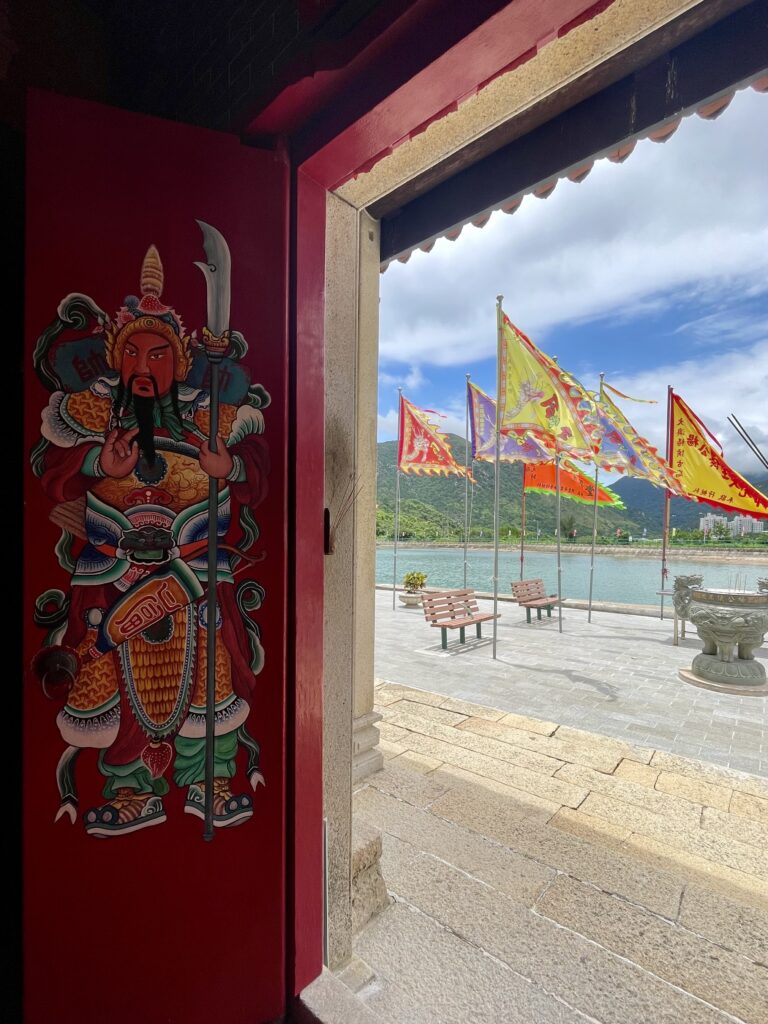
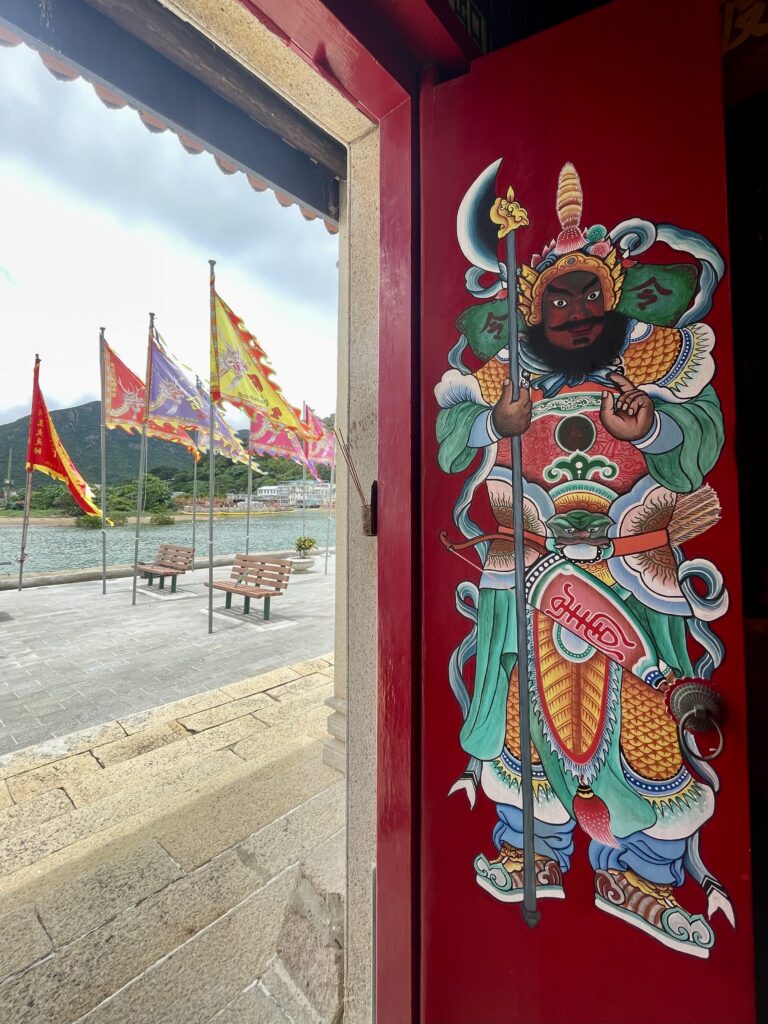
I stepped gingerly over the raised wooden threshold, nodding respectfully at the two stern-faced deities, each painted on a separate leaf of the main doors. Guardians such as these were ubiquitous in Chinese temples, at least in all the ones I’d been to, instantly recognisable from their bellicose stance, full body armour, and brandished jian (sword), dadao (big knife) or other weapon. “Hello, Sok Sok! Thank you for letting me in,” I mumbled as I passed under their gaze, referring to them casually as “Uncles.” I didn’t know their real names, being completely unschooled in written Chinese despite being able to speak Cantonese fairly fluently. Shamefully, it was a deficiency I’ve never tried hard enough to address.
As my eyes adjusted to the dimly lit interior, the tightness in my shoulders—which I hadn’t realised was there before—miraculously disappeared. Houses of worship, of any size or denomination, have this salubrious effect on me. Apart from the smoking joss sticks and the flickering flames of the oil lamps, there were no other signs of life. I wasn’t surprised by this. Back then, in the days of social distancing and masking, quiet desolation was the common condition of most public spaces, and there was no reason why this temple would be an exception.
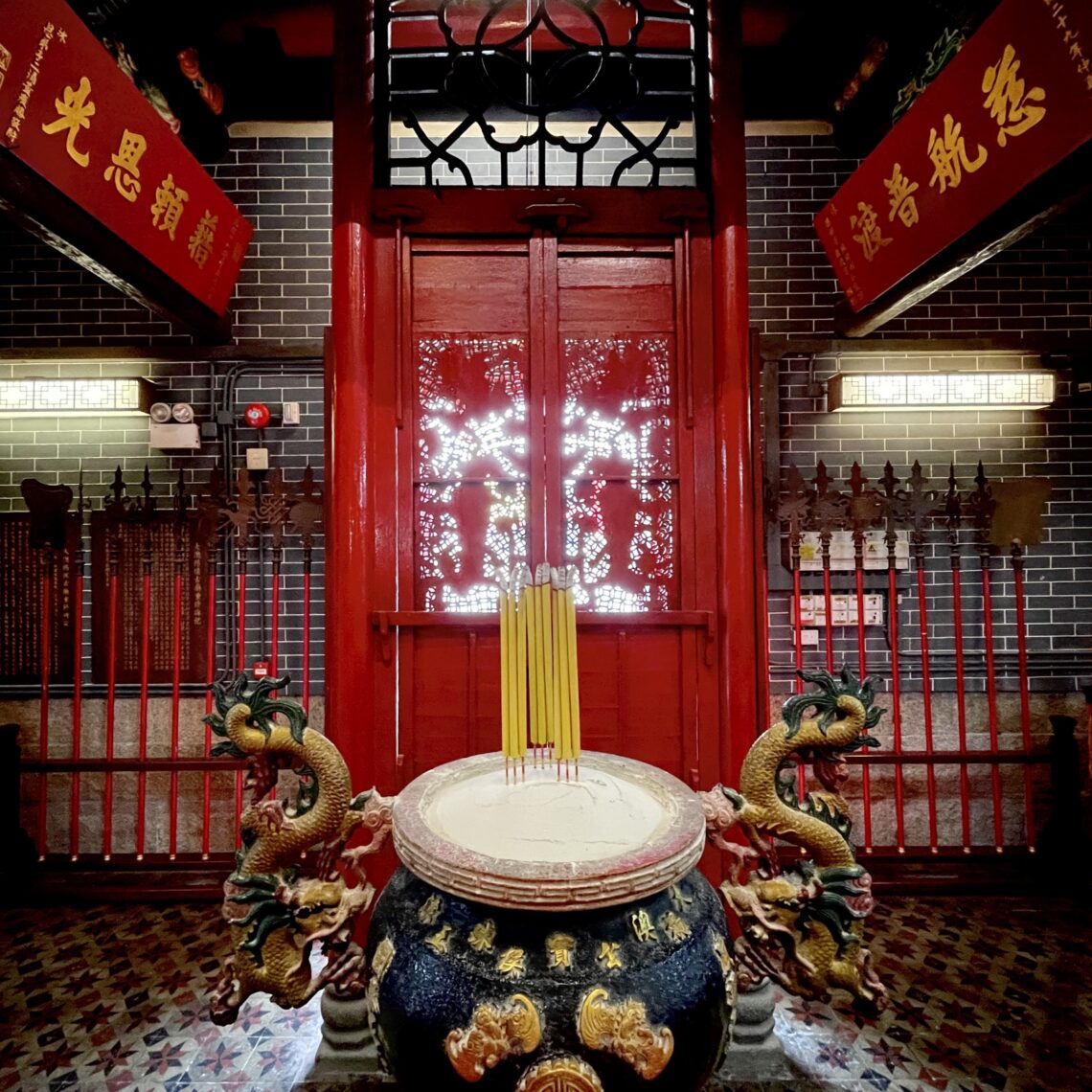
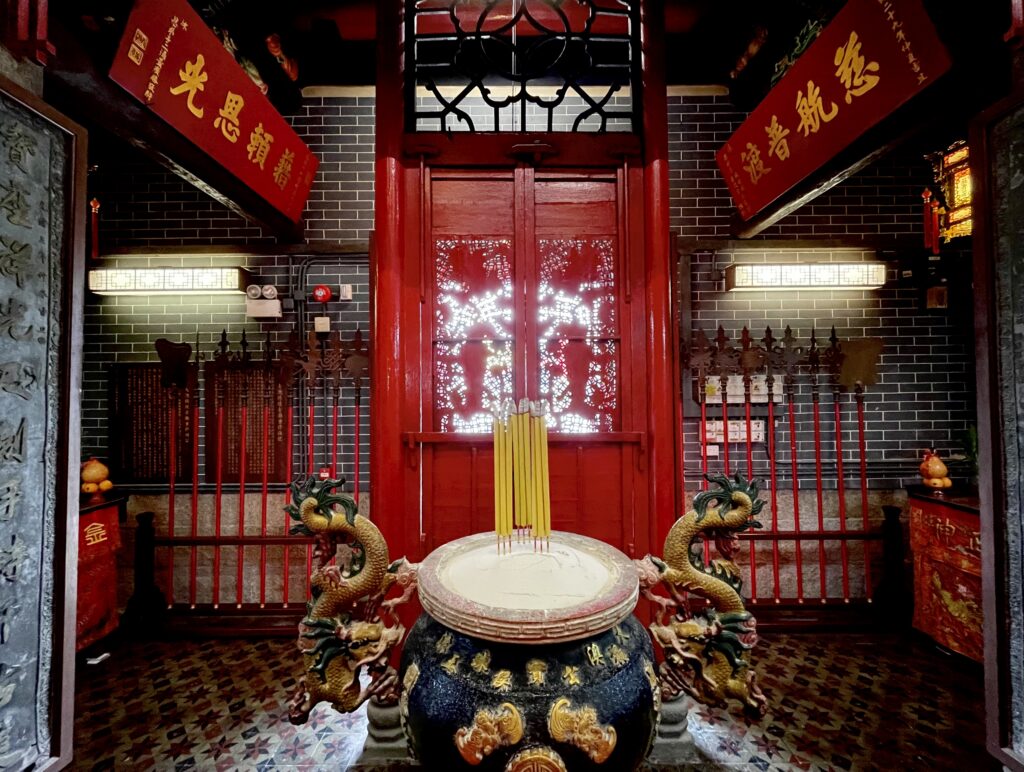
I padded across the faded tiled floor, around a gigantic urn flanked by twisted golden dragons, past a desk hardly visible under the stacks of colourful joss paper and bundles of sandalwood joss sticks, towards the pantheon of wooden statues lined up in a row within the temple’s inner sanctum. I stood in front of the gods, and was struck anew by embarrassment and regret. As usual, I couldn’t decipher any of their names. I’d lived in Hong Kong for over a decade—I was of Chinese descent, for goodness sake!—and hadn’t bothered to learn to read traditional Chinese characters. Kwan Tai’s pomegranate-red face gave him away immediately, but I couldn’t identify any of the other gods, including the largest statue of them all, the main deity who took centre stage on the flower-festooned and ornately decorated altar.
I stood in silence for several minutes, surrounded by the gods with their impassive wooden faces. I imagined they were all tut-tutting me in unison for my linguistic shortcomings. As I made yet another mental note to sign up for Chinese on Duolingo, I walked a circle, pausing to look at a time-encrusted metal bell, as large as a church bell—I would learn much later that it had been cast in 1699—and poked my head into the courtyard to gape at the concrete incinerator for paper offerings. I was about to leave when I saw something that made me start visibly. A masked man stood silently behind the desk I’d passed earlier, having materialised out of nowhere. “Aiya! Hak sei ngor!” I exclaimed in surprise, my hand patting my chest. The youngish man shuffled sheepishly at being told he’d almost been the death of me. Seeing his downcast eyes and feeling a little sheepish myself, I felt compelled to approach him.
“Can I ask you a question? Who is the god of this temple?” I ventured hesitantly through my own mask. “Hau Wong Yeh,” the man responded, in a voice soft and slightly breathless. It wasn’t a name familiar to me but for some reason, the words “Who is he?” stuck in my throat. I was inexplicably too embarrassed to show my ignorance. I learned much later from the Internet that Hau Wong Yeh was Yeung Leung Jit (楊亮節), who’d been a loyal follower and a marquis of the last Emperor of the Southern Song Dynasty. How or why he became a deity is still unclear to me.
“Would you like to pay your respects to him? Say some prayers for people in your family?” the young man asked. I gulped. It had seemed disrespectful to wander into the temple without knowing whose temple it was, and now it seemed equally disrespectful to leave without doing anything, so I nodded mutely.
The temple man flipped through the pages of a thick rectangular book that reminded me of the ledgers we’d used for accounting in secondary school. He soon found a page of empty grids in which to write the names of the recipients of my prayers. Even with a mask covering most of his face, I could tell he was unfazed and non-judgmental as he helped me write the Chinese names of my own parents, as unfazed and non-judgmental as I was when I helped him write the English names of my children. “Yes, the ‘Tai’ as in ‘Tai Mou’ (wear a hat),” I confirmed, looking at the multi-stroke Chinese character of my surname that he’d written, a symbol I knew by heart but could never myself reproduce on paper. “Your children have very long names,” he said in turn, chuckling.
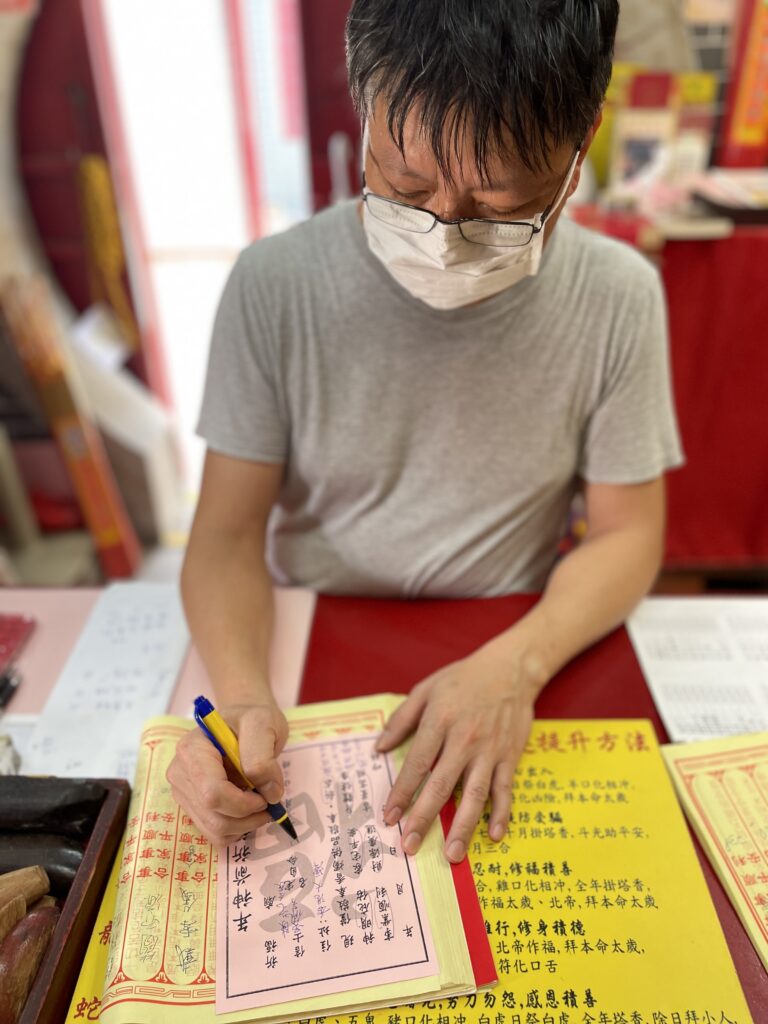
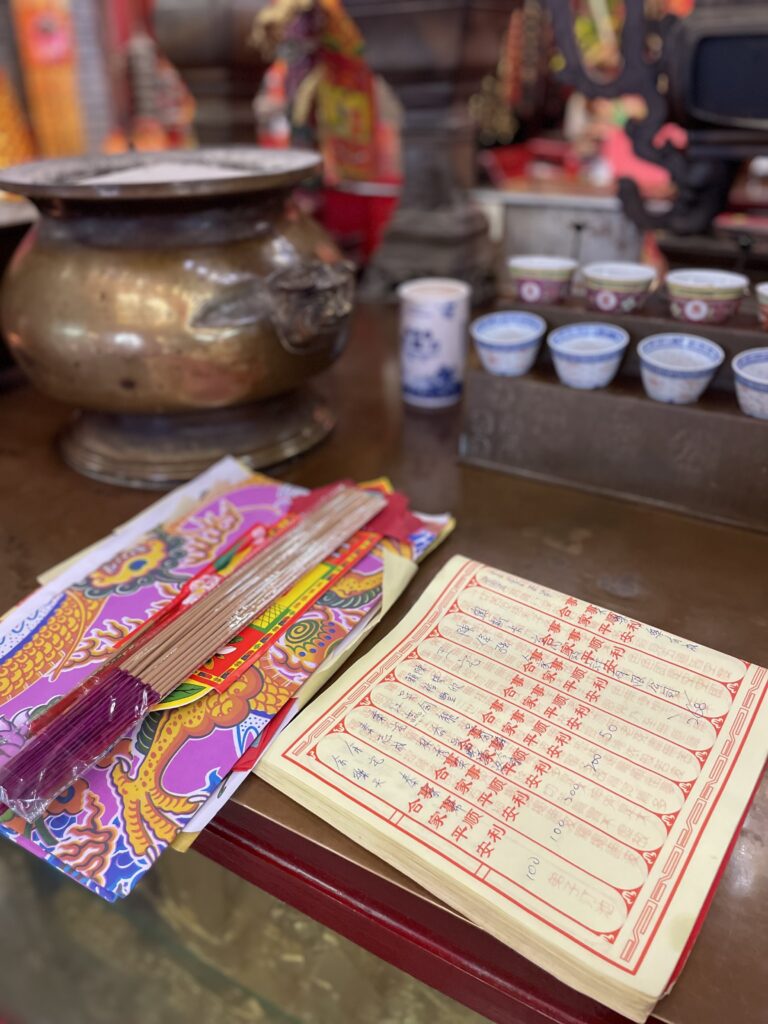
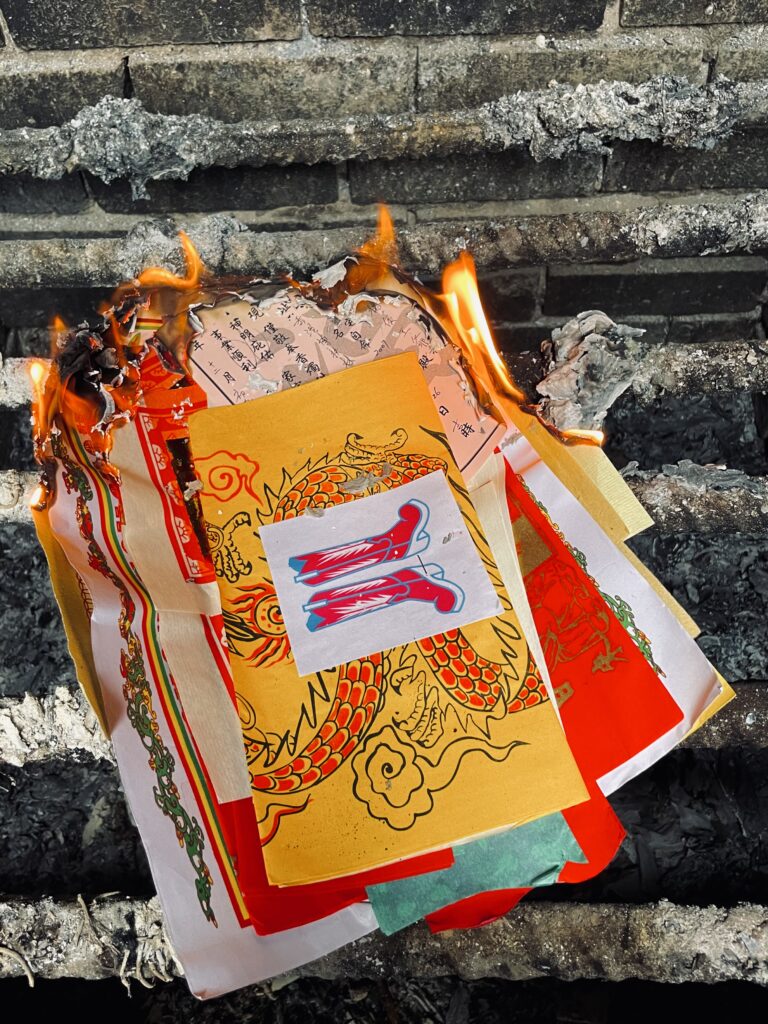
The temple man then proceeded to gather the offering materials: a couple of red candles, a fistful of joss sticks and some pretty joss paper. Sensing that I didn’t have a clue about his temple’s protocols, he guided me, step by step, on how to present the offerings: light the candles, place one in each urn, bow three times, dip the tips of the joss sticks in oil, glimmering in a shallow dish—it makes the sticks easier to light—place three smoking sticks in each urn in front of each deity, make sure you don’t miss any gods, they’re both inside and outside the temple, yes, even the guardian Uncles at the main entrance, bow three times each time, mind the falling ash, it burns, head back to the main altar, take the joss paper and cradle it in your hands, say your prayers, or if you don’t know how, let the temple man step in obligingly, reciting your unspoken heart’s desires out loud in mellifluous Cantonese, using the correct terms and honorifics, pausing to allow you to chime in with your children’s names as the man’s tongue is unwilling to bend to those Western tones, just as much as your hand is unwilling to bend to those Chinese strokes, wait for the man to sound a drum, three resonating beats, then off to the incinerator to set your blessed joss paper alight, supplications made, hope restored. All for the cost of two breakfast sets at a local cha chaan teng.
Did the prayers work? Well, in the many years that followed, the pandemic ended. My parents healed. I successfully ran a literary festival. My son made it into his dream youth soccer team. My children passed their exams. Our rescue turtle found a new forever home. We left Hong Kong and arrived in Canada intact with all our worldly possessions. My heart, although shattered, did not stop beating. So yes, perhaps Hau Wong Yeh did his thing. But how could he not, especially after the temple man’s lengthy and soulful intercessions on my behalf, always with a depth of detail, earnestness, and sincerity that had, from our fateful first meeting, never failed to move me, nor ever been replicated or surpassed by anyone else. Even the temple man’s mother, who stood in for him one day when he was unwell, merely passed me the offering package in exchange for my Hong Kong dollars, nudging me on my way without so much as a grunt or a glance.
Each time I returned to the Yeung Hau temple after that initial visit—which was far more often than I’d visited any place of worship as an adult—I’d have long chats with the man, first masked, then unmasked; about the many deities, about the intermittent flooding due to typhoons, about the villagers who came to the temple bearing gifts of roast suckling pig or bags of pink buns, about his life as the temple’s caretaker, about his pet cat, about how and why we pray, about how we must pray, culminating in the final exchange of WhatsApp numbers before I left my beloved city for a new life abroad. True to form, despite the pangs of guilt and regret, my Chinese reading skills were still stuck at an abysmal zero. I had no clue what the temple man’s real name was.
“Is this you?” I asked, showing him the English word that had popped up on the screen of my smartphone next to his phone number. “Yes, that’s me,” he nodded shyly. “Camel.”
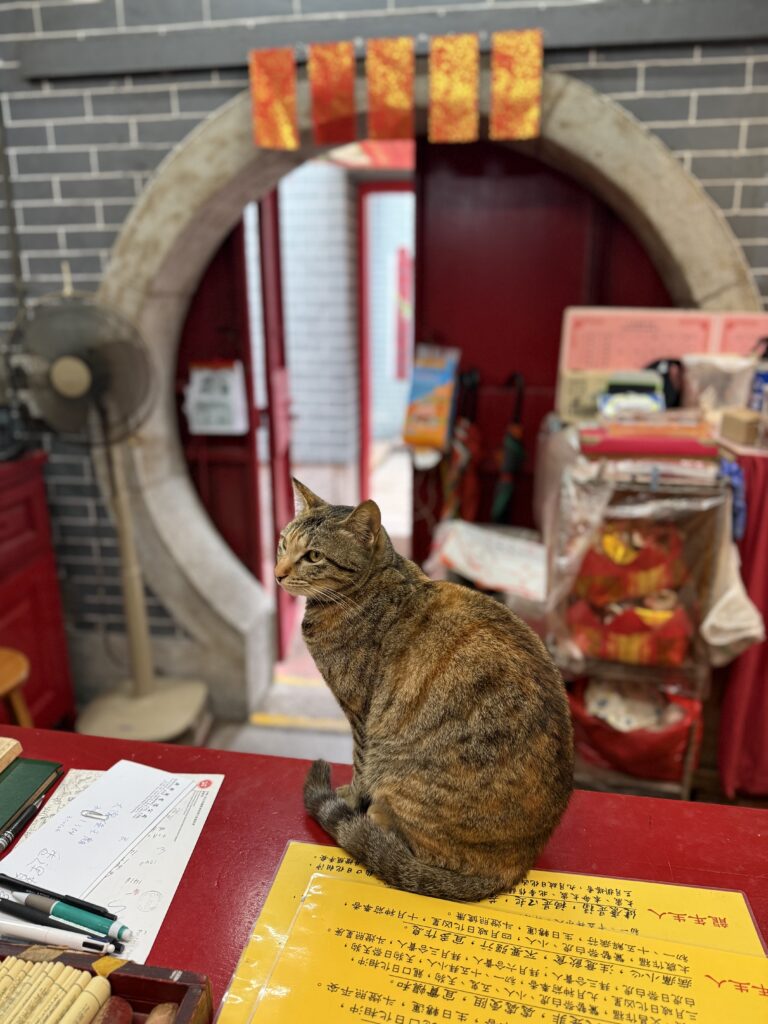
Photos by Maureen Tai

Maureen Tai has a multi-faceted literary career as an award-winning published children’s author, adult fiction and non-fiction writer, accidental poet, book reviewer and literacy advocate. Her works have appeared in Cha, the Asian American Writers’ Workshop, the Baltimore Review, Kyoto Journal, Voice & Verse Poetry Magazine, Does It Have Pockets, Ricepaper Magazine, The Hooghly Review, Fieldfare Press and Porch Lit Magazine, among others. She is also a speaker, moderator and visual storyteller, having managed the Hong Kong International Literary Festival in 2023 and presented at the Singapore Writers Festival in 2025. Maureen’s work can be found at www.maureentai.com. X: @MaureenTai