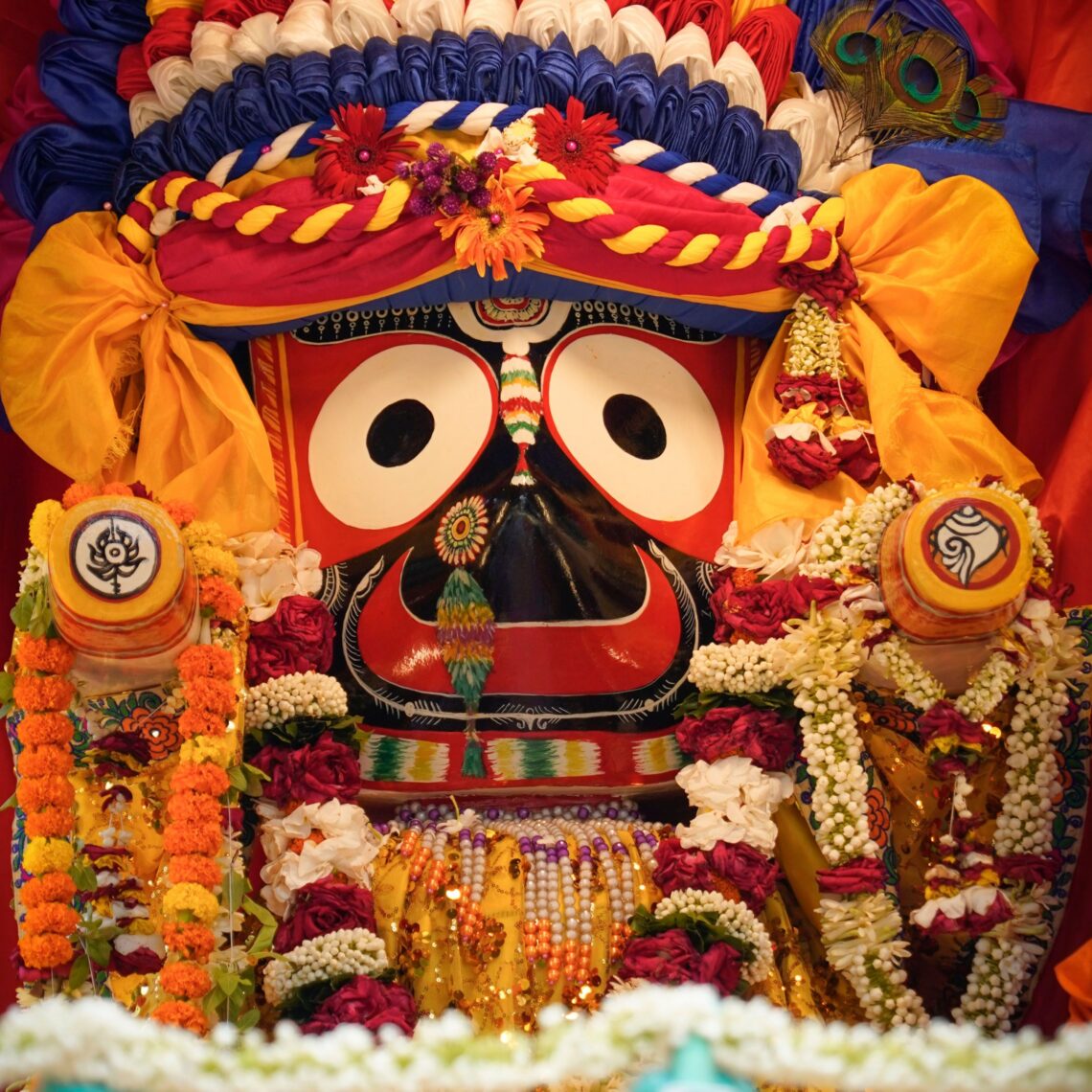
I believe that I may have accidentally met the perfect god, in New Delhi—a god who would appeal immediately and directly to nerds like me, but who cares about everyone. When you think about how we anthropomorphize gods, you get the great musclemen like Zeus or Poseidon. You get guys running around with bows and arrows and tridents and women who melt hearts and ensure fertility with their sheer beauty. You get unrivaled physical masculinity and drop-dead feminine beauty. But this guy is just gonna let his freak flag fly. Enter the Hindu god Jagannath, the Lord of the Universe, supreme nerd of creation.
Most gods advertise superiority through idealized anatomy: Zeus = power, Apollo = beauty, Krishna = erotic charm, Shiva = dangerous ascetic masculinity. Jagannath is indifferent to prestige aesthetics. The face is closer to a child’s toy, a mask, or folk art than classical sculpture. And yet he is not a minor comic deity, he is literally “Lord of the Universe.”
He is, actually, what an anthropomorphized god would have to look like—why the hell would a god care how beautiful I think he/she is? I kinda need the god more than the god needs me. He does not need to impress, he’s packin’ cosmic heat, he laughs to scorn the second law of thermodynamics, he da man. You don’t see muscles, no curly blond hair falling down his shoulders… you think Jagannath gives a fuck? No, he doesn’t. He’s the god who simply doesn’t give two fucks, the god who removes any humiliation or shame for not being socially dominant.
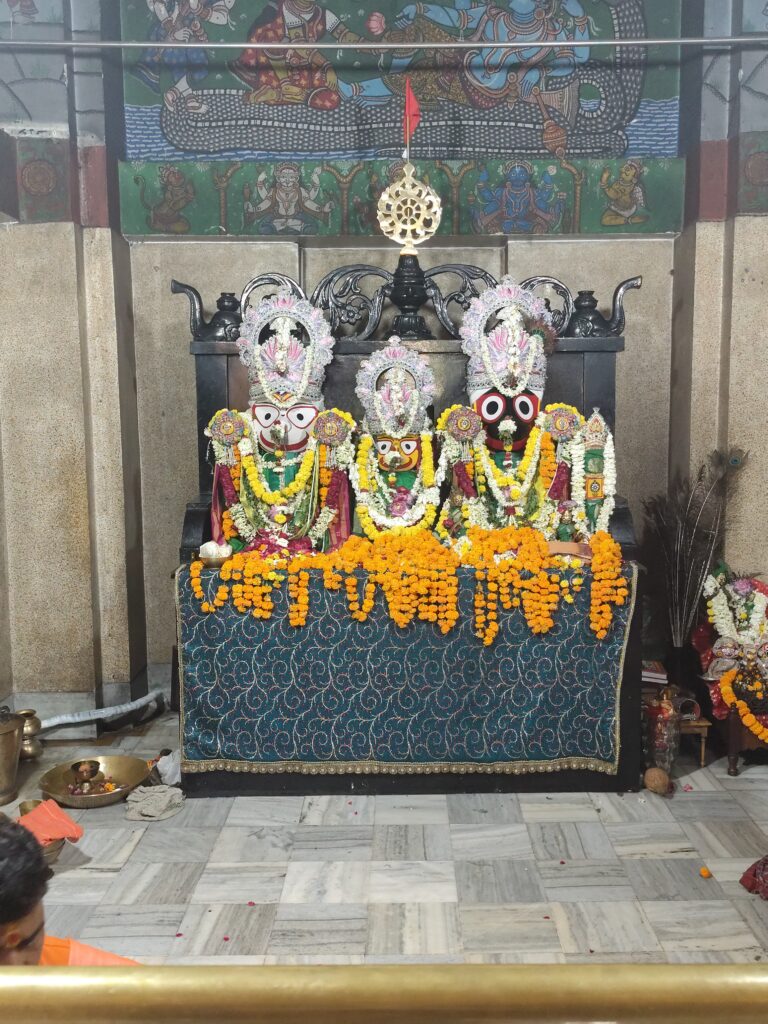
Jagannath is nearly comic in his basic, minimalist depiction, and his two sidekicks (siblings) look like fellow nerds with huge glasses and giant smiles. They show the weird mixture of slight social insecurity and awesome academic skills you see in really smart kids who are not spoiled or full of themselves. Jagannath has huge circular eyes (symbolic—to indicate he sees all), a flat face, no visible legs, and little more than stump-like arms. If he ain’t got ‘em, he don’t need ‘em.
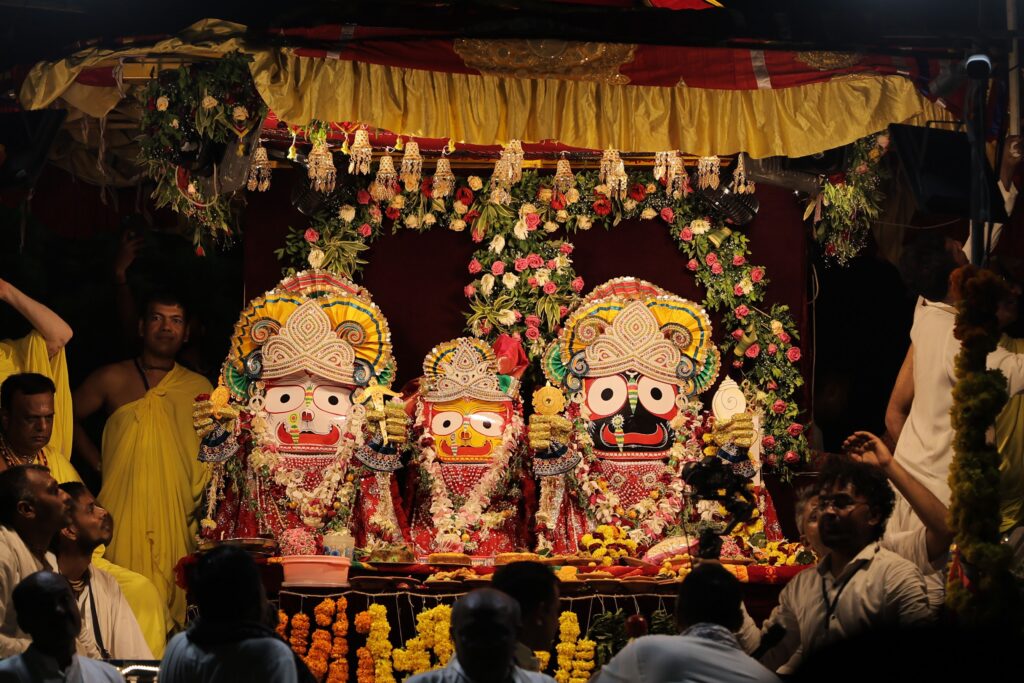
He looks like someone with an oversized T-shirt concealing his arms. For millions of devotees, this unusual form is what grabs them. Jagannath is not meant to represent perfection in any classical sense. He is a god who defies godly expectations and who leans into his inner dorkiness… for us. He is a dork, for us, so that we are free to be dorks. For the future belongs to the dorks, who will inherit and save the earth. Our future depends on deposing the guys like Zeus and elevating the Jagannaths.
So we see theological anti-narcissism here. Greek gods are hyper-idealized because they magnify human status traits like beauty, strength, sexuality, dominance. But Jagannath is post-status. Omnipotence has made vanity irrelevant. I can see a trend here… as a deity ascends toward greater power, we will see greater nerdiness. And that’s how it should be, right?
So why do you want a nerdy god? Honestly, Zeus scares me a little. They say he’s a nice guy but someone who has invested that much time in pumping up, I don’t know, I sense some insecurity issues. Do I want that guy judging me? Can he understand me? We don’t go to the same gym, I don’t do any reps, I accidentally broke my Nordic Track 25 years ago.
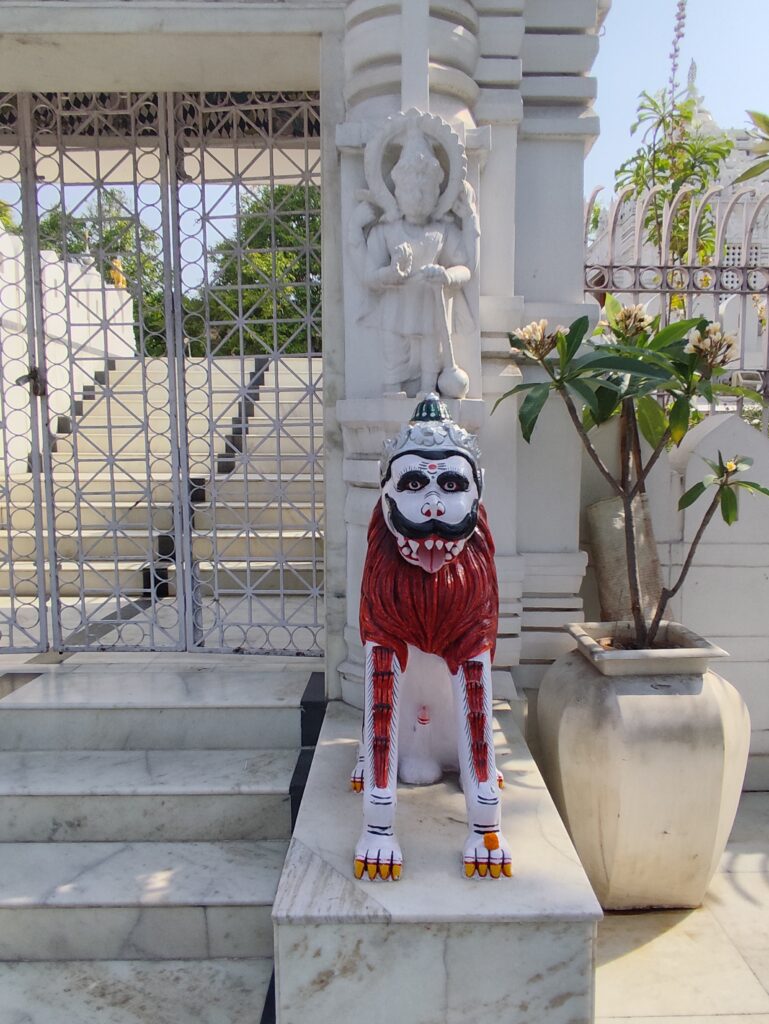
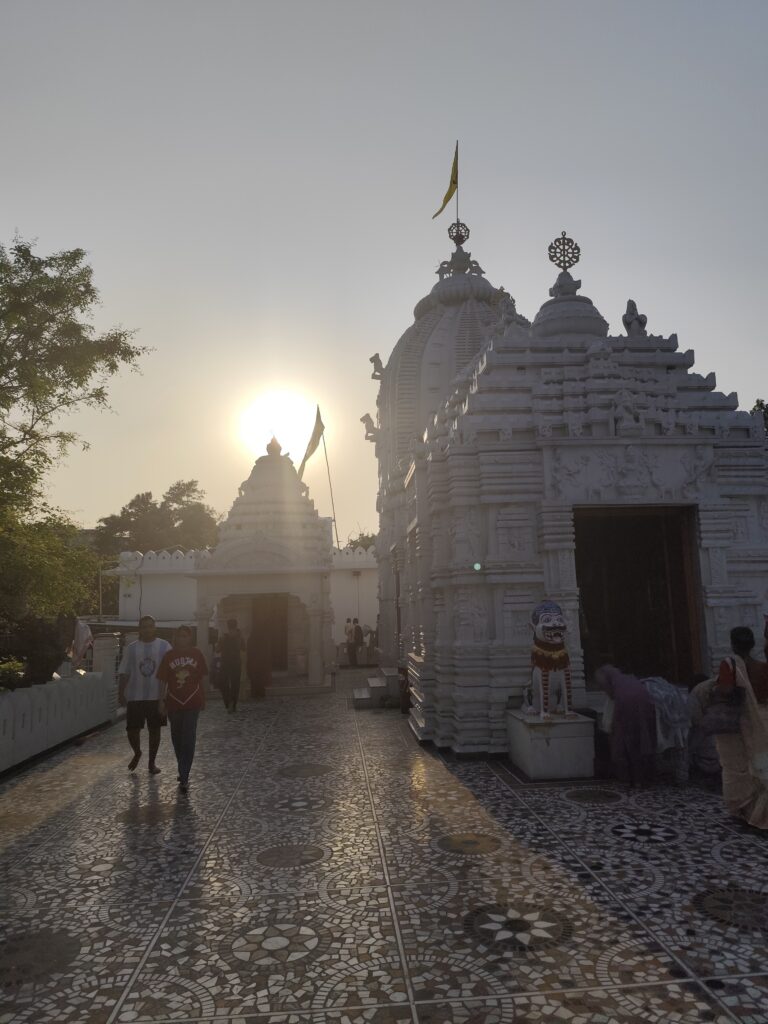
What most followers of Jagannath get, is that the guy is chill. When I went to a Wednesday night worship event near Hauz Khas in New Delhi, people were smiling and horsing around. People talked to me—the stranger, the outsider, the White-guy who probably didn’t belong there (this White guy has never belonged anywhere which promoted me straight up the Jagannath appreciation ladder).
He attracts the outsider, the stranger, the folks who are different and socially shunned or attacked, those who experience wrong and injustice. Jagannath sees. Look at those big old eyes. The guy sees everything. Light is my burden, boobie, he says to everyone with that big ‘ol goofy smile on his face with his buddies looking gleefully on. He is a god who defies. What does he defy? What have you got? He provides a religious psychology for outsiders, intellectuals, awkward people, non-alpha personalities, people exhausted by performative masculinity and status games.
He is a god of joy and hope to me, a restorer of optimism, someone who says we can look inside and overcome the malicious and harmful in us and relax in our goodness and kindness… we can all be chill and live in a chill world and solve problems in a chill, non-violent and super-smart, kind nerdy way (the kindest people are the nerdiest people, after all). It reminds me of Brecht’s poem ‘The Mask of Evil’: “On my wall hangs a Japanese carving, / The mask of an evil demon, decorated with gold lacquer. / Sympathetically I observe / The swollen veins of the forehead, indicating / What a strain it is to be evil.”
Bring him your status systems, your beauty standards, your masculinity cults, your hierarchies. Jagannath survives all of them while looking like a happy weirdo.
“Jagannath” comes from Sanskrit: jagat (“world” or “universe”) and nath (“lord”). He is “Lord of the Universe.” But unlike many universal gods, Jagannath is intensely local and deeply human. He laughs, eats, travels, falls sick and (shit!) periodically dies but (fuckin’ A) is reborn through ritual renewal. The dude freaking dies and we gotta freaking revive him—which we do gladly, no problem Jagannath. He is less distant cosmic ruler than divine bro. He’s a deusbro, a god who’ll go bowling with you or check out the latest indie rock bands.
Most Hindu gods emerged from relatively coherent mythological traditions. Jagannath appears instead to be the result of centuries of religious fusion. Frankly, we don’t care where the bro came from any more than he cares where we’ve been… or is Jagannath female… omg, it just hit me… Jagannath’s pronoun is: They/Them. Of course!
Tribal religion, classical Hinduism, local folk worship, Vaishnavism (the worship of Vishnu and Krishna), Buddhism, and perhaps even Jain influences all seem to have blended together inside them, but we just know Jagannath as the little wooden figure that we turn to for joy, truth and hope, and burn and resurrect when their wood begins to rot a little.
Some folks have told me that Jagannath began as a tribal deity worshipped by the indigenous Savara people of Odisha. According to old traditions, the deity was originally worshipped in a forest, not a grand temple. Yeah, that makes sense. The god may have first existed as a sacred wooden object rather than a sculpted human figure. This matters because Jagannath remains one of the few major Hindu gods still made from wood rather than stone or metal. Every twelve to nineteen years, the wooden images decay and are ritually replaced in a mysterious ceremony called the Nabakalebara (“new body”).
This idea, that God inhabits perishable material and periodically receives a new body, is deeply unusual in Hindu temple worship. Most temple images are intended to be permanent. Jagannath’s mortality-like cycle gives him a strangely organic quality. He ages. He changes. He dies and returns. Over time, Jagannath became associated with Krishna, one of Hinduism’s most important gods. Many devotees today understand Jagannath primarily as Krishna in a special form. Yet Jagannath never fully became Krishna in the conventional sense. He retained his own identity.
Many Hindus experience other deities as tied to particular philosophies, castes or ritual systems. Jagannath has long had a reputation for crossing boundaries. In Odisha, people often describe him less as a sectarian god and more as everyone’s god. One reason is food.
The temple kitchen at Puri (his hometown) is among the largest religious kitchens in the world. Vast quantities of sacred food (mahaprasad) are prepared daily and distributed to pilgrims. Traditionally, eating food touched by another caste could be considered pollution within orthodox Hinduism. Yet Jagannath’s sacred food historically weakened those barriers. Devotees from different social backgrounds consumed the same blessed meal connected to the same god. This gave Jagannath worship a reputation for unusual inclusiveness, even if social inequalities never disappeared entirely.
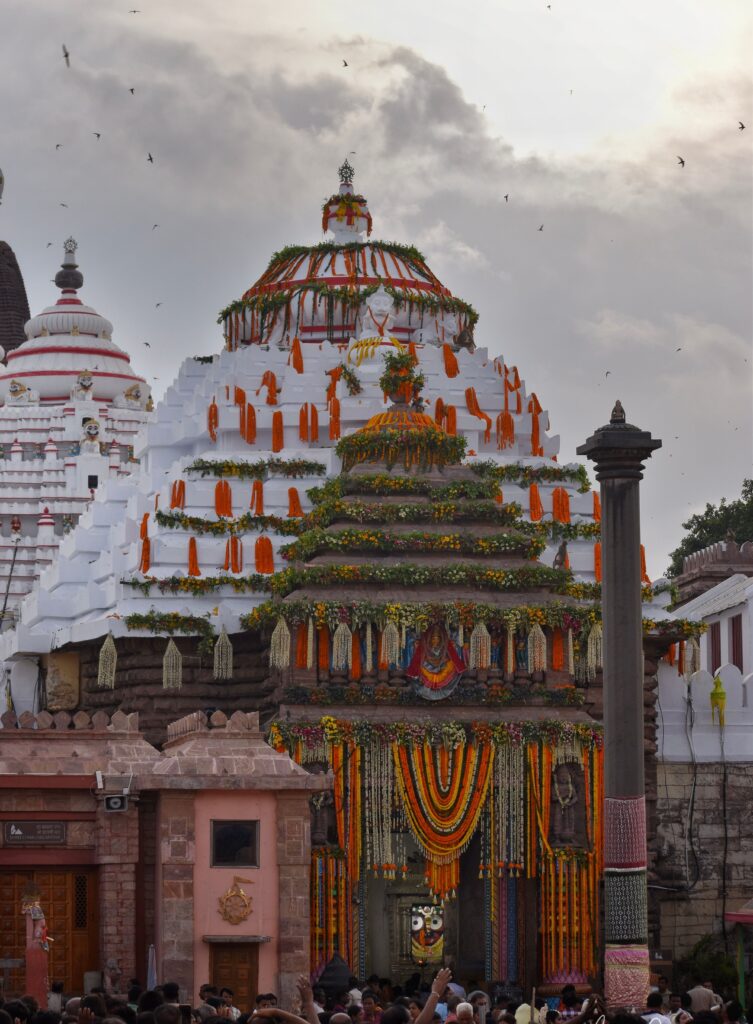
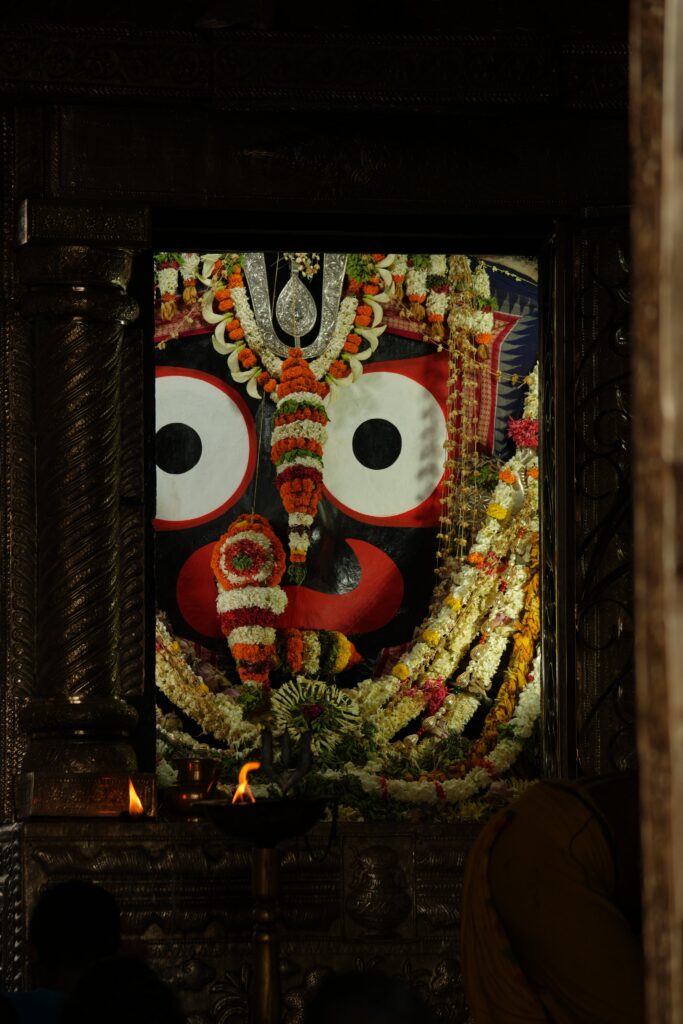
Another reason is emotional accessibility. Many Hindu traditions emphasize discipline, philosophical knowledge, ritual precision or renunciation. Jagannath devotion often emphasizes affection, surrender, and emotional closeness. The god is not merely worshipped; he is cared for almost like a family member.
This becomes most visible during the famous Ratha Yatra, the Chariot Festival. Each year, gigantic wooden chariots carry Jagannath, his brother Balabhadra, and his sister Subhadra through the streets of Puri. Thousands pull the ropes together. The gods leave the inner temple and come out among ordinary people.
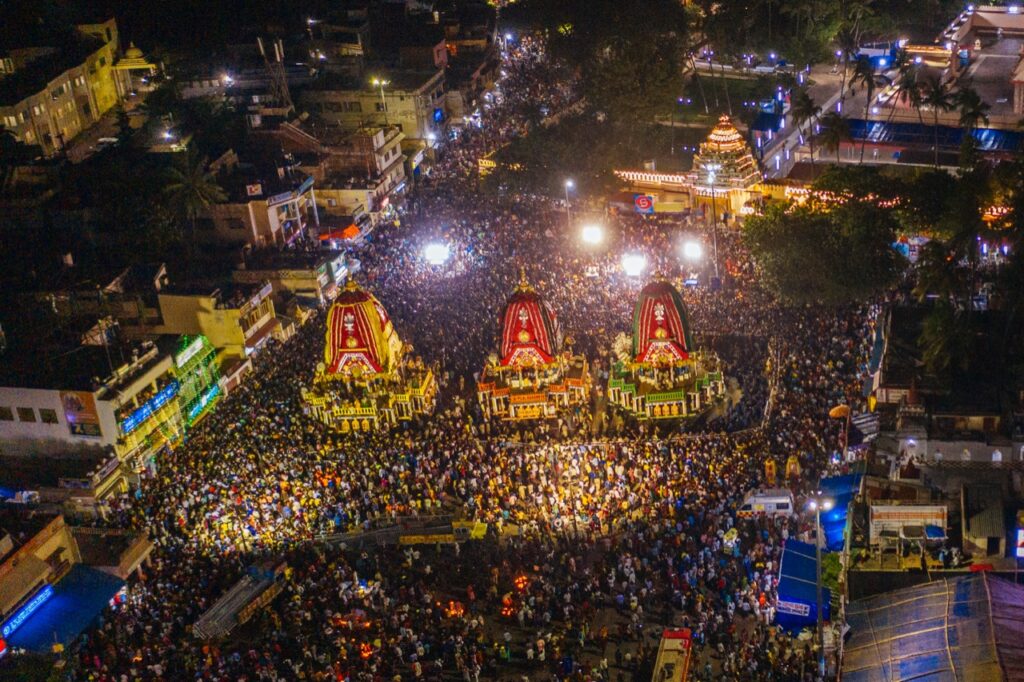
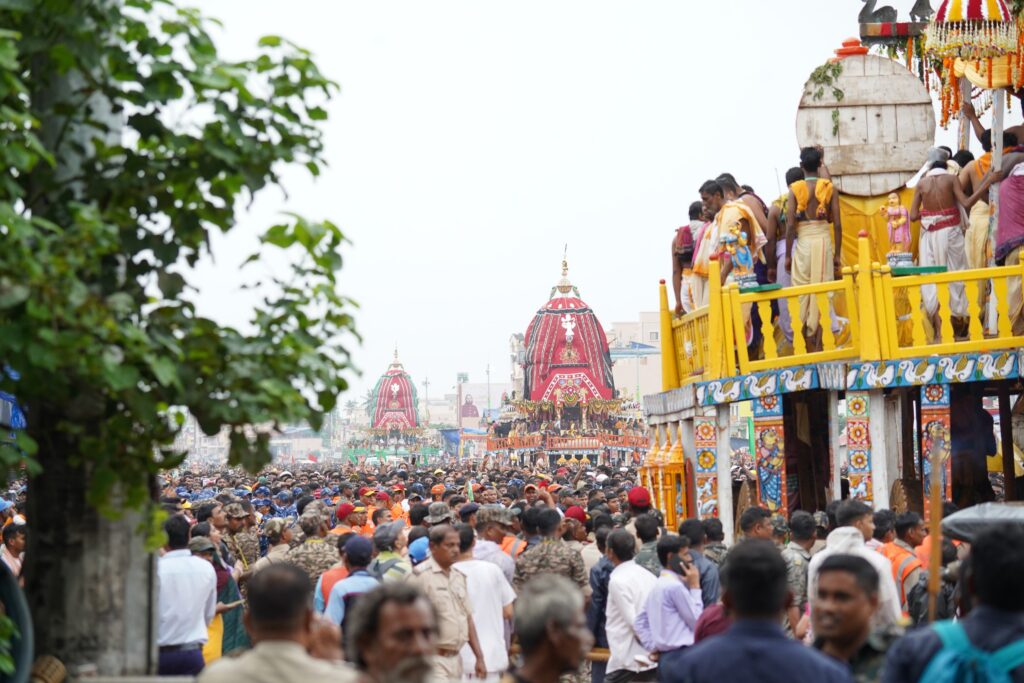
The emotional power of this festival has helped spread Jagannath devotion far beyond Odisha. In the sixteenth century, the Bengali saint Chaitanya Mahaprabhu became intensely devoted to Jagannath after visiting Puri. Chaitanya interpreted Jagannath through ecstatic Krishna devotion: overwhelming love for God expressed through singing, dancing and emotional absorption. Through Chaitanya’s influence, Jagannath became linked to the broader Bhakti movement, a major religious trend emphasizing personal devotion over ritual hierarchy.
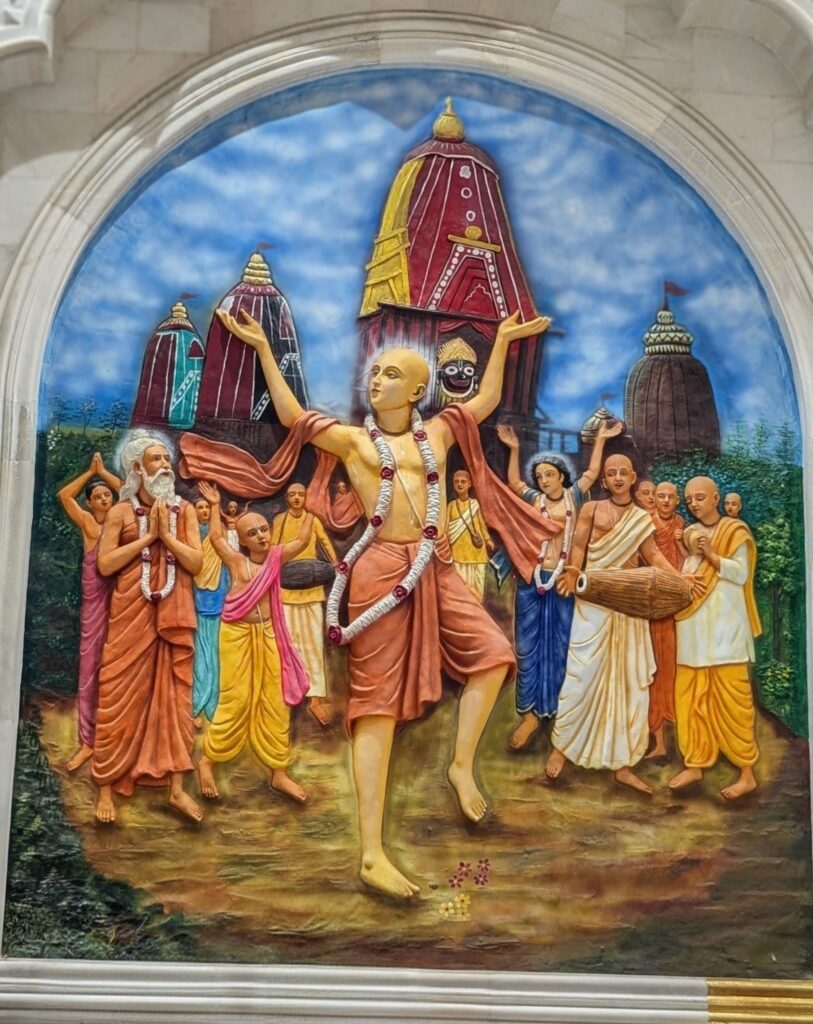
Most Jagannath devotees are still broadly Hindu. They often worship many gods, visit other temples, celebrate other festivals and participate in ordinary Hindu family traditions. Hinduism is generally pluralistic rather than exclusive. Worshipping Jagannath usually does not mean rejecting all other deities. However, Jagannath devotion often carries a slightly different emotional and philosophical atmosphere. There is usually less emphasis on rigid theological system-building and more emphasis on shared devotion, pilgrimage, music, sacred food and emotional connection. Jagannath’s worshippers frequently see him as unusually compassionate and accessible and they readily adopt these characteristics themselves.
There is also something psychologically distinctive about Jagannath himself. Many gods project perfection, power, beauty or moral authority. Jagannath projects acceptance. His odd form almost invites imperfect human beings toward him. Devotees sometimes interpret his wide eyes as endless compassion watching the world with discernment and expectations of deeper humanity, but lacking harsh, critical, punitive judgment. His unfinished body can feel strangely modern: a god who embraces incompleteness rather than hiding it.
This may help explain why Jagannath has appealed not only to traditional believers but also to reformers, mystics, poets and ordinary people uncomfortable with rigid religious elitism.
Jagannath endures because he occupies a rare middle ground. He is cosmic yet intimate, ancient yet strangely unconventional. He belongs fully to Hinduism while also seeming larger than any single doctrine. He emerged from tribal forests, absorbed Buddhist echoes, merged with Krishna devotion and evolved into one of India’s great sacred beings.
For believers, Jagannath offers radical belonging. The devotee does not approach a distant perfect being but a god who comes out into the streets, eats with humanity, changes bodies and looks at the world with enormous unblinking eyes, taking everything in. I think Jagannath is the type of god who brings peoples together instead of dividing them according to ethnicity, doctrine or ritual. Yeah, there’s this cool god I discovered outside of a hipster village in New Delhi. Let’s all hang out someday.

Daniel Gauss was born in Chicago and studied at UW/Madison and Columbia University. He has worked in the field of education for over 20 years and has published non-fiction in diverse publications such as 3 Quarks Daily, The Good Men Project, Bright Lights Film Journal, Back Page Football, Daily Philosophy, and others. He has had fiction published in The Hooghly Review, Home Planet News, and Mobius: The Journal for Social Change, among others. Daniel lives and teaches in China.
Writing Portfolio: https://sites.google.com/view/daniel-gauss/home
Instagram: @dgaussqu
LinkedIn: Daniel Gauss
Featured photo by Susmoy Dhaka TV (Pexels)