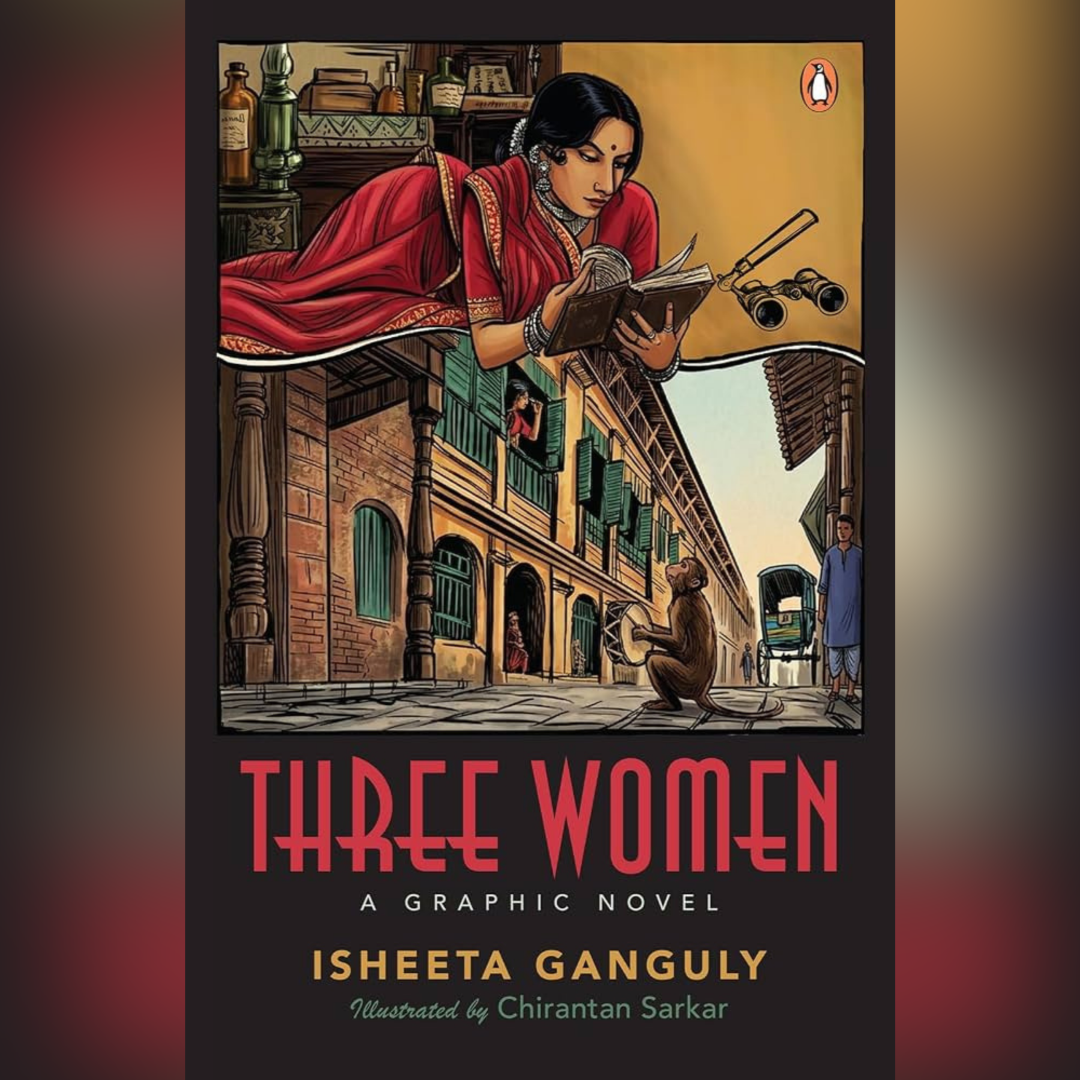
Three women, one real as far as history is concerned and the other two drawn from the pages of Tagore, inspired by that real woman—the notun bouthan who was Tagore’s muse and who died tragically. However, Isheeta Ganguly’s graphic novel gives their stories a new twist by introducing Kadambari as a ghost from the 21st century who has returned to tell Charu and Bimala not to make the same mistakes that she did. Charu and Bimala are, of course, fictional recreations of Kadambari, and it is Ganguly’s innovative take on Tagore that makes this graphic novel very different from conventional retellings.
The story begins with Charu, soaked in her love for Amal and convinced that love is the only way she can survive her solitary existence and her husband’s neglect. A modern Kadambari sweeps into her life and lectures her on the inadvisability of being a man’s plaything. She proceeds to tell Charu that the rules for women have changed and that if Charu thinks she is a nobina, as per Tagore’s description, she had better truly become modern. Kadambari returns equipped with a cosmopolitan viewpoint and a rulebook for what the woman of the 1990s should be.
While being a critique of relations between men and women, Three Women also requires some understanding of Tagore’s texts and his relationship with his bouthan. Bengali words and phrases are slipped naturally into the text, creating a layered narrative that speaks simultaneously to readers familiar with Tagore and to those encountering these characters for the first time. Adapted from Isheeta Ganguly’s dram-com musical Three Women: A Musical Theatre, this graphic novel offers a witty and provocative reimagining of Tagore’s heroines.
The story also looks back at Bengal’s Renaissance period, when women were beginning to enter public life but remained constrained by social expectations. Charu discovers her identity as a writer, while Kadambari herself was known to write and participate actively in the intellectual life of the Tagore household. Ganguly’s interpretation suggests that the seeds of modern female selfhood were already present in these nobina women, even if society was not ready to acknowledge them.
Bimala enters the book in the second act—the graphic novel is divided into acts in keeping with Ganguly’s play. She, too, is torn between two men, but in her case she has the ideal, understanding husband while the other man claims to be a passionate swadeshi patriot with a keen eye on Bimala’s golden guineas. Nevertheless, she is captivated by the romance of revolution and remains blind to her lover’s shortcomings until it is too late.
At one point, both women turn on Kadambari, feeling that she has no right to preach because she escaped from her own circumstances through suicide. Their anger forces Kadambari to confront her own choices and adds emotional complexity to what might otherwise have become a straightforward feminist intervention.
The graphic novel does not idealise its central figure; instead, it allows her contradictions and vulnerabilities to remain visible.
The last act teleports the women to the 21st century, where they discover new possibilities and alternative lives for themselves. Yet they also arrive at the sobering conclusion that nothing has really changed. Women may now have careers, greater freedom and independent identities, but they continue to negotiate expectations, relationships and societal pressures. Life has become more liberating in some respects and more stressful in others.
It is this comparison between past and present that gives Ganguly’s graphic novel its distinctive perspective. One could describe it as Tagore meeting Sex and the City, though beneath the humour and irreverence lies a serious engagement with women’s agency, desire and selfhood across generations.
Underlying the entire work is Ganguly’s theory that Rabindranath Tagore became the poet and writer he was because of Kadambari. His songs, poetry, novels and even paintings were, in some sense, sparked by the grief of her death. She was a mother figure, a sister, perhaps even a romantic companion—all rolled into one. Her loss created a profound sense of abandonment that haunted Tagore until the final days of his life. Ganguly takes this idea a step further in her fictional recreation. Here, Kadambari comes to realise that her death was not in vain; that the grief it generated helped shape the creative genius that Tagore became for the world. In that sense, the graphic novel is not merely a reimagining of Tagore’s heroines but also a meditation on the enduring power of absence, memory and artistic inspiration reinforced by Chirantan Sarkar’s striking illustrations.
Three Women: A Graphic Novel (Vintage Books, 2026) is available here.

Born in Allahabad, schooled for a time in the UK, Anjana Basu has to date published ten novels and two books of poetry. Her novel Curses in Ivory was published by HarperCollins in 2003. In 2004, she was awarded a Hawthornden Fellowship in Scotland, where she worked on her second novel, Black Tongue, published by Roli in 2007. She began writing for children in 2010 when Roli brought out Chinku and the Wolfboy. Her Jim Corbett’s ghost series for TERI deals with big cat conservation for children—the fourth in the series, Hide and Seek Tiger, was published in June 2019. Conspiracy of Aunts, her first adult novel after years, was brought out by Readomania in the same month. Her byline has appeared in Outlook and Outlook Traveller. She has worked on the dialogues for the Amitabh Bachchan starrer The Last Lear, directed by Rituparno Ghosh. Anjana Basu lives and works as an advertising consultant in Calcutta.