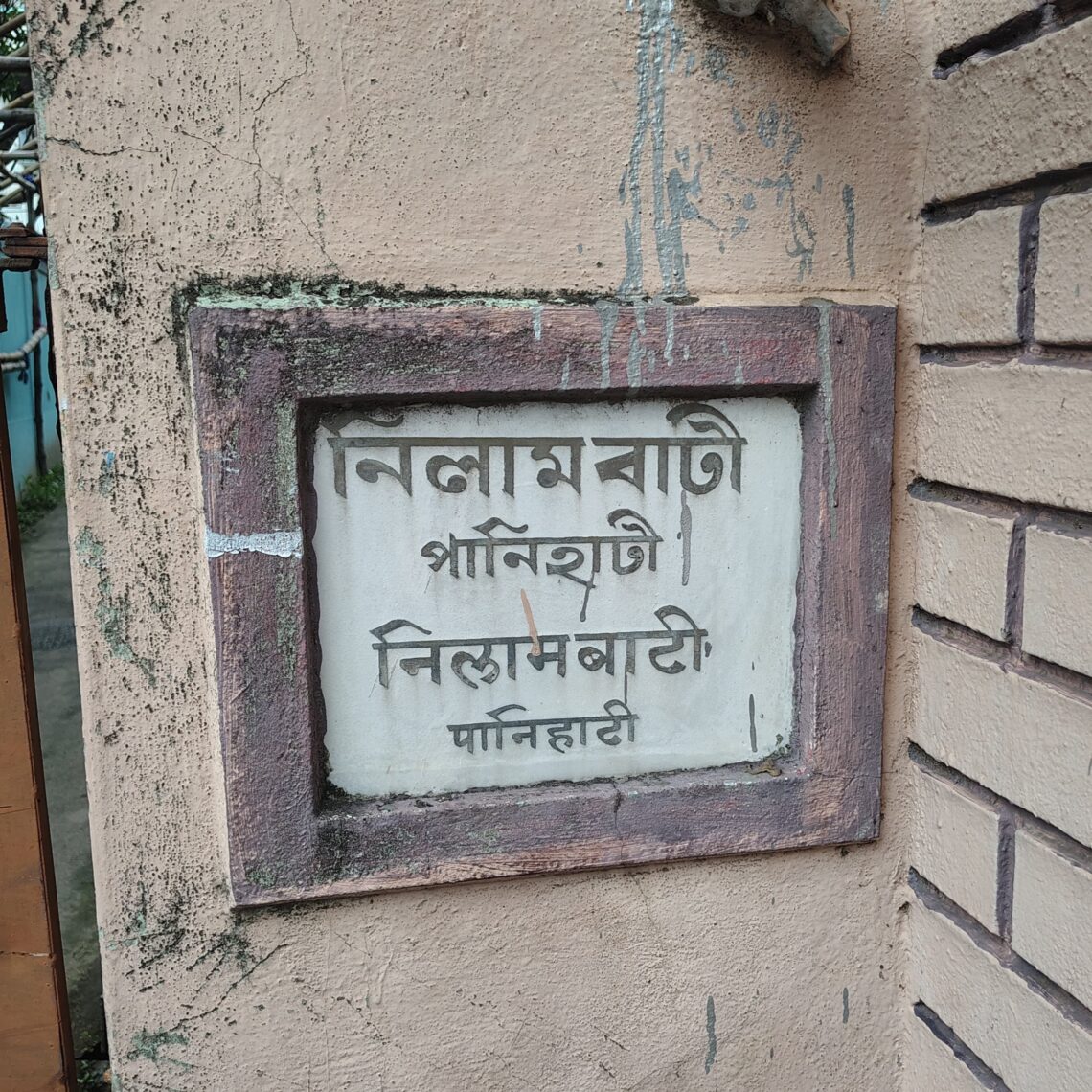
The address read, in proud Bengali script:
নিলাম বাড়ি, ব্যানার্জী পাড়া, পানিহাটি, সোদপুর
which would read in English as:
“Nilaam Bati, Banerjee Para, Panihati, Sodepur.”
The door number? A riddle. Just the lonely digit ৫ (5), wedged between two missing numbers. The nameplate, once elegant black on white marble, had weathered into a mournful clay-grey, still clinging to a crumbling pillar like a loyal sentry refusing to abandon its post.
An architect might mentally reconstruct the gate as something grand and ornate. But to ten-year-old me, it felt like the toothless mouth of a haunted house. There were no boundary walls to demarcate where the land ended. Only a hyacinth-choked pukur (pond) marked the edge of the Banerjee turf. A jagged path of broken stones led to a central courtyard, framed on all sides by weary wooden balconies, their railings drooping like old men nodding off mid-conversation. Tufts of dry grass poked through the cracks in the ground like ancient white beards; perhaps belonging to my long-departed ancestors, ushering me in with a ghostly chuckle: “Atta girl… so you made time to check your roots.”
The visit came about during an unplanned trip to Calcutta. Thus began my pilgrimage to the enigmatic Nilaam Bari, home to generations past, my great-grandfather, his father, and whoever else came before them. A train from Sealdah Station took us to Sodepur, followed by a cycle rickshaw ride that dropped us at the gate.
“But who owned the house before great-grandfather?” I asked Baba, half-expecting tales of noble warriors or secret zamindars. I could tell he was searching for an answer. Then, ever resourceful, he pulled out a fragment of ancestral lore passed down by Thakurma, my formidable grandmother and the sole living repository of our past.
“As the name suggests,” he said, “Nilaam means auction, Bari means house. Your great-grandfather bought it at an auction. And that’s how the house got its name. Nobody knows who lived there before.”
Just like that, the past was scrubbed clean. As though history itself had been put on mute.
But Baba shared that Panihati wasn’t some nameless hamlet. Our ancestral stomping ground has been mentioned in 13th-century texts. Nestled along the banks of the Ganges, it was once Pannyahati—an “emporium of merchandise,” a thriving hub of trade and tradition. Over time, it evolved into a typical Bengali township, its paras (neighbourhoods) defined by caste and profession. Ours, Banerjee Para, was the stronghold of the Kulin Brahmins, a lineage considered elite and erudite. These Kulin Brahmins were prized as grooms for girls from upper-caste Brahmin families.
It was Thakurma’s tales that made me eager to see for myself the house that hosted the legendary Satyanarayan Puja. A ritual observed unfailingly on every full moon. As she described it, the entire neighbourhood gathered outside our once-grand, ivy-draped gate to hear my late grandfather, Makhanlal Bandopadhyay, recite the katha in a voice that rumbled like monsoon thunder. On Mahalaya, his chanting of the Chandi Path was nothing short of a spectacle. So powerful that people came from far and wide just to listen.
After the rituals, he would distribute prasad himself, while the women of the household, Thakurma included, remained behind the veil of purdah, bound by the unbending customs of their time.
I never met him, but I’ve come to know him through a sepia-toned, gilt-framed photograph I inherited by chance. He appears there, ramrod straight, unsmiling, his eyes seeming to pierce right through you. Unyielding, stern, almost accusatory. Even now, when I look at that photograph, I feel a chill travel down my spine, as though his gaze transcends time, silently judging me for straying from our Brahminical traditions. On every Mahalaya, I still offer prayers to my ancestors, him, and my parents, but I cannot shake the feeling that he watches me, his eyes heavy with silent reproach.
That, then, was my introduction to Nilaam Bari: not just a house, but a relic, a time capsule, and, oddly enough, a character in its own right.
And at its core stood Thakurma. The iron spine of the household.
She entered Nilaam Bari at the age of twelve, a child bride in red silk, handed the keys to a household and a future she barely understood. While her peers played hopscotch, she juggled rituals, responsibilities, and, occasionally, secret games with her stepdaughter when no one was watching.
She bore five sons and one daughter, all born and raised within those walls (except Baba, who was born in Benaras). The deliveries were overseen by matronly aunts, earthy midwives, sacred chants, and generous helpings of turmeric.
Before I go further, I must recount a few stories she passed down. Fragments that have stayed with me.
She often spoke of her bridal jewellery box, hidden ingeniously behind the puja altar. Two bricks had been carefully pried out, creating a secret cavity just large enough to conceal the box; a perfect disguise. During pre-Independence raids, when homes were searched and valuables seized, her jewels escaped confiscation.
During that period, Nilaam Bari had acquired a new identity: a hotbed of sedition. Under kerosene lamps, Baba and his friends plotted in their own small ways to shake off the British yoke. Printed inflammatory pamphlets meant for distribution were stored dangerously close to the family altar.
One evening, as the story goes, sharp knocks echoed through the baithakkhana (meeting room). British loyalists were at the door, tipped off by British loyalists. Quick as lightning, Thakurma had gathered the leaflets into aluminium buckets, covered them with dirty laundry, and draped in a widow’s white walked past the officers to the pukur (pond), calmly disposing of the evidence beneath lily-choked waters. Baba and his friends were spared, thanks to her nerves of steel.
One story that always unsettled me was about the snake that lived near the Tulsi Manch. Harmless, she claimed, appearing only on full moon nights to drink milk left out in a brass plate. I suspect that detail was added more for dramatic flair than truth. The Tulsi Manch I saw as a child looked more like the moss-covered stump of a dismembered prehistoric giant.
Baba, however, had a different theory. He believed Nilaam Bari was cursed. Not in a dramatic, cinematic way, but in the slow, lingering manner in which injustice seeps into the soil and never quite leaves.
According to him, the house was inhabited by the dissatisfied souls of past generations. Those cheated out of their rightful share of land and home, condemned to roam in restless protest. Baba spoke of nights when the air stood unnaturally still. Yet voices drifted in on invisible currents from the direction of the old bael (wood apple) tree, heavy with fruit. The sound of loud thuds in the darkness, followed by the soft, wet sound of flesh bursting open, he surmised, were the ghosts of his ancestors, throwing the ripe fruits at each other, over unsettled family feuds. Proof? No one ever picked those fruits. Nor were the sacred leaves plucked for offerings to Lord Shiva.
Thakurma dismissed it all as Baba’s imagination. But perhaps fear is hereditary. Even as a child, those stories lodged themselves under my skin, making it crawl whenever I stepped into Nilaam Bari, as though something unseen was watching, waiting, remembering.
From those days of secrets and stories to my thirties, the house slowly began to give in to time. Yet it crumbled with a quiet dignity. More gracefully than most humans ever manage.
A House in Decline
After Independence, members of the third generation began to leave, migrating to the city. Baba found work at Dum Dum Airport, and the family gradually dispersed in pursuit of opportunity. Two brothers held on to Nilaam Bari, though parts of it were abandoned. The north and west wings collapsed, surrendering to time. Two of my kakus (Baba’s younger brothers) built a modern home nearby, partly to keep watch against illegal claimants.
In 1979, when Thakurma’s health started to decline, Nilaam Bari was reopened, renovated and briefly revived to honour her final wish: “I will breathe my last in my husband’s bhita. (home).” After her funeral, the house fell silent once more.
Years later, it reopened again. This time for an uncle battling terminal cancer. Another facelift followed: electricity, running water, a modern staircase. He passed away there in peace and was cremated at the same ghat as his parents.
My last visit came after that.
We drove through the narrow lanes of Banerjee Para. The gate was now choked with rubble, but a newly built staircase offered access. A pale, recently widowed kakima (aunt), greeted us with quiet warmth. She insisted we stay for lunch. We did. The taste of kasha mangsho (slow-cooked mutton curry) and luchi (deep-fried Bengali flatbread) served on heirloom brass plates still lingers.
The Last Chapter
A few years later, the news came: Nilaam Bari had been sold.
The land was parcelled off to a realtor, and the proceeds distributed among the surviving wives. Baba and my kakus had already passed away. The beneficiaries were the surviving wives, two kakimas (aunts) and Ma. Allegedly, Baba had long ago signed away his share to his unmarried, disabled brother, who in turn willed it to his nephew. So, Ma received nothing. A contentious matter that was never contested by my sibling or me.
I have not returned to see what stands there now. I heard through the grapevine that apartments rose from the ashes.
All I know is this: a home that once housed six generations, hosted pujas, sheltered revolutionaries, raised children, buried legends, and fed strangers vanished without a headline.
And yet, when I close my eyes, I hear Thakurma’s giggles. I see her braids flying as she plays hopscotch. I smell the incense she lit each evening. A potpourri of scents fills the air: fried Ganga hilsa (fish found in the Bay of Bengal), brass polish, damp earth.
I see her again, draped in white muslin, a distant look in her eyes, grieving for Nilaam Bari.
Sometimes I wonder if Baba was right. Why else did the house fall to greed and neglect, instead of slowly exhaling its grief into the earth? Perhaps the restless souls he spoke of finally found release when Nilaam Bari was dismantled. Brick by brick, its land measured, priced, and sold. Or perhaps they were only displaced once more, rising with the dust as apartments clawed their way skyward.
I imagine the old bael tree, if it still stands, shedding fruit into the night, unheard, unacknowledged. No voices left to listen. No one left to be afraid.
And yet, somewhere between what Baba feared and what others dismissed, I feel it still:
That certain homes do not vanish when they are demolished.
They linger, in unease, in silence, in memory.
In the quiet knowing that not all debts of the past are ever settled.
Author’s Note: Some stories attached to Nilaam Bari are based on hearsay and tweaked for dramatic effect. There is nothing to corroborate these, and they are entirely the memories I have of the ancestral home, albeit stretched to fit into the essay.
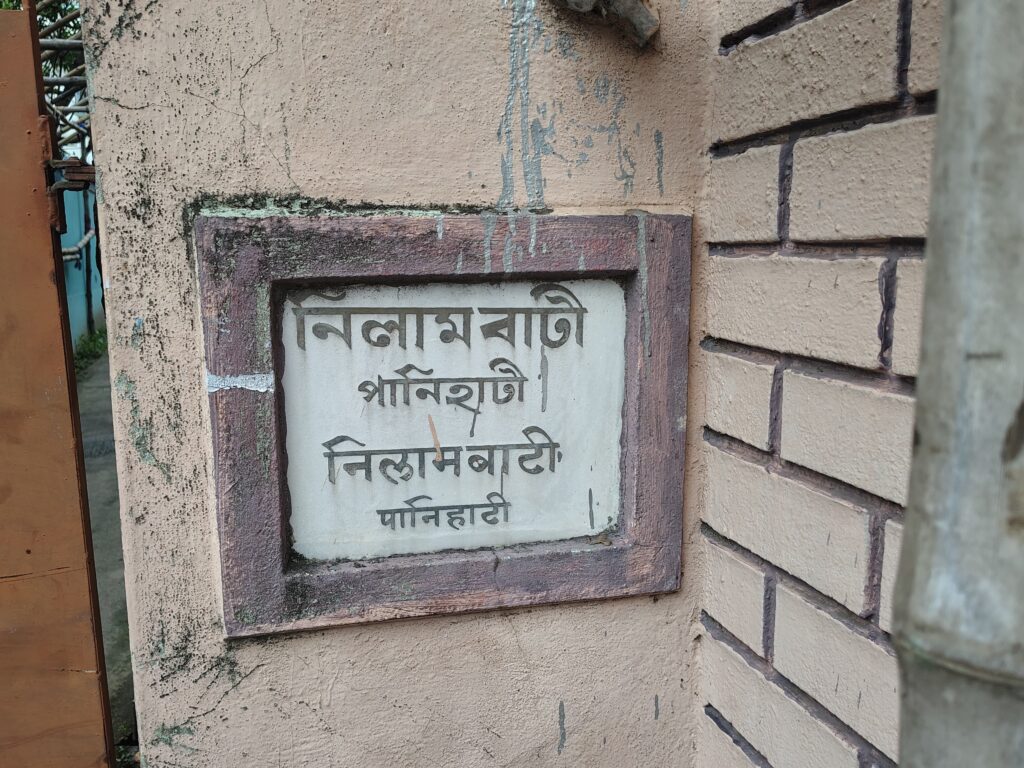
Editor’s Note: It was Sunday evening, and we still didn’t have a photo to accompany the essay. We asked Snigdha. She said she had last visited Nilaam Bari in the early 1990s and has no photos of the old house. It struck me then that the address mentioned in the essay could be close to my ancestral place on my father’s side. I called my cousin Gayatri in Panihati and asked her if she could run an errand for me. Gayatri was quick to oblige and sent me a photo of a nameplate that still stands. Snigdha, in her 70s, is happy to have “a fresh surge of memories.” For me, it is another memorable day in an editor’s life. There’s no money in this gig. But I guess some gratifications come with no price tag. — Tejaswinee Roychowdhury

Snigdha Agrawal (nee Banerjee) was raised in a cosmopolitan environment, with exposure to Eastern and Western cultures, imbibing the best of both worlds. Educated in Loreto Institutions run by Irish Nuns, she developed a love for writing from childhood. She holds an MBA in marketing and has over two decades of experience working in the corporate sector, which has refined her writing skills in both commercial and artistic contexts. A versatile writer, she writes across genres, including poetry, prose, short stories, and travelogues. She is a regular contributor to online journals published worldwide. A published author of five books, the latest, Fragments of Time, is a memoir written in a simplistic style. It is available on Amazon worldwide and Flipkart. She was nominated for the Pushcart Prize in 2024 for Poetry.
FB: Snigdha Agrawal
X: @SnigdhaAgrawal1
LinkedIn: Snigdha Agrawal
Threads: @chunnuchoku
Website: https://randomramblings52.wordpress.com