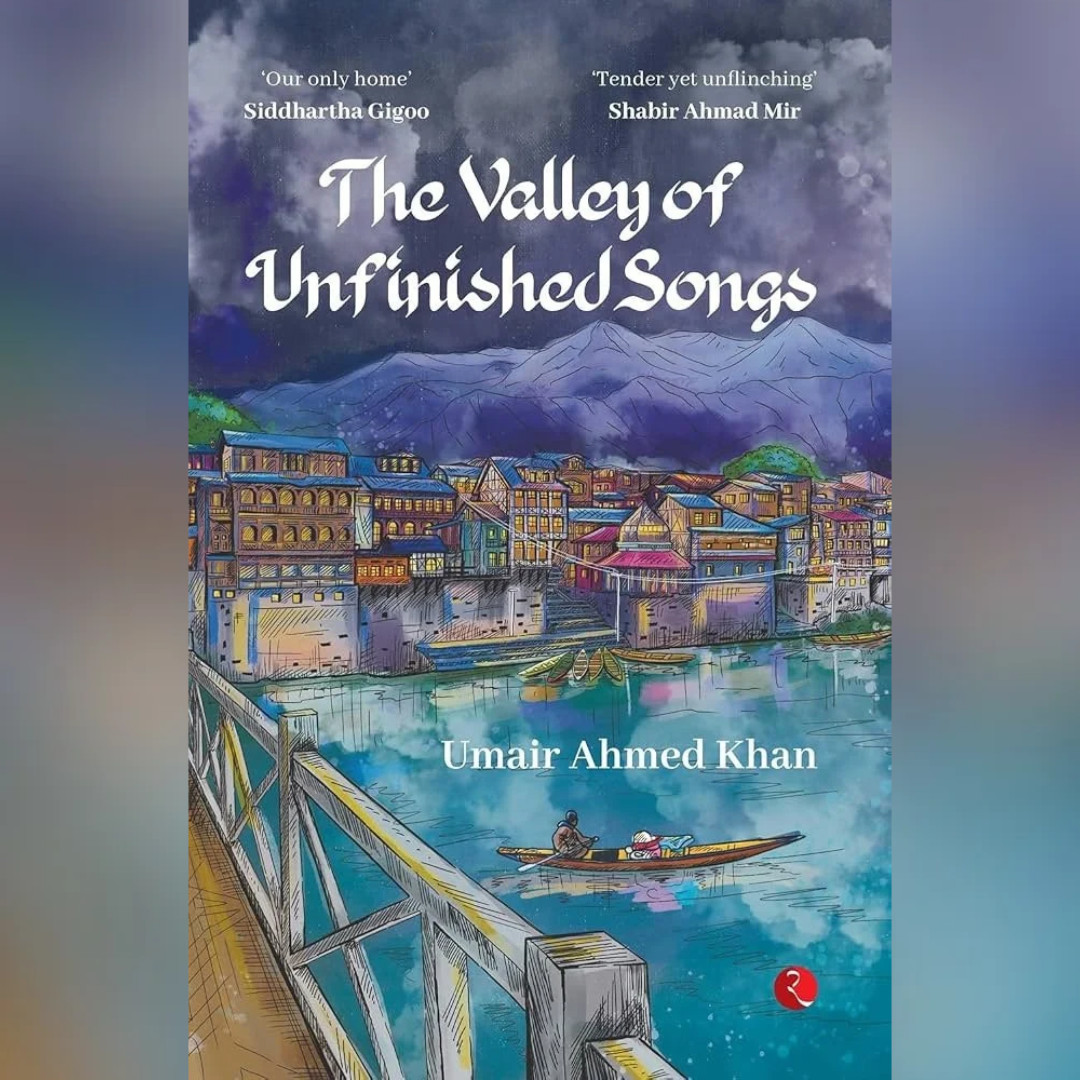
There are some places that leave us before we leave them. There are places that gradually leave us over the years until one day we realize that the leaving was not an event, but a state. Kashmir is such a place, suggests Umair Ahmed Khan in The Valley of Unfinished Songs. It exists in one’s geography but also in their inheritance. A landscape enfolds inside the body. The buildings in the city all have interesting history which is shared through its stories.
Winter is never just weather in this place. Chillai Kalaan refers to a period imagined as a season of endurance, when the cold from outside presses into the warmth of the house. The Bukhari is ablaze. the kangdigrows happily under the pheran. Kehvais a beverage served in a cup. Experiencing life is a daily chore. Despite this warmth, discomfort comes across as the novel states, “even silence feels cold.” In Khan’s Kashmir, silence is never empty. It consists of unutterable things.
You can already see it at GawKadal. Outside the wooden house, history is gathering a terrible momentum; inside, Iravati is making kehva. Through the radio, which is one more voice and connection instrument, varied and eclectic sounds of the city come through. Khan juxtaposes tenderness at home and political rupture, not allowing them to be independent of each other. The streets experience many historical events. However, the deepest impact of history happens at kitchen tables, bedrooms, or parents changing their gestures.
Iravati is the novel’s great keeper of silence. She copes by not remembering too closely. The past has turned into a barricade to keep the worst out, so it stays out. Simply denying something does not necessarily make the memory vanish. It adopts a different form. An attitude of reserve emerges and is passed on to the next generation.
This silence is inherited by Kanval without original catastrophe. This makes her feel oddly liberated. She possesses the capacity to inquire what her mom doesn’t have the ability to ask. She is able to examine the closed doors of family history and say, Open them. Her insistence on looking back is not a longing for the past, rather it is a quest for clarity. This perspective on acceptance is emphasized in the present instance, for, “Acceptance was the path to liberation.” It means not allowing what happened to be a covert force.
The house, old and rambling, becomes a physical expression of the strife. When Kabir and Kanval arrive at the deserted house, they see no well-kept paradise. They find ruin, absence, and objects expecting them. The house can be seen as an archive, albeit an intimate one. The furnishings and documents don’t communicate with that official history. The presence of wood, dust, portraits, recalled meals, as well as names.
Kabir’s identification after so many years is one of the mildest encounters with the past in the novel. She imagines him even before the actual meaning of him. For Kanval, this acknowledgment is a revelation: her mother came from a world of warmth she almost completely erased. Hospitality manifests the power of memory. A meal can recall things a history book forgets. A friendship’s shape can endure after its occupants have been removed from its house.
Kashmiriyat takes on the most convincing meaning. Instead of an idea, acts of care are offered along with actions such as feeding someone, opening a door, composing a family, and sharing a table.
The Sunday meals and wazwaanare not decorative details. They comprise the elements that make up a social world where distinction does not destroy intimacy. Khan discovers companionship in everyday life. Perhaps this is the reason why its absence hurts.
Another type of memory comes from the Jhelum. It meanders through the city, as if it has conjured a time machine. Some locations are being linked to one another and also separated from other locations. This river flows outside of politics and does not care what you call its banks. When the river rises, you think buried things may return. The comparison is quite clear: you may keep it bottled for now but not forever.
Kanval’s unfinished writing on missing people has a structure identical to the novel. She tries to use words to express absence and make the absent present. Her article is nonetheless unfinished and indeed, the larger history is also undone. The incomplete tune and the incomplete article are both part of the same moral universe. When the historical record has gaps that grief cannot fill the pages.
Kalsoom and Aariz make the question harder. Aariz comes back after decades while the landscape does when institutions don’t recognize him. The continuity established through pine trees, chinars, mountains and meadows are stronger than political papers. Nonetheless, it actually tells another truth: papers, citizenship, proof.
Kalsoom is at the painful crossroads of these two truths. Kashmir is the region’s but not hers legally; she exists in Kashmir. It’s a beautiful prison, she describes it, which is a contradiction of the novel how you love your country yet feel imprisoned in. Something like belonging without freedom, and beauty without freedom does not liberate.
Khan places music at odds with these legal and political definitions of identity. Music knows only the world. It moves quietly across national borders. Umika’s incomplete song is a kind of bequest; Armaan becomes the voice through which an interrupted intent carries on. In this sense, he richly complicates and deepens the novel’s exploration of sight: the person who cannot see conventionally becomes the person through whom others learn another kind of vision.
This difference is starkly highlighted with reference to Armaan’s experiences of Kashmir and Mumbai. For all his childhood, Kashmir has been about restrictions, ambiguity, uncertainty, and fear. In Mumbai, movement gets the character of freedom. Displacement can’t erase one’s past, even at Rouen. Armaan immortalizes his memories. Iravati supports those in need. The landscape outside continues to undergo changes, the inside does not. This could explain why silence is present in both the voice of the book and story.
Kashmir is a complete silence, recalls Armaan, during the lockdown. But against this silence, Khan places voices. Tarannum identifies Kabir, Kanval asks her mother, Kabir composes, Armaan sings. The story refuses to burn out as it makes its mark.
As a result, GawKadal is important to return to. Returning after thirty years, Iravati sees the bridge is different, the houses changed, and the familiar world reduced somewhat. Yet, another version of the place is kept in memory. While the present is different from the past, they are connected. Despite everything being different, the essence of what was is somehow still there in the strange mathematics of return.
It could be that the scenery isn’t the cause. It may be concerned with the relationship between landscape and memory.
A house lives as long as someone remembers it. The river exists in history because it is interpreted and remembered. A voice finds a song that it can endure. The novel’s incompleteness is no failure to finish it up. What one generation may be too timid or afraid to say, another might say. One generation’s inability to return to something may lead another to approach it in hope.
The Valley of Unfinished Songs essentially calls me to think of memory not as a museum but as living tissue: injured, developing, unfinished. Kashmir is no mere paradise, nor mere tragedy. In this geographical location, beauty and tragedy share a room, where hospitality can outlast displacement, where rivers can carry borders without bending, and where a song can break the silence of history.
The Valley of Unfinished Songs does not wait for an end, but for someone to listen. There lies the future of incompleteness. It is transferred from Umika to Armaan, Iravati to Kanval – from generation to generation. Perhaps the novel’s secret wish is that we do not need to repair the past in order to carry it differently. Sometimes, it is better to listen and let silence speak as we prepare for whatever is next.
The Valley of Unfinished Songs can be purchased here.

A postgraduate gold medalist in English Literature from the University of Kashmir in Srinagar, Wani Nazir, from Pulwama, India, is the author of the poetic collections, …and the silence whispered and The Chill in the Bones. Presently working as a Senior Lecturer in the Department of Education, Jammu and Kashmir, he has been writing both prose and poetry in English, Urdu, and his mother tongue, Kashmiri. Wani has poetry and prose in Kashur Qalam, The Significant League, Muse India, Setu, Langlit, Literary Herald, Cafe Dissensus, Learning and Creativity – Silhouette Magazine, The Dialogue Times, and elsewhere.