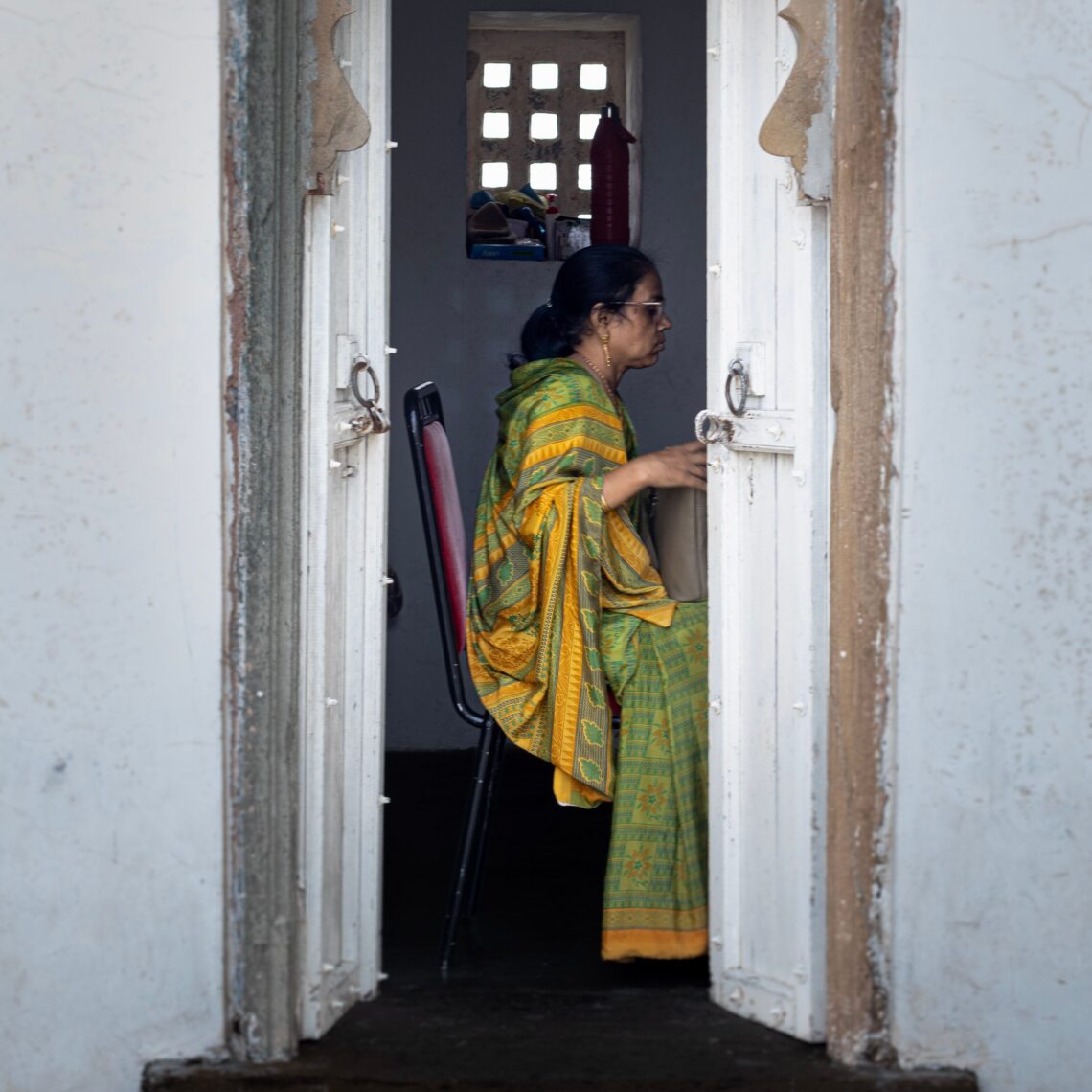
My mother. Yes. The one in the title.
Did she ‘work’? For money? No. She was, what we have magnanimously labelled a ‘Home Maker’. She had no money–of her own, that is. As a child, she had been taken care of. As a married woman, her husband fetched the bread, the butter, both literally and figuratively.
Where would she get any education about money? But then, my father died and she got the family pension. It came to her account. She was now in possession of money! She could spend it as she wished. But native shrewdness and a horror of overspending held the reins in check.
My mother kept track of all announcements of an increase in Dearness Allowance (Relief for pensioners). She would meticulously go around informing the other women in her group about the latest DA news.
She would make a beeline for the bank, to find out if the Dearness Relief arrears had been credited. Even the clerk at the counter started recognising her. She would call out, “No Madam, not yet.” Or it would be a smiling face, by which my mother knew the amount had arrived.
She loved to calculate how much would be due as arrears and by how much her pension would increase. The only problem was that she did not have a clear concept of where the decimal point should go in her calculations.
The DA increase is usually 3 or 4 per cent, and has to be calculated based on the basic pension given.
“Usha, come and check my calculations,” would be her command, the minute I returned home.
“Mother, let me have a cup of tea, at least,” I would protest.
But mother was not to be fobbed off with such excuses.
“Tea can wait. I think something is wrong in my calculation. How can I get so much money as arrears?”
I checked her notebook. (Yes, we maintained a notebook which held all the calculations. It was not used in a linear fashion. No, we were too creative for that.)
3702 x 3 = 11106.
“The amount looks to be high. Will I get so much?” Mother was aghast. She did not want too much money!
Then, I burst out laughing. Mother had forgotten to add the decimal point after multiplying the DA and her Basic. So she had come up with the figure 11106 which was more than her Basic pension and DA put together!
“Oh, Mummy, after multiplying, you have to place the decimal point.”
“Yes, I know. But I was not sure where to put it,” she replied.
The actual amount would be 111.06 rupees.
And this process was repeated every time there was an announcement regarding a DA increase.
One day, she was sitting mulling over her accounts. She had this beautiful habit of allotting certain amounts every month. The list included medicines, clothes, gifts and travel. The gifts were always in cash, given to me, my brother, and his two children. It was always in cold cash. She did not believe in wasting time and money on a gift which might, most probably, be rejected.
She told me, “Don’t think I depend on you. See, I use my pension wisely and don’t have to ask you or your brother for anything.”
Not that my brother or I had ever complained about anything.
Just to needle her, I asked, “What about house rent, Ma? You haven’t allotted anything towards that.”
“Oh, why should I? That is your problem. Your organisation provides quarters. I just live with you.” And she smiled triumphantly.
She was grateful to the government that it provided for her and she did not have to live at the mercy of her children. She did not realise that the pension was insufficient for any individual who wanted to live alone!
And one day she dropped a bombshell.
“You know, Usha, I have given you twenty lakh rupees over the last twenty-five years.”
I was flabbergasted, gobsmacked, call it what you will. Being my mother’s daughter, I spent the whole day worrying over what had I done with her twenty lakhs. How could I possibly have spent such a vast amount? And on what? I was not a spendthrift.
And it was the next day it dawned on me! My mother had calculated her pension for the last twenty-seven years or so. She had forgotten to subtract the money she had spent on her medicines, her clothes, her travel. I had to gently explain to her that she had used her money for whatever purposes she had felt were important.
“Oh, is that so? Is that how I spent all my money?”
“Yes, Ma,” I replied. My heart felt relieved. But it also made me realise that Mother was slowly forgetting. Nothing serious. But the nitty-gritty details of her finances were getting eroded.
Till the end she followed her budget. Fixed amounts for my brother, his children, and me for birthdays. Wedding anniversaries were not important. If a God had to be cajoled, she offered a coconut and 1.25 rupees. This amount only increased in small bits. It finally reached the princely amount of 11 rupees! Even a God could not expect lavish expenditure!
She even learned to save. Fixed deposits were her favourite method. Initially, she had asked, “Why should I save? I get a pension every month!”
Later she realised that expenses keep mounting, but income does not keep pace.
Just before her hospitalisation, she stated, “Use my Fixed Deposits for the operation.”
As her stay in the hospital extended week by week, her only concern was whether her savings would be enough. I assured her that it would be more than enough.
For a woman who had no exposure to handling money or to budgeting, my mother had come a long way. And she left lessons for her grandchildren. They still remember her budgeting and her calculations. And her son and daughter still maintain notebooks of accounts.

Usha Aswath Iyer is a post-graduate in English and Education. She has worked as a teacher, Principal, and Director in Kendriya Vidyalaya Sangathan. Her collections of short stories, titled The Quilt and Other Stories and The Last Laddoo-Colours of Childhood, have been published.
IG: @usha58iyer
Featured photo by Anshul Kaushik (Pexels)