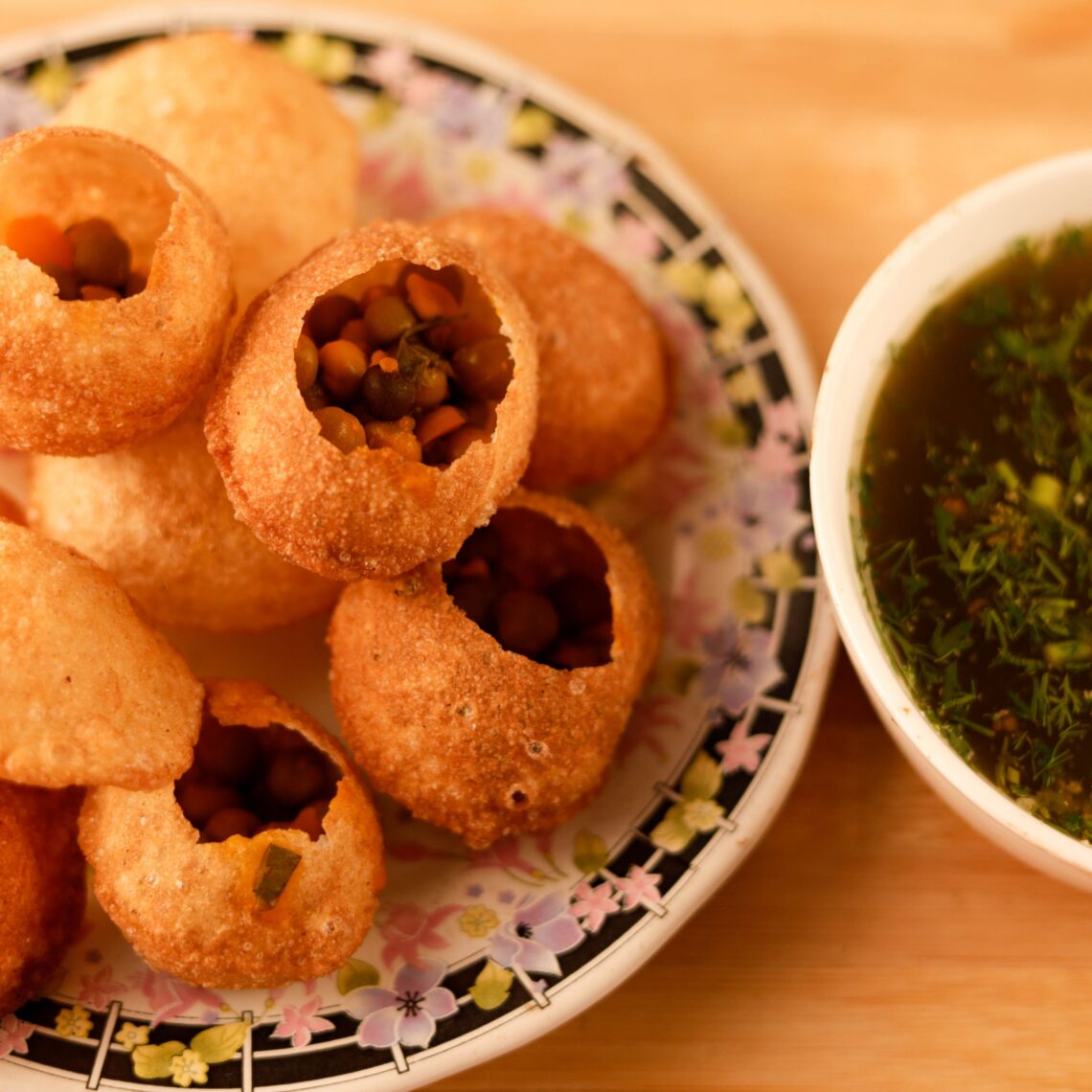
For the Love of Pani Puri
You could tell the woman wasn’t from Pune right away.
I’m not a local either, and even I could tell.
Even before she opened her mouth and an American-laced Hindi popped out, drawn out and uncertain.
She wore a white, untucked shirt, dark jeans folded above her ankle, and neat, dark red lipstick. She carried a big tote bag.
It screamed ex-pat.
But she really gave it away when she asked the pani puri wala bhaiya (pani puri vendor) what kind of water he used. I shall hereon refer to the pani puri wala bhaiya, whom I hold in much more regard than my bhaiya (brother), as PPWB.
For the uninitiated, pani puri is a popular Indian snack consisting of a hollow, crisp sphere which is broken to add spiced potato and mint water. Anyone who has eaten it on the street knows it’s much better than the one at restaurants.
I cringed inwardly; I’d been eating at this stall every time I visited Pune, which was about once in six months. So far, it hadn’t affected my morning expulsions, not substantially anyway.
But if PPWB said something undesirable, it might affect me.
I’m aware of the nocebo effect. For example, the day after I’d taken my first Covid shot, I read that one of the side effects is vomiting. And sure enough, ten minutes later, I was expelling coconut water in an undignified manner.
So, now I avoid reading the side effects of medicines.
Luckily, the PPWB whispered his answer.
Anyway, after her extensive enquiry, the woman began eating. This woman, who wasn’t local, wasn’t new to pani puri. She didn’t even have to taste all the flavours to know which ones she wanted. Her husband managed to eat five puris before raising his hand in surrender.
Now, anyone who has eaten pani puri one-on-one knows that it is no small feat to keep up with the PPWB’s speed. But the woman stood her ground.
I don’t know what the PPWB said, but the woman was eating puris like we were going to run out of them. I wondered if she’d been sent as part of the Clean India campaign to clear out all the street food stalls in Pune.
Her husband watched her clutching his paper bowl in inaction. Perhaps wondering why she didn’t eat the food he prepared with that much gusto.
Her world had narrowed to her and the hand that fed her.
Since it’s impolite to stare, I’d taken to watching the jewellery ads splashing across the screens behind us. I ranked each piece of jewellery out of ten and told my brother what they could do to improve. He nodded but I think it all looked the same to him. He had the same glazed look as I did when he’d explained bowling variations.
Now, I refer to pani puri as ‘Papu’ from the first two sounds of its name. It’s how acronyms are derived in Marathi, so Purushottam Laxman Deshpande becomes Pu La Deshpande.
Papu also means ‘baby’ in Kannada. I felt as possessive of pani puri as one might be of their child, or the baby you end up with after late-night conversations.
When was this woman going to finish eating? Would there be any puris left by the time she was done?
The woman finally held up her hand. She gave a loud, obvious burp. Luckily, we weren’t standing close enough to be assaulted.
We ate in silence, except for the perfunctory widened eyes and approving nod at the moment you bite into the first puri and the salty, tangy and spicy water bursts into your mouth. The chatpata potato filling and crunchy diced onion elevated the experience.
As I gestured for another round, I heard a not-so-silent exhale from the woman who’d materialised next to me. She was waiting for her turn.
I concentrated on the puris.
Swearing: An Act in Nine Parts
1. The older, precarious girl spouts the F word like she’s stubbing her toe every time she opens her mouth. She’s the coolest person I know.
2. The rebellious in my class asks the teacher the meaning of the ‘F word’. The teacher threatens to slap her.
3. A temp teacher uses the F word while shouting at a boy. Maybe it’s okay for grown-ups to use it.
4. The teacher says no one in the class scored more than 90%. I mouth: What the F?
5. My mother calls me the B word for throwing up on the floor.
6. The girl’s poem is filled with swear words, like her tattooed arms and blood red lips. I listen to it every time I think about my love life, or mostly, the lack of it.
7. My father is calling for me after calling for my brother twice. Upset about leaving my phone, I scream at my brother to ‘get the F up’.
8. The young man doesn’t value his life. He jumps in front of my car just as I’m ready to accelerate. I value my life, my limited freedom and my driving license. So, I swear, ignoring my mom and brother (who is probably used to it). My mom is upset for two whole days. I think it’s ridiculous to expect someone to go a quarter century without swearing.
9. I write a poem about swearing. For my mother’s sake, I don’t use any swear words. Even though I want to tell her, it’s okay for grown-ups to swear.
Aditi Surana writes observational pieces about being a woman, love, and lessons from everyday life. Please be careful about what you say/do in front of her, or she will write about you. Her work is published in Daijiworld, CafeLitMagazine, and on Instagram under @writin_gal.
Featured photo by Shahbaz Ansari (Pexels)





Very nice! Loved the PaPu observation!
Swearing is an expression of anguish. It lets out the negativity. It is cool as long as it does not involve innocent women who happen to be related(generally mother and sister) to the troublemaker/ instigator.
Thank you for your kind words Prajakta!