Anasuya Basu
It is hard to come back to reality after finishing Girl in White Cotton. It lingers on, absolutely not with a good aftertaste. You are shaken, unnerved, if a little frightened. For this novel speaks from the author’s gut. Whether it’s a gut full of parasites, harmful bacteria or microbes, depends on the reader’s ability to gauge the most fraught and volatile relationship between a mother and a daughter.
There are too many factors that Avni Doshi, a Dubai-based American novelist, tackles in her debut novel that was nominated for the Booker Prize in 2020. The first chapter itself lays down the complexities – dementia, anger, revenge, hatred. And as you read on, promiscuity, abandonment, reprisal, bisexuality … the book occasionally also indulges in scientific exposition, the chemistry and molecularity of dementia.
It is interesting to see how Antara, the daughter and the primary caregiver, tackles her mother Tara’s dementia. The book is a first-person account of Antara and she states quite categorically in the beginning that it gives her pleasure to remind her mother of the occasions when her mother had been cruel to her only to watch her reaction. But she is robbed of that pleasure because her mother has genuinely no memory of her cruel actions. To care for a dementia patient, one needs copious amounts of kindness, empathy, love, but the complex relation between Antara and Tara come in the way of such a linear, uni-directional flow of love. For Antara vividly recalls how her mother walks out on her father for no reason, finds escape from the mundane in a guru’s ashram where Antara has to live not out of her own choice but because Tara has taken her with her as she leaves her husband. And then when the guru discards Tara like his worn cotton robe, Antara and Tara are driven to beg in the streets. Till they are rescued by Antara’s father and dumped at her grand-dad’s. It is interesting to note that Tara chooses to take her daughter along with her when she leaves for the ashram. A mother’s instinct working here?
The ashramite life is seen from the perspective of little Antara who forges a mother-like relation with another abandoned soul there, Kali Mata. She wounded up in the ashram from the US, possibly falling to the charms of the guru, who has ironically abandoned her for Tara. Kali Mata perhaps finds solace in forging a relation with Tara’s daughter who continued to be in touch with her long after her ashramite days. The book provides a glimpse to the reader of what the famous Osho ashram might have been like since it was also on the outskirts of Pune.
From an ashram, Antara’s eventful childhood then takes her to the regimented life of a Catholic boarding school somewhere in Maharashtra where again she encounters inexplicable physical harm. Doshi in her novel has gathered a number of tortured and demented psychopaths and it is indeed a wonder Antara turns into a responsible, sensitive, caring daughter who also embraces motherhood at the end of the novel.
As she grows up, Antara again encounters her mother’s bohemian relationship with a photographer, who she describes as her first experience with an artist. Antara herself is an artist who studied at the JJ School of Art but didn’t graduate, did the rounds of art galleries in Bombay, drank a lot of wine, and occasionally sketched. There is one description of an exhibition of her artwork, where she displays her sketches of a human face that she copies from a photograph. That photograph takes on a pivotal role in the unfolding of the mother–daughter relationship at the later stages of the novel.
The bohemian relationship between the mother, her lover, and the daughter is expounded in the description of a holiday in Goa where the three are in the buff in sea. Or in the way Antara describes how the lover touches her mother and draws her into him. The young Antara’s gaze never leaves the two. And later almost fait accompli, Antara and her mother’s lover become lovers in Mumbai but Tara doesn’t get to gaze in it. In fact, she discovers much later through one of her dementia episodes that her lover and her daughter were together.
In between, we glimpse Antara’s struggle providing care for her dementia-ridden mother. She writes down small episodes from Tara’s life and puts them in various corners of her house for her to discover and rejog her memory. Descriptions of the doctor’s clinic and how Antara analyses Tara’s hippocampus with its build-up of amyloids through sketches on paper are interesting and provides information on the disease for the uninitiated.
The character of Nani is sketched lovingly with her idiosyncracies and her unassuming practicality with which she tackles a wayward daughter and tries to give a semblance of normalcy to her grand-daughter. Like when both Nana and Nani try to give Antara an education when they drive her to the boarding school. Till before then Antara did not know how to write. Later in a penultimate scene at the end of the book, the Nani and Tara are together in role reversals and Avni’s description of how Tara looks like an old mother and Nani looks younger than her daughter tugs at the heartstrings. The realities of dementia are peppered throughout this novel that drags the reader to Antara’s present challenge even as one traverses through labyrinths of emotional, physical, and psychological dimensions of her young life.
Antara eventually finds love, or does she? She finds a husband, an America-born, Pune-living corporate executive who has an ambivalent attitude towards his country of origin. Again, Antara’s mother-in-law who lives in the US but makes prolonged appearances in Pune is portrayed as an atypical Indian mother-in-law. Antara’s attempts to turn her gaze away from the spectacle that is India is both comical and farcical. Like the street urchins defecating on an open road in Pune.
Through the novel, Pune appears in descriptions of its chaotic roads, in its colonial clubs, in marketplaces and cafes, in both posh and middle-class neighbourhoods. The city is seen through Antara’s eyes where she was born and lived most of her life, also through her US-born husband Dilip’s eyes who has a non-committal attitude towards the Indian city and also through his mother’s eyes that seek out the ugly and the unpalatable.
Antara’s relationship with Dilip is at best a tepid relationship with Dilip playing an accommodating if aloof role. They never have serious arguments, only mild misunderstandings that are swept under the carpet. After motherhood, Antara’s post-partum drives them apart and they hardly communicate but that doesn’t come between the marriage. Dilip accommodates her mother at his house despite the dementia episodes, including the burning down of Antara’s studio.
The denouement brings together all the myriad characters of the novel, including Antara’s bisexual friend, her overbearing husband, Antara’s father and step-mother and step-brother, and her Nani and her mother one evening at Dilip’s mirrored living room. The occasion is the arrival of Antara’s daughter Anikka, which means bird calls. It is like this one big reunion of disparate and extended family members who instead of getting on each other’s cases, sing a lullabuy in unison, where the four generations of Nani, Tara, Antara and Anikka meet and coalesce.
Girl in White Cotton can be purchased here.
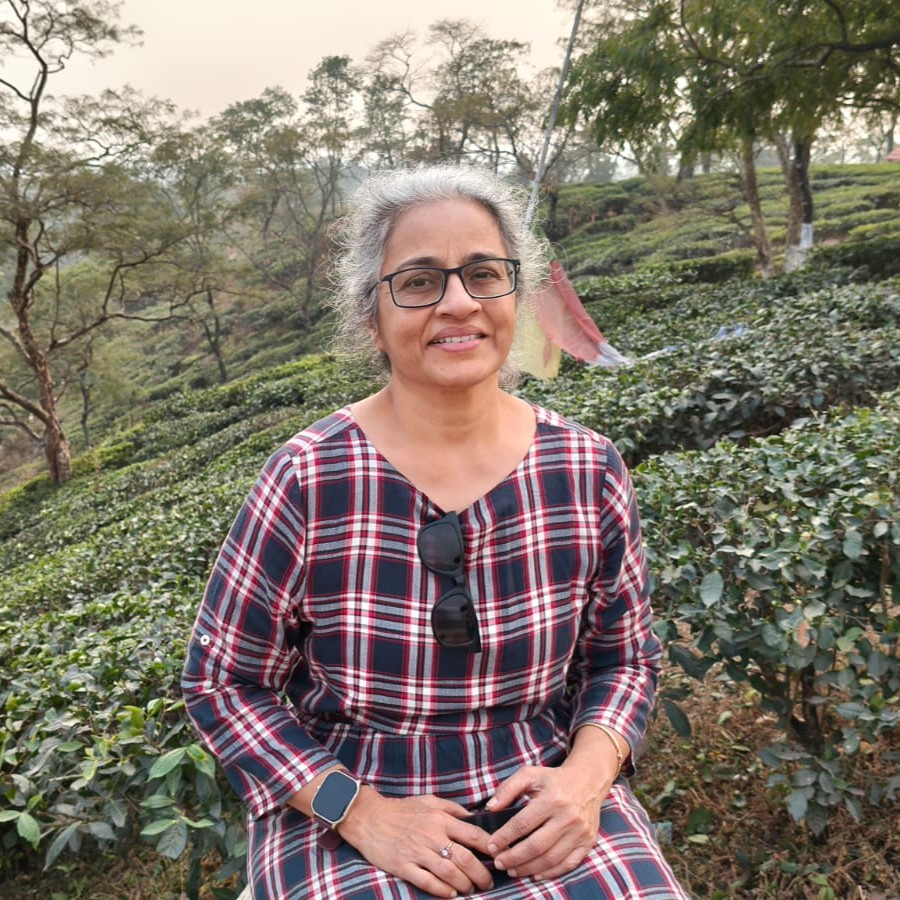
Anasuya Basu is an independent writer and media educator based in Kolkata.
Instagram, Threads and Substack: @anasuyabasu
LinkedIn: Anasuya Basu