Alka Balain
“or just the way the light hit at that angle,
making every shadow
look deeper than it was?” (‘Growing Up’)
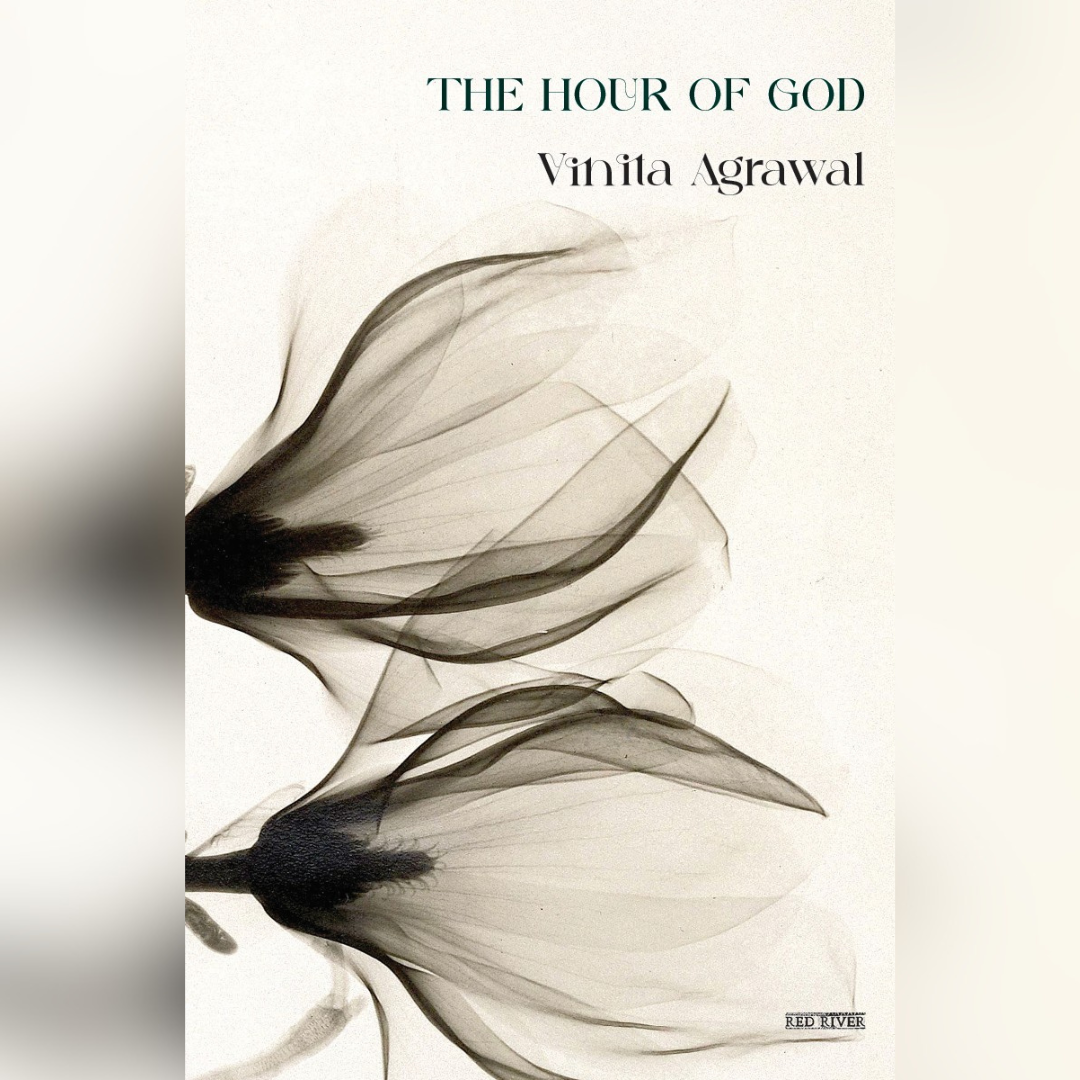
Vinita Agrawal’s The Hour of God unfolds in a quieter, more diffused Hour—the Brahma Muhurta. Rather than dramatizing such a decisive descent, the poems dwell in the sacredness of the hour, a time of awakening and well-being. The title recalls Sri Aurobindo’s Hour of God where certain moments mark an intense descent of Grace, demanding readiness and offering the possibility of effortless results. This distinction is subtle, yet significant.
The Hour of God opens with a sacred invocation to wholeness from the Brihadaranyaka Upanishad, and this invocation sets the tone of the collection. Nature itself is whole in its fragmented existence. Each poem appears as a fragment yet holds within itself a completeness that simultaneously participates in a larger, more expansive wholeness. The fragmentation of the collection is therefore a conscious design: each poem, while self-contained, contributes to an overarching meta-ecology of meaning. Light holds a continuous field of presence in the collection.
Award-winning Singaporean poet Desmond Francis Xavier Kon Zhicheng Mingdé states in ‘Tenebrism Again, In Relief’, “Fact is: the unilinear is an unreasonable expectation of art.”
Like nature and art, the book resists linear order, and becomes almost elemental, where meaning emerges through loss, grief, memory, possibility, renewal, and interconnectedness. Vinita Agrawal’s poetics are not expository; they do not argue or explain. Instead, they embody a metaphysical inquiry through nature.
The book moves through a landscape of loss—personal, ecological, and existential—while holding open the possibility of regeneration through attentiveness to the natural world. The poems do not remain abstract; they stay grounded in the body, land and the spaces in-between. The human body, house, trees, seeds, birds, animals, and rivers form an interconnected field of presence, where boundaries between inner and outer life are continuously dissolved and reformed. Home, in this sense, is no longer architectural but organic; it is flesh, earth, memory, and continuity of being.
In ‘Before the Ancestral Home’, the house becomes a shell, a prop, while the land carries the deeper weight of ritual and continuity. The loss of the mother becomes the central emotional and philosophical axis through which this interconnected world is re-seen.
The poems return repeatedly to questions that resist closure in the wake of passing: what could have been done, what remains unresolved, how grief alters and revives. Vinita writes: “My eyes ride past the roses, / Nailed like dried prayers to the wall; / past the pond’s blank eye” (‘Before the Ancestral Home’). The imagery holds both stillness and ache, capturing the suspended temporality of mourning. Yet even within grief, there is an undercurrent of sacred renewal.
Nature is participatory; a barbet’s call can stitch the self back to the subconscious root (‘Reparation to Mother’). Even Tulsi becomes a healing presence for bruised chakras.
“This barbet tuk-tuking outside,
let it stitch us back together, Mother,
back to the subconscious root
where we began.” (‘Reparation to Mother’)
Seeds speak, trees instruct, birds can teach, and even darkness is generative. In ‘Conversation with a Seed’, Vinita writes: “You think me small? / Listen—this dark is a patient craft.” Darkness is a place of quiet non-movement, a process not yet initiated, but this is also where earth connects to light. Similarly, the oxymoronic “generous dark” suggests that what is unseen or unformed carries within it the potential for emergence.
Likewise, trees carry stillness like a root stays still in soil—foraging for anchor (‘How to Listen to Trees’). Even the heron, still as a monk (‘Fragile Lexicon’), embodies this quiet presence.
Nature is forgiving, accepting, and unhurried, like trees she calls us to simply turn towards light (‘Alchemy of Trees’): “green tongues tasting sunlight, / drinking their fire that does not burn.”
There is no greed in nature, only an assured stillness and trust that all will be given, as a deer knows “Tomorrow’s grass is already theirs” (‘Homebound, Dusk’).
The metaphysical dimension is embodied through recurring symbols of light, sound, stillness, and silence. In ‘Beyond Body’, the poet asks: “See the light of the spirit / How it holds the clay / Where do humans lose it?” The question is exploratory, pointing toward forgetfulness, how in everyday life we distance ourselves from what connects us to ourselves and to existence. The image of the spine, like a flute, emptied so that breath may pass through it, becomes a powerful metaphor for this process of inward release and renewal.
“A constant flowering, realm after realm.” (‘Beyond Body’)
A beautiful image to behold when touched by the light not only visually but experientially, an inner flowering almost like a colour spectrum unfolding from within.
But before colours find their true light, they have to embrace ‘Phantoms of Portals’, unlived and lived crossings, the question marks in the spine, becoming a flute emptied of all but its light.
There is a damp sadness here, a hollow but deep ache that cannot be missed, like a longing of an unwanted girl child, “Who knows, / if I’d have lived.” (‘Stone Baby’).
Ecological consciousness runs quietly but persistently through the collection. There is awareness of damage, oil spills, loss of species (vulture), and human aspiration (sending a reactor to the moon) that disrupts balance. Vinita reminds the reader to see the larger picture. Nature is both resilient and vulnerable to human actions, yet it continues to heal.
The poet also explores the significance of letting go. Letting go is not simple; it is a deep alignment with the natural rhythms, where shedding and blossoming coexist. The tree offers to the bulbul and then sheds the flowers without groan and sound. Vinita asks the bulbul to teach humans how to be like a tree—to bloom and break (‘Teach Me, Bulbul’), and still rise, wearing wounds as wings to the sky, to sing like the bulbul, soft and melodious, as if the throat becomes a flute and the light of truth tunnels into words.
The poems frequently move toward silence as a space of return. Sound interplays with silence and silence asks to be embraced. “[Y]our throat a quivering cup of unsung hymns” (‘Teach Me, Bulbul’), evokes the bulbul’s throat as an image of silence and light, so ours too long for that state.
“Our throat’s bright corridors
eager to blend into eternal light.” (‘The Light Phenomena’)
Human life, and all life, begins with light; even a small spark sets forth creation. The universe itself is born from light, hence we always crave to return to it, whether through renewal or through death, where sound falls into silence.
The lines, “The storm left its ledger open, / the roots traced their verdicts underground” (‘Fragile Lexicon’), guide us into our light. The poem suggests that nothing is resolved at the surface. Like an open ledger, life does not close its accounts in visible ways. The roots move inward, drawing strength from the unseen. In that inward movement, something begins to find its voice again where we meet our inner light.
Similarly, the figure of the Chataka bird, which drinks only from the sky, is symbolic of patience and unwavering aspiration for only the highest.
Vinita brings in a note of caution in the eponymous poem, ‘The Hour of God’: “Guard it.” The sacred hour can be desecrated by commodification “and the grime of commerce.”
We are chasing the material and forgetting our connection with nature on which survival rests. If we return to the light that connects humans and nature, we may still guard the sanctity of the hour. Yet humans have largely lost the ability to tap into this light. Across the collection, light does not remain a single image but becomes an evolving field.
Ultimately, The Hour of God does not seek to resolve the tension between loss and renewal, fragmentation and wholeness, sounds and silence, and dark and light. It suggests that if we pay attention, nature holds the key to renewal.
As Vinita writes, “The new key is not mine” (‘Before the Ancestral Home’). She offers it with generosity, like nature itself, giving without expectation.
The book is rich in poetic devices: onomatopoeia (“tuk-tuking”), alliteration (“lost in the labyrinth of limping lines”), simile (“I held mirth like a dandelion seed”), metaphor (“boxes that dreamed in cold arithmetic”), personification (“rocks clutch their shadow rags”; “Quietness crouches like a figure”), and anaphora ( “from consuming fire and false saviours, / from self-destruction and slow death of the spirit / from numbing comfort and suffocating ruts”).
If this review feels non-linear, it is perhaps because it mirrors the logic of the collection. The poems ask to be approached with the same qualities that nature embodies: patience and openness. It invites the reader into the quiet world of becoming:
“for the language of trees
is not in words and volume
but in the vocabulary of shadows,
designs and shapes.” (‘How to Listen to Trees’)
The Hour of God can be purchased here.
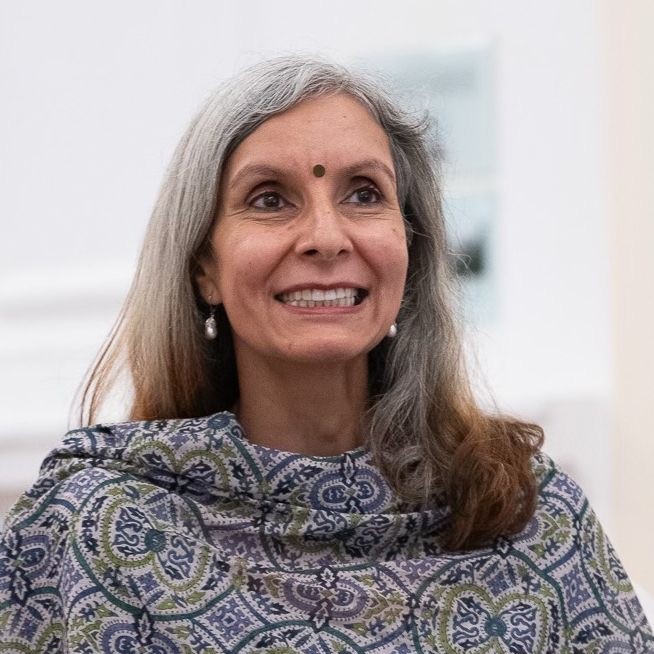
Alka Balain lives between Bangalore and Auroville. She facilitates Poetry as Sādhanā, an online contemplative practice engaging with sacred poetry. Her debut collection, Parijat Petals, centred on themes of longing and seeking, was nominated for the Rabindranath Tagore Literary Prize (2024–2025). Her work has been shortlisted for the Glass House Poetry Award, Poetry Festival Singapore–Catharsis, Word Weavers, and the Asian Literary Society Wordsmith Award. She co-edited the ekphrastic anthology interlude (Words on Art: National Gallery Singapore) and has curated ekphrastic readings for Poetry Festival Singapore. A former educator, she completed a short-term online Poetry Writing course at the University of Oxford and holds a postgraduate degree in Management from Lucknow University, India.