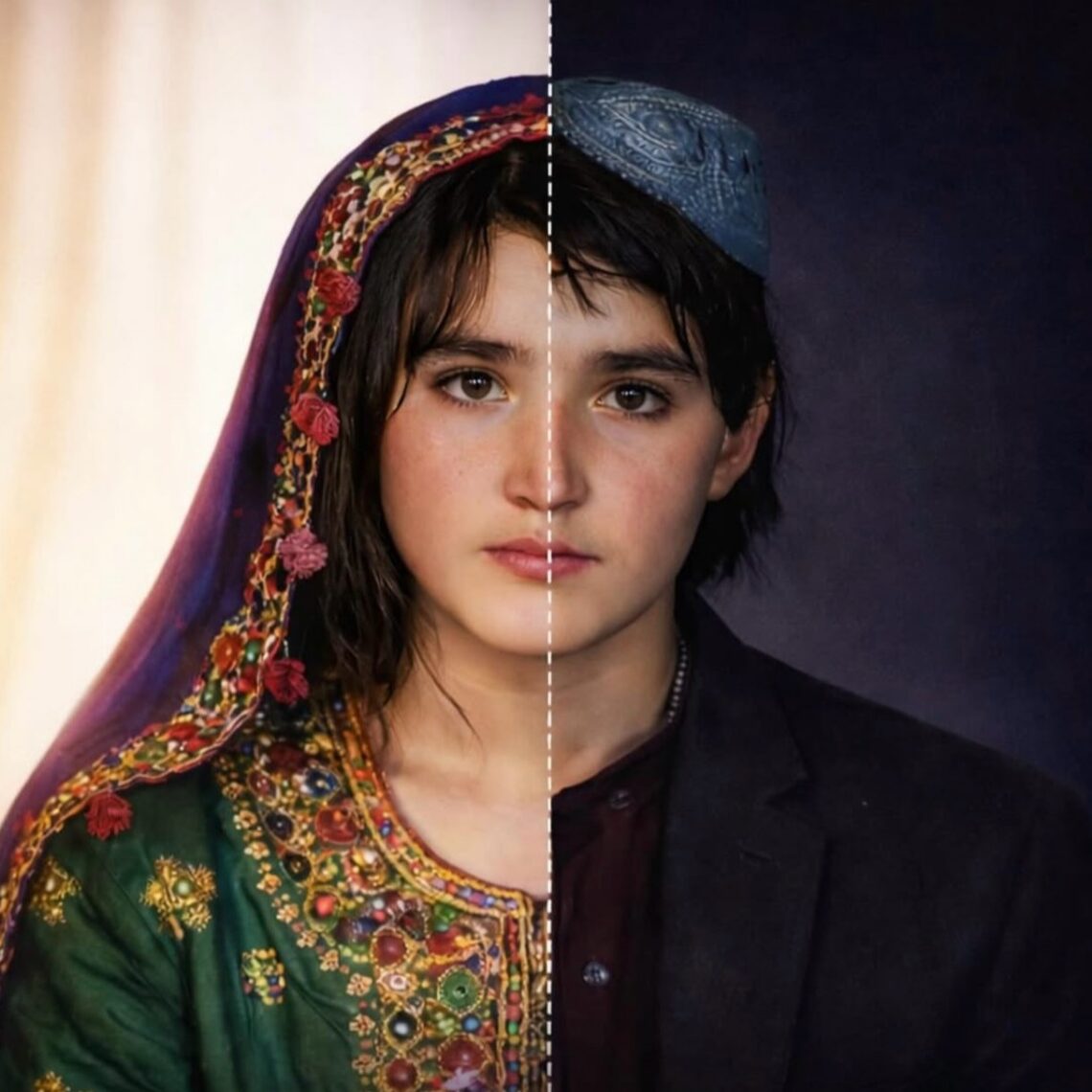
Inspired by the real-life story of a thirteen-year-old Afghan girl, Nooria, living in Helmand province, who became a symbol of survival under Taliban rule.
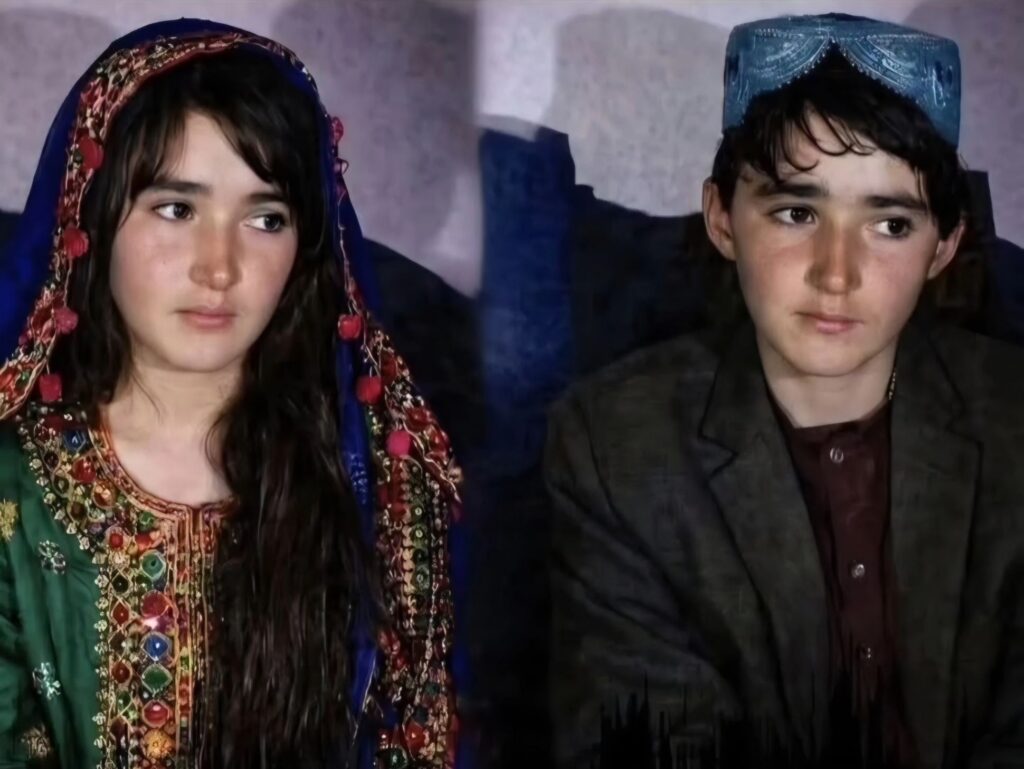
Note: Her videos were released on TikTok, etc. No one knows who put this image of her together, but it’s been widely used everywhere.
In a land where even the sun sometimes struggles to rise through the dust, being born a girl means always having to explain and justify yourself just to breathe. In this country’s alleys, the walls are built taller than the dreams of daughters. Names are never just names; they represent either permission or prohibition. Nooria, a girl from one of these alleys, learned early on that her name was always going to be an obstacle for her.
Nooria’s house smelled of dry bread—not from abundance but from lack. Her father was ill. His cough seemed to rattle the low ceiling above them at night. Her mother, with cracked hands, wove carpets, yet the knots she tied in wool never untangled the knots of poverty in their lives. Most days the tablecloth’s stark whiteness stood out—so white and empty.
One night, her mother decided to make one of her daughters a bacha posh. That night, it was decided that Nooria would no longer be Nooria. No one celebrated, no one even raised their voice. Silence, heavier than any scream, pressed down on the house.
The words were simple, but behind them lay an ocean of humiliation. It meant accepting that being a girl was not enough to survive in this world. It meant confessing that this society offers you no work, no bread, no path or means to support yourself if you are a girl.
Nooria did not cry that night. She only ran her fingers through her long hair, the hair her mother used to braid, all the while saying, “A girl should be like a flower.”
In the morning, only the scissors spoke.
Each strand of hair that fell made her feel as if she were losing a part of her childhood. Her hair lay scattered on the floor like birds with broken wings. The mirror in front of her showed a girl slowly disappearing. They cut her name too. Nooria became Noor Ahmad.
Her floral dress was folded and put at the bottom of a chest. Her small girlish shoes remained by the wall. A boy’s shirt hung on her thin body. Neither the clothes nor the life fit her. For bread, she was made to become a boy.
When she stepped outside for the first time, the air was the same, the alley was the same, but the looks coming her way were different. No one frowned and told her to “go home quickly.” No one blocked her path. She could walk straight through the streets. She could go to the bakery. She could speak loudly. The same alley she once crossed with her head down had now become her playfield.
Nooria started working as an assistant in a small grocery shop. She woke up before sunrise. She dragged sacks of rice and moved heavy boxes. Blisters formed on her delicate hands. When she placed a small amount of money on her mother’s palm each evening, something flickered in her eyes—not pride, not joy, just a feeling that came from helping her family stay alive.
She also knew this freedom was not real freedom. It was a mask that could fall at any moment. Whenever a customer looked too closely at her face, her heart pounded against her ribs. Whenever her voice grew slightly soft, she cleared her throat. She practised walking with longer steps and kept her shoulders open. She shortened her laughter. In time, she even forgot how to cry.
She had to perform this role every hour of every day.
At night, when she removed the boy’s clothes, her body could breathe, but her soul could not. She would stand before the mirror, no longer able to recognise the former girl. The fabricated boy looking back was also a stranger. It was as if she were trapped between two mirrors, both reflections showing her as an incomplete person.
Years passed, and Noor Ahmad grew older. Her voice deepened slightly, but her body could not hide the truth. The signs of womanhood slowly appeared like a truth that breathes even when it’s buried under soil. Her mother slept each night with anxiety. The neighbors whispered, and we all know in small neighborhoods, secrets have short lives.
One day the shop owner looked at her suspiciously and asked, “Aren’t you a little too delicate for a boy?” and the ground trembled beneath her feet. And the day came when her mother said, “It’s time to become Nooria again.”
Returning should have meant coming home; for her, it felt like exile. She had grown used to walking without fear. To bargaining in the market, and to running at dusk with the boys. Now she had to wear a veil, lower her voice, and shorten her steps. She had to become invisible again.
She realised that as Noor Ahmad she at least felt like a person. As Nooria, she returned to being a shadow. Returning was harder than changing.
Girls her age measured her with heavy looks. Some whispered, and some laughed. The boys who once worked beside her, upon learning the truth, laughed behind her back. Their laughter struck her like stones. She no longer belonged among the boys, nor among the girls. She stood between two shores; both seas rejected her.
Poverty does not only starve the stomach; it devours identity.
Nooria was not the victim of a choice. She was the victim of having no choice. If she had not become a boy, her family would have had no bread. If she had remained a girl, her father would have had no medicine. She sold her childhood so the house would not fall into darkness.
There are hidden wounds that no one asks about when a child gives up their childhood. No one asked about the nights she cried in the dark, or about the days she wished she truly were a boy so that her family wouldn’t have to lie to be able to survive. There were times she wondered whether God had made a mistake when he made her a girl. No one asks what happens to a tired heart when the mask finally falls.
A society that ties human worth to gender divides its daughters into two groups: those who are made to maintain their silence, and those who are forced to change. Nooria belonged to the second group, but she paid the price with her soul.
Months later, sitting at home again and listening to the boys playing in the alley, she did not smile. She only looked at her hands, which still carried the scars of labour. These hands once brought bread home, but now they must remain behind walls.
Each night before sleeping, she whispers her name softly, “Nooria…” Not so that anyone can hear it, but as a reminder to herself about who she is.
In a city where being a girl is treated like a crime, there are many Noorias. Children who carry responsibility instead of toys, who go to the markets instead of school, and who perform roles meant for adults instead of dreaming of a future for themselves. Nooria did not become a boy to work; she became a boy to survive.
One day, history may write about wars, about politics, and power, but few will write about little girls whose hair fell beneath scissors so their homes could have light. Few will ask how many more Noorias must bury their names before we understand that humanity has no gender.
And perhaps the most heartbreaking part of this story is that even now, when Nooria passes a mirror, she pauses for a moment, searching for herself. Searching for the girl who once laughed with long hair. In the reflection, she sees only a shadow of a child who learned that to survive, she must not be herself.
There is no tragedy deeper than this: A child who sacrificed her identity for bread, and a society that still does not understand what she lost in the process.
Marwa Karimi is an Afghan writer from Herat. In her writing, she speaks about her own experiences, migration, loss, identity, and the pain carried by Afghan girls. Through her words, she hopes to make sure that the voices and stories of Afghan girls are not silenced or forgotten.