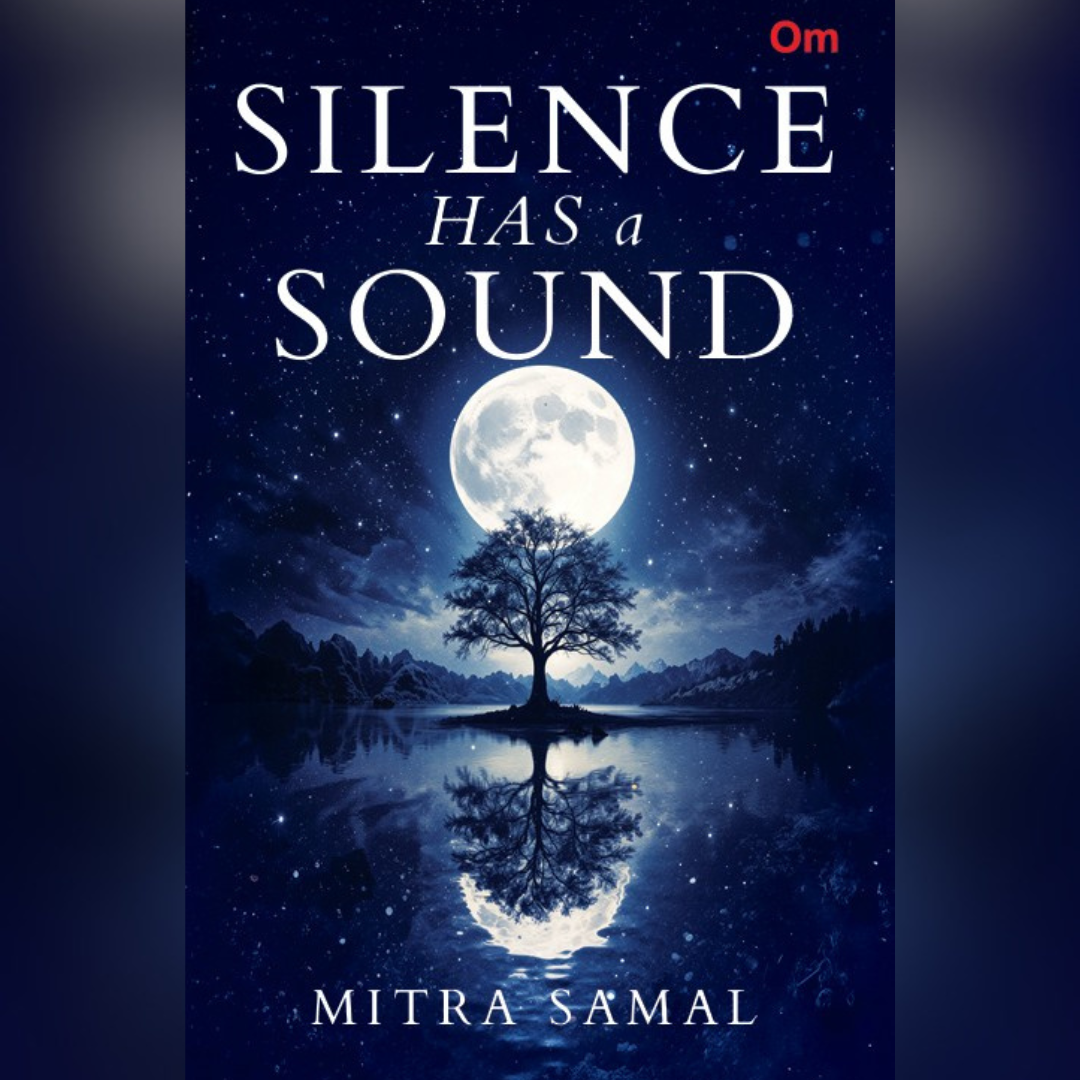
The very title of Mitra Samal’s collection of poems reads like a paradox coming alive, a paradox that the poet wields effectively to trace a bond, a link across conflicting emotions, to discover a connection between opposites, a pattern in shambles, and a poise in disbalance. For the poet, silence is not a void, but a mysterious, solid whole pulsating with many moods of life, many layers of emotional depth, and experiences that are grounded in reality at one point and that soar up to a height of transcendental sublimity at another.
They engage with people and places one can connect and interact with, about the problems and privileges man lives through, the raw, throbbing tension of accomplishing and losing and reconciling. They are also about realizations that are complexly subliminal that reaches a level of extra-real at certain points.
The poet seems to be aiming at internalizing the pleasure and pain of the people she connects to displaying a fine fusion of collective and personal unconscious where past and present, truth and untruth, time and timeless merge to map out a world of private as well as shared experiences.
The paradox embedded in the poems prompts the reader not to stop at the surface meaning and look forward to something more intense, to delve into the perplexing elements archived beneath the ‘expressed’ emotions, to explore the interfacing of nostalgia and nemesis, one pulling you into a comforting idealized world of memories and dreams and the other prodding you towards the inexorable realty that stares at you in your face. They are not just about the pleasant crowds and foreboding loneliness our life journeys through, but about an existential search, of reaching beyond the common and the ordinary, of transforming isolation into connection, of bridging the real and unreal, and the self and the soul.
The collection is discretely structured in five segments to capture the varying moods of the poems drifting across the philosophical, melancholic, merry, mystic and maverick. All the way under-runs this paradox of human existence, at times evident, concealed under well-crafted expressions at others, joining the moods together, grafting them uniformly into the matrix of the body of the collection, displaying multiple dimensions of poetic ingenuousness.
Sections 1 and 4, captioned respectively as ‘Nostalgic Reflections’ and ‘Yearnings’, not so rigidly estranged from each other in their manner of response to the stills and stirs of life, have poems that reveal different levels of expression reflecting a duality of mood in their effort to blend floating phases of time. In poems like ‘I Like Old Walls’, where the longing for the lost lures the poet to feel “the past diffusing in the present,” and in ‘Photograph’ tracing out a likeliness between the face of the poet and her grandma pointing at an intergenerational transmission of proclivity and predilections: “I know the dreams you pass on to me though we never met / Dreams with which I still struggle / In the consciousness of being awake and the silence of my sleep.”
Poems like ‘Let Go’ and ‘It Wasn’t Forever’ unfold a similar kind of duality of emotion when the poet apparently grapples with a mood of indecision and wavering.
Lines like “I will let you go just as I let you come,” or “For tonight, I know / Forever was a dream / Tonight I know / It was never meant to begin (‘It Wasn’t Forever’) present an emotional conflict that sets up that mood. In ‘Twin Souls’ the mood is intensified to “Tonight, let us journey / Into each other’s fairy world / The one that so easily slipped / Into a fervent nightmare.” The choice of expressions like “nightmare” to contradict “fairy world,” and “Tonight is the first / and tonight is the last” throbs with the subdued rings of Neruda’s “My love has two lives, in order to love you: that’s why I love you when I do not love you / and also why I love you when I do” (XLIV 100 Love Sonnets).
While the segments captioned as ‘Nostalgic Reminiscence’ and ‘Yearnings’ ring with a longing for the lost love and lost joys, ‘Realities’ and ‘Nature’ poems in a way define the poet’s response to the people and surroundings in terms of an immediacy of effect. Even as the poet lets her thoughts shift from plaintive to analytical, from idealizing to empirical and explanatory, the conceptual dichotomy continues to voice its presence, reshaped now as a questioning and serious perusal. ‘Come Out God’ is one such poem that resonates with a spiritual skepticism, accepting God as a supreme power while questioning the merits of religious rituals and sacred practices.
The two poems ‘If Death Were to Come to Me’ and ‘Seizure’ that draw the paradox of living and dying hold faint semblances of the mystic mood of Emily Dickinson reflected in her ‘Because I could Not stop for Death’ and ‘I Feel a Funeral in My Brain’, the first one being an imagining of the companionship of death as a serene, redeeming fulfilment.
“Because I could not stop for Death he kindly stopped for me…” in the first poem could have its echo in “Death may help me endure / the eternal peace of my mind/ the transcendental gift of the divine.”
And the other of the grueling agony of getting trapped in an experience of living and dying simultaneously.
“I try to pull myself free / but iron arms coil around me / suffocating, striking / and the cry I believe I realize / turns out to be only a whisper,” which brings into mind Dickinson’s “I Felt a Funeral in My Brain / And Mourners to and fro / Keep treading–treading–till it seemed / That sense was breaking through.” (‘I Felt a Funeral in My Brain’).
The paradox that defines an existential crisis is further intensified in ‘Two Lives’ where the poet acknowledges the duality she lives through: “I just realized I have two lives / the one I live / and the one I want / the one that holds me captive / and the one that sets me free.”
Though not evidently discernible, the paradox continues to thread through the poems in the section captioned ‘Celebrating Nature’. They describe golden sunsets and wispy evenings that are not yet plasticized, sprawling over a city with a plastic heart; they describe the enticing song that throbs silently in the furrowing sea waves and in the warbling greens. The poems could be read as a silent resentment against the cacophonous urbanization that ruthlessly muffles nature’s delicate symphony.
The final section is a well-crafted subsumption of the elements of the paradox scattered in the preceding poems. By placing the title poem that holds the core paradox at the end of the final section, the poet establishes an interconnectivity between the segments. It helps unify the multiple strands of conflicting emotions and approach them in a holistic perspective.
Mitra Samal’s poems are not just snippets of isolated individual experiences that aim to define individual issues in their own style and tone, but by being empathetic in nature, they carve out a space to admit the heterogeneity and plurality of the struggles and sufferings of the whole of mankind. The altruistic note ingrained in “And if I live / let it not be / only for myself” effectively resolves the existential paradox.
Silence Has a Sound (Om Books International, 2026) can be purchased here.

Snehaprava Das is an eminent poet, author, and translator. She has translated several Odia classics into English. Das has five poetry collections to her credit: Dusk Diary (2018), Alone and Other Poems (2018), Songs of Solitude (2019), Moods and Moments (2019), and Never Say No to a Rose (2020). She has also written two short story collections: Night of the Snake (2023) and Fog Whispers (2024). Das has received the Pravasi Bhasha Sahitya Award (Delhi), Jivanananda Das Award (Kolkata) and Fakir Mohan Translation Award (Odisha). She is a former professor of English literature in Odisha, and lives in Bhubaneswar, India.