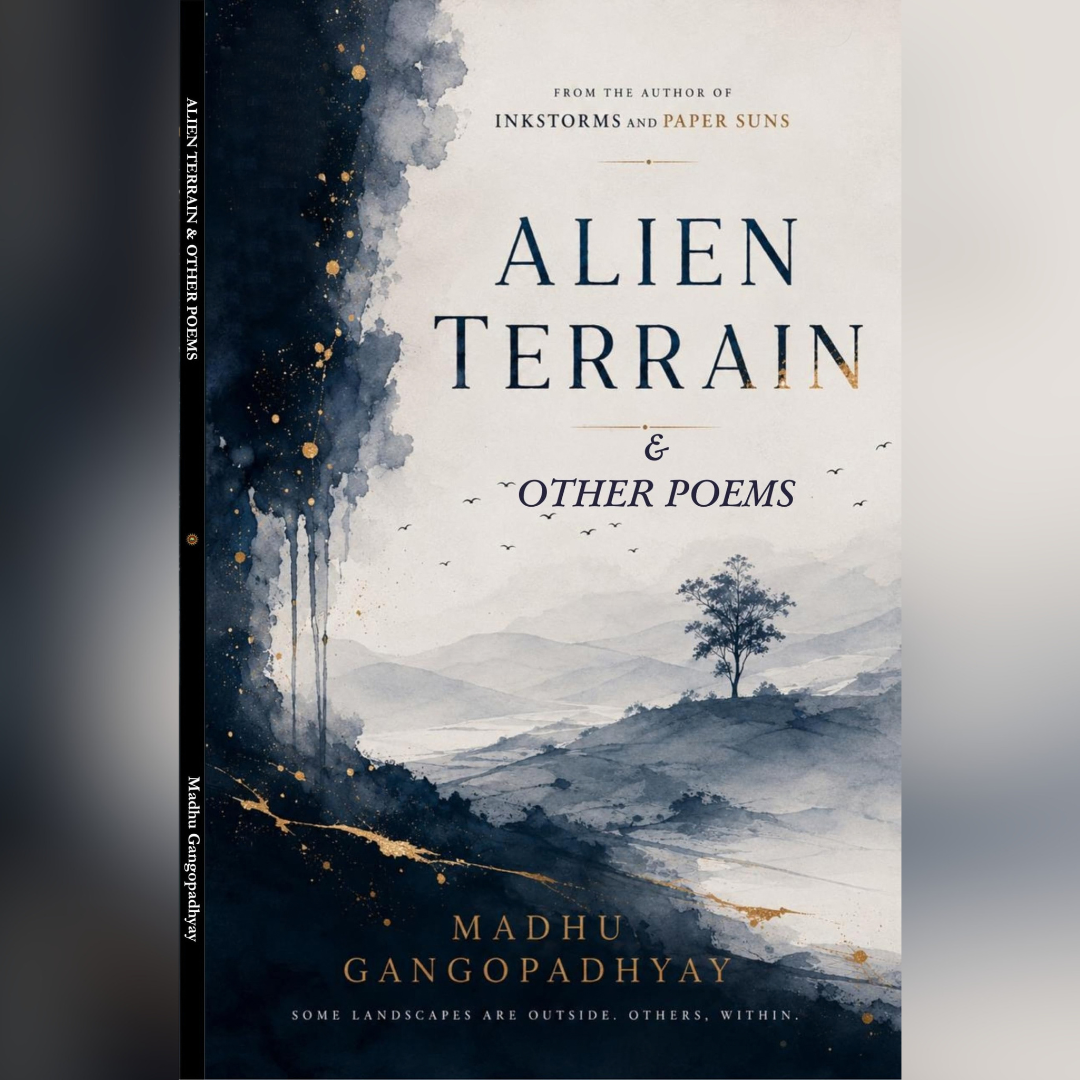
Madhu Gangopadhyay’s Alien Terrain explores physical landscapes as metaphors for inner feelings and moods, often described as emotional landscapes, or even metascapes, that also penetrate with intensity into intuitive powers and memories, both personal and collective. Madhu Gangopadhyay’s poems, hence, almost always play out against the classic and spectacular elements of the Earth—the red mud, fields, rain, flora and fauna, forests, skies, mountains, seas, snowfall, sunshine and moonshine, days, nights and twilight, winds, and seasons—that are overlaid with emotions and perceptions. It is perhaps no wonder that Gangopadhyay infuses the ancient Greek worldview in many of her poems: their vast, cosmic framework that merges myth, rational philosophy and scientific enquiry to explain humanity’s condition, its trials and victories. Her interplay of physical and mental topographies creates a unique poetic idiom that bears her stamp; her poems also shift from the familiar and recognisable to the unfamiliar and uncongenial in just a few words, and just as easily back again. It is Gangopadhyay’s metier.
The first of the forty-five poems, which bears the same title as the collection, plunges readers into a ravaged, hostile terrain stripped of its earlier loveliness; we are led to a place of trying climes that is bereft of birdsong and gentle breezes of yesteryear, where the disturbances and loss are as much physical as psychological. “Pain has mastered / The art of hurting / Effectively and eternally.” But the heart, though “[s]ick, sore, still / Secretly brews a smile.” This quiet, everyday courage to make a deep, authentic connection with life, through its precarity and disintegration, is what shines through in the end.
The poem sets the tonal grain—the figurative language, to be exact—and the emotional timbre and complexity of the poems that follow, where resilience is not that easy to come by and where mastery of metaphor must be subtly nuanced. Take ‘Wounded Sands’ and ‘Lost Shores’, for instance, which show the elusiveness of certitudes, where misery may not end with certainty but certainly with experience.
Twilight draped the wounded sands
And everywhere
A vermillion hue suffused
One couldn’t tell the sky from the earth
Where mankind laid bruised (‘Wounded Sands’)
And
Exiled joys seldom return
The uproar of waves,
In frenzied pursuit
For lost shores
Tumultuous silence
Scoured passion
She yearned for the wind in her hair (‘Lost Shores’)
Loss, memories of that loss, and the ability to hold out against it are the leitmotifs that hold this collection together. ‘The Gift of Grit’ is a wonderful example. The poetess mourns the loss of her father, the epicentre of her childhood and part of her adulthood, deeply and grievously, while at the same time celebrating his containment within her personhood to date and his abiding legacy.
Father, I still scour for your smell,
The one beneath your armpit
Where my head found
A safe alcove.In me
You sowed the seeds of grit.
Of her mother, she similarly laments in ‘Before She Was My Age’:
My mother died
Before she was my age
What would she feel
If she were alive
Under this venomous sky
Where vermin evolve to human form
Chicanery a norm?
In the end, she finds a strange comfort in the realisation that:
Ma, you are blessed
At least nobody can
Rout your rest.
Similarly, as the people suffer, hope springboards from the core of their being. Gangopadhyay makes ingenious use of Van Gogh’s life and his painting ‘Starry Night’ to make this point.
Daffodils of hope
Hang between
The corrugated vault
And when darkness fall.
Van Gogh’s
‘Starry Night’.The tormented artist’s
Ethereal precision!Who says insanity
Blurs vision? (‘The Vision Beyond Madness’)
This is, of course, a reference to the painter’s creation ‘The Starry Night’ that found brightness even in gloom. Van Gogh created this portrait of optimism against the backdrop of despair, from his room in a mental facility, when his life was at its lowest point.
Life, the poetess, believes is about building and rebuilding castles, it’s a constant process of negotiation: “Some crumble, /While some welcome/The stars upon a silver canvas black —” (‘Again’)
The Earth similarly beset with contagion and darkness of all manner recovers and defiantly refuses extinction. In ‘Echoes of Crisis, Voices of Change’, Gangopadhyay highlights an earth in crisis:
The earth coughed smoke,
Rivers swallowed roads,
And cities wore panic
Like a second skin.
Yet in the concluding paragraph of the poem, the earth survives:
For every collapsing world
There survives
A stubborn pulse of light
Refusing extinction.
Yet darkness is a force that has staying power and nihilism is a power to reckon with. The poetess is well aware that life bears whirlpools that are dangerous and destructive and does not dismiss it lightly. The poem ‘Thole’ (meaning to endure or suffer through something) exemplifies this by looking unwaveringly at darkness and acknowledging its perpetuity:
The summary of existence
Tired, bushed and spent,
Harrowing tales of life never end.
Optimism is fool’s art of solace;
Living is akin to grappling blindly in the dark.
Existence mocks endurance.
But readers are assured in ‘Victory’s Voice’ of recovery and healing in the midst of apocalypse:
The secret of triumph
In this earthly heaven
Is to conceal pain
Even when it drills a hole
Thole, oh thole!
Then watch how magically
The dice roll
And life vaunts victory
It’s all endurance’s story
In summary, Gangopadhyay clearly recognises that growth often involves upheaval and the loss of familiar comforts, compelling individuals to carry their past experiences as memories. However, change is the only certainty that must be embraced and celebrated. This theme is beautifully illustrated in her poem ‘The Geography of Becoming’.
There is a newer dream
That hides behind the mountain,
Urging me to cross over the peak.
I dare.
Madhu Gangopadhyay’s Alien Terrain & Other Poems (Anuradha Prakashan, 2026) can be ordered here.
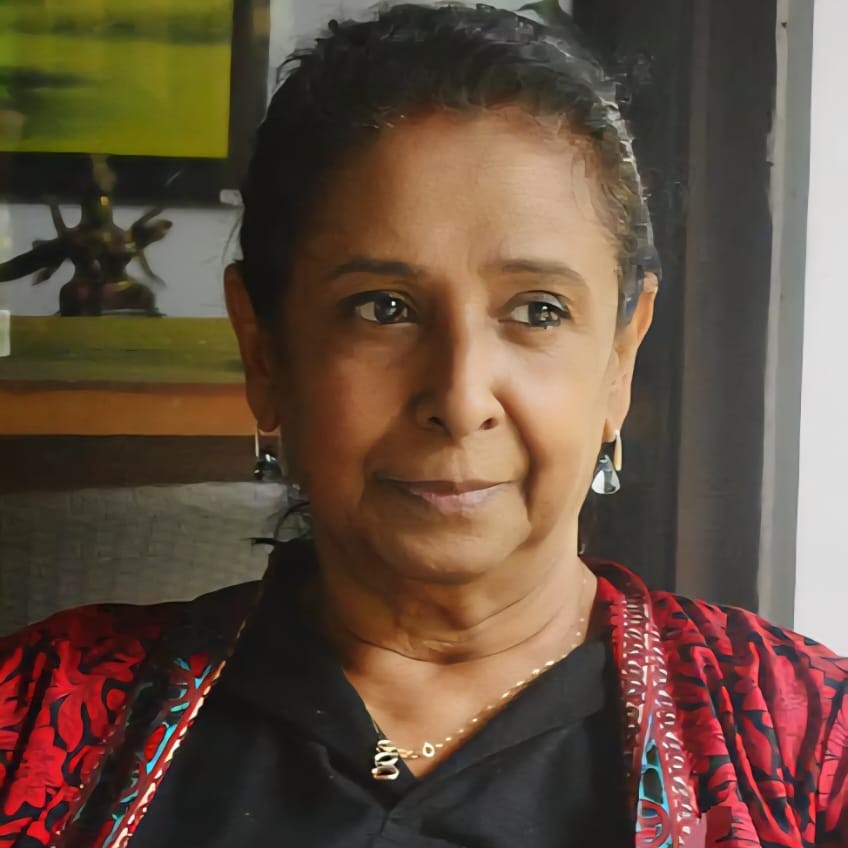
Chitra Gopalakrishnan pursues fiction, creative nonfiction, poetry, essays, book reviews, and opinion pieces. Based in New Delhi, she uses her writing to break firewalls between nonfiction and fiction, narratology and psychoanalysis, marginalia and manuscript, and tree-ism and capitalism.
Website: www.chitragopalakrishnan.com