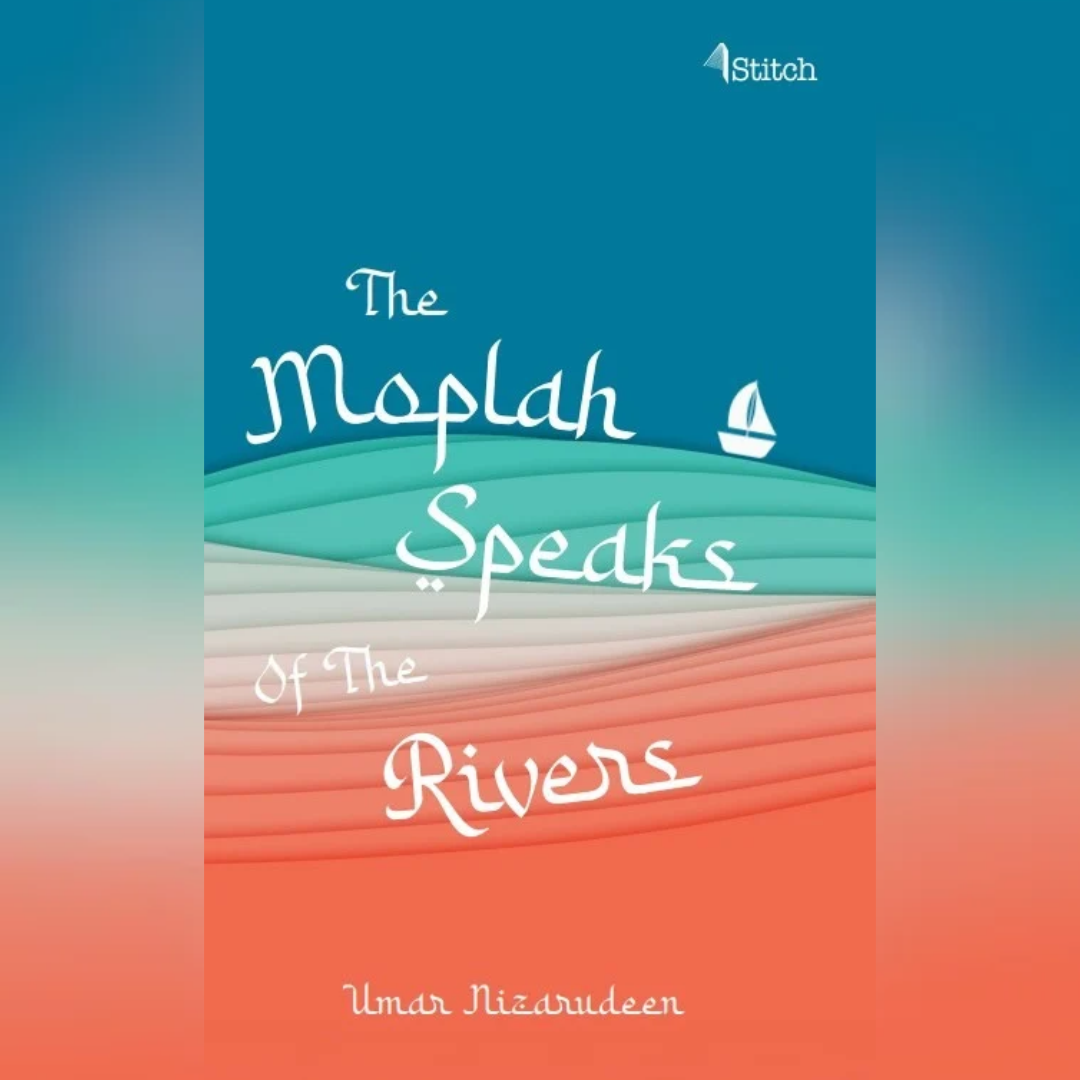
Some poetry collections invite to be read one poem at a time, while others gradually reveal themselves as an argument. Umar Nizarudeen’s The Moplah Speaks of the Rivers, edited by Sufia Khatoon and published by The Antonym Collections, belongs to the latter category. Across its 58 poems, history, religion, violence, language, gender, and memory repeatedly collide, producing an intellectually restless collection that is less interested in providing answers than in unsettling the categories through which we understand identity.
Its title announces this ambition immediately. Nizarudeen reworks Langston Hughes’ ‘The Negro Speaks of Rivers’, replacing Hughes’ historical subject with the Moplah, a term deeply entangled with the colonial history of Malabar Muslims. Where Hughes used rivers to construct a genealogy of Black historical consciousness, Nizarudeen transforms geography into memory in much the same way: the Nila, Kadalundi, Arabian Sea, Nile, Euphrates and Amu Darya become not merely locations but carriers of cultural inheritance. The river, in this collection, is an archive, but an unusual one that refuses fixed borders.
The Mappila world that emerges from these poems is neither an isolated regional identity nor a culturally pure inheritance. It is made through movement: between Malabar and Arabia, Malayalam and Arabic, Islam and local traditions, oral memory and written literature. The collection’s cultural politics lie in embracing historical complexity, which is also why the poems are so preoccupied with language.
In ‘Eternal Sunshine of the Spotless Mind’, dedicated to the Malayalam poet K. Satchidanandan, the poet speaks of a “tongue” that might have become extinct. Language becomes simultaneously bodily and historical: a tongue is an organ, a mode of speech, and the vessel of cultural memory. The poem brings Malayalam into conversation with Rumi, Orpheus, Heideggerian existentialism, and the film from which its title is borrowed; juxtapositions characteristic of Nizarudeen’s method, whose poems rarely stay within a single intellectual tradition.
Sometimes this density is exhilarating; at other times it risks making the reader feel as though they have entered a private library without a catalogue. Yet the difficulty is not purely ornamental. The poems seem to suggest that identity itself is made from such collisions, and that the poet’s crowded consciousness- full of languages, histories and texts is precisely what the poem reproduces.
This makes the collection deeply postcolonial without being conventionally so. Its concern is not simply colonial oppression but the afterlife of classification: who gets named, who gets remembered, and whose version of history becomes authoritative. That concern is especially powerful in the title poem’s play with the community’s different names: Mappila, Moplah, and their variants. Naming here is an act of power. The colonial archive does not merely record a community; it produces a version of it. Nizarudeen’s poetry attempts to reverse that relationship, turning the historical object into the speaking subject.
The collection’s politics are rarely expressed through straightforward declaration; they are embodied. In ‘No Child, No Cry’, a speaker outside a child welfare office encounters a city of children, sex workers, riots, and violence. The title’s inversion of ‘No Woman, No Cry’ turns the familiar into something darker: childhood, ostensibly the space of protection and innocence, is placed beside institutional failure and sexual violence. When the city’s streetlights acquire “wings / like angels,” the image is both beautiful and bitter; the modern city can offer only mechanical substitutes for divine protection.
In ‘Veil’, a torn magenta shawl becomes an emblem of damaged female visibility, and the poem moves from the female body to schools and the destruction of intellectual life. Violence against women, the poem suggests, is not restricted to physical injury; it also threatens education, speech, and the life of the mind.
Nizarudeen’s treatment of the body is among the collection’s most striking features. ‘Mathru Devo Bhava’, whose title invokes the familiar formulation “Mother is God,” refuses to leave motherhood at the level of reverence. The mother appears through breasts, scales, flakes, and exposed bodily labyrinths, and the sacred maternal figure is returned to flesh. This movement from abstraction to body is fundamental to the book: ideologies become wounds, history becomes flesh, theology encounters suffering.
‘Damiens’, drawing on Michel Foucault’s account of the eighteenth-century execution of Robert-François Damiens, makes this most explicit. Nizarudeen takes an event that has become a foundational illustration in the history of punishment and restores its physical horror. The repeated Qur’anic refrain, “Fabi-ayyi ala-i rabbikuma tukaththiban” (“Which then of the favours of your Lord will you deny?”), becomes deeply unsettling set against torture and dismemberment. Is it consolation, irony, or theological provocation? The poem refuses to settle the question, and in doing so implicates the reader: we are made spectators of suffering even as we’re asked to consider the ethics of looking. This tension recurs throughout the collection; the poet wants to expose violence, but exposure itself risks becoming another form of spectacle.
That tension shadows the poems dealing with gender and the violated body more broadly. Nizarudeen is often most powerful when bodily violence reveals larger structures of power, but the intensity of his imagery occasionally risks aestheticising the suffering it seeks to condemn–not a trivial reservation, given how central the ethics of representation are to the collection’s project.
A smaller poem, ‘Gandhi Caps and Saffron Flags’, shows another side of Nizarudeen’s political imagination. Che Guevara’s berets, Malcolm X T-shirts, and Lincoln and Gandhi caps appear as symbols that can be worn, discarded, museum-ed, or burned, before men line up for “a ticket to heaven.” Politics becomes costume; history becomes museum material; even salvation acquires the language of commerce. The poem’s sharper target is not one ideology replacing another but the transformation of complex political thought into portable symbols; the same crowd that queues to discard one identity can queue just as readily for another form of belonging.
This idea links the collection’s political poems to its poems about religion. Nizarudeen treats faith as neither simple refuge nor simple oppression: Islamic imagery exists beside Hindu and Christian symbols, mythology beside modernity, Rumi beside European philosophy. These traditions do not sit comfortably together; they collide, argue, and contaminate one another. The result is a poetry of hybridity, but not the celebratory multicultural hybridity of easy slogans. This is hybridity marked by historical wounds.
Ultimately, The Moplah Speaks of the Rivers is a book about what survives. When official history excludes, language remembers. When names disappear, poetry restores them. When bodies are destroyed, memory gives them another existence. And when cultures are treated as static identities, the river reminds us that continuity is possible only through movement. Nizarudeen refuses the neatness of a single identity, a single history, or a single literary tradition.
The river is therefore more than the book’s governing metaphor; it is its philosophy. A river carries sediment from elsewhere. It changes course without ceasing to be itself. It contains the traces of everything that has entered it. So does this poetry collection.
In The Moplah Speaks of the Rivers, Nizarudeen does not simply recover a forgotten past. He asks what it means to carry a past that was always made of crossings and to speak when the archive has already decided what your name should be.

Haimanti Bagchi is a folklorist, researcher, and storyteller documenting the relationship between ritual, ecology, and cultural memory. Her work explores the intersections of folklore, ritual, ecology, and cultural memory. Through her research and public engagement initiatives, she works to document and promote folk traditions, indigenous knowledge systems, and community-based ecological practices, with a particular interest in how cultural narratives shape relationships between people, place, and belief. Her academic work focuses on ritual cultures, environmental humanities, oral traditions, and the politics of cultural preservation. She has published peer-reviewed research in the International Journal of Critical Diversity Studies and has presented papers and participated in scholarly discussions at national and international conferences hosted by institutions including IIT Ropar, Pondicherry University, SRM Institute of Science and Technology, Swamy Saswathikananda College, and Ramakrishna Mission, Narendrapur. Alongside her academic work, Haimanti is an active literary writer whose poetry and short fiction have appeared in national and international journals, anthologies, and digital publications. Her poetry collection Autumn of Life, published by Authorspress, received appreciation from readers in India and abroad.
Instagram: @world_of_fourleggedlove
Facebook: Haimanti Bagchi