Albert Abdul-Barr Wang
On June 24, 2022, the U.S. Supreme Court case Dobbs v. Jackson Women’s Health Organization would remove all federal protection for a woman’s right and access to abortion. In addition to the ruling’s sociopolitical ramifications, this legal shift became a symbolic act that reverted the status of the female body from its autonomous concreteness being back into a state of abstraction regulated by the patriarchal system. During the second Trump administration, further regressions in the public arena such as the outlawing of DEI (diversity, equity, and inclusion) institutions and the growth of the surveillance capitalist state under the domain of ICE (United States Immigration and Customs Enforcement) and Palantir have highlighted the stark situation of radical feminism and gender politics within American culture. Allison Field Bell’s recently released chapbook entitled Without Woman or Body reflects not only on autobiographical imagery and metapoetic themes but also on the status of the female body within various states of physical and spiritual liberation, freed from the constraints of the male gaze or social or religious proscriptions.
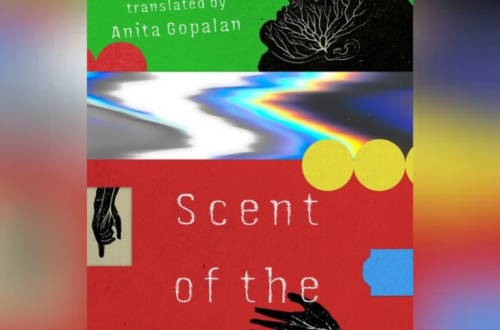
Field Bell’s book, which features on its cover a cropped black-and-white photograph of a posed female torso, limbs, and hand, comprises twenty pieces ranging the gamut from autofictional prose poems to fragmentary concrete poems. The cover photograph taken by the author herself provides a clue to the range of themes: self-portraiture, literary craft, formalism, the female body, whiteness in relation to post-feminist America, and natural landscapes versus constructed interiors. Through a dizzying variety of writing styles and page layouts, the poet’s delicate mastery of multiple forms demonstrates her intimate approach to making more visceral her abstract emotions into a web of allusions to everything from Hebraic traditions to desert geology.
Her opening piece “Garden” starts off with a rather engaging flourish of an opening stanza filled with complex twists and turns.
I haven’t been honest with myself. The peony in my front
yard had just one bloom last year. Fleeting, fuchsia.
The opening abstract sentence disarms the reader with its brutal simplicity and stark confession. More in the vein of Adrienne Rich than that of Sylvia Plath, Field Bell’s assertion focuses on this feminist approach to personal revelations and imagistic epiphanies as a form of therapeutic self-reflection. Suddenly the poet switches to her second sentence which is a crisp enjambment. This firm break in the physical layout of the printed words on the page reflects a breakdown in the author’s mental state. Also the lack of blooming in the physical garden suggests a conflation between the lack of flowers and the flagging of creative inspiration in relation to mental health. The second line of the poem ends with a punctuated fragment in two words that veers from the abstract word “fleeting” to the concrete word “fuchsia,” which could allude to either the floral genus or the color itself. That open ambiguity suggests a certain fuzziness to the poet’s memory. Is the peony fuchsia-colored? Or was the fuchsia misremembered as peonies? Field Bell suggests these different interpretations as valid; the instability of memories in relation to self-actualization and spiritual compass is a theme throughout the rest of the chapbook.
Field Bell’s tone and rhythm shifts between the intimate and the epic particularly as she relates her focus on autobiographical details in relation to her environs. For example, in “Beneath the Roots,” the author recounts the relationship with her mother as follows:
that I’ve traveled, that I am so adventurous. To live
in Indiana / New Mexico / Arizona / Utah. To live
in Ecuador / Israel / Greece / England. To follow my impulse.
She doesn’t know how difficult it is to leave the house.
The concept of memory as a personal checklist demonstrates the impulse to match the written word with natural speech patterns. Usage of the slashes in between the places visited suggest a caesura in between the geographic points to reflect a pause in breath or a mental blankness. This startling command of rhythm envelopes the readers within an imagined travelogue as a parallel to the author’s stages along life’s way; this approach prods the reader to conjure up memories of virtual destinations. Also the doubling of meaning between the physical and the mental worlds becomes key for looking closely at what the poet deems. For example, the phrase “[s]he doesn’t know how difficult it is to leave the house” points towards two interpretations for the word “house.” One would be the literal house that Field Bell fears exiting with her real-life body; the other would be the figurative house of her fraught mental state that she is scared to escape. Trauma and depression can often be structures that cause people to get addicted; the inertia to escape those doldrums may be too great. In multiple ways, the author implies that the fleshly female body is the seat of passionate desire or lack thereof.
The desert, particularly in Morocco, as a literary trope has been the nexus of projected desires for the exotic and the strange by various American and European writers ranging from Paul Bowles who fantasized about the Tangier to J. M. G. Le Clézio portraying the local tribes in his 1980 novel Désert. Rather than entertaining colonialist fantasies, Field Bell’s connection to her surrounding desert landscapes are homegrown as they focus on her previous residency in New Mexico and her current home in Utah. Refusing the oft cliched portrayal of the wilderness as a stand-in for the sensuality of the female body, the author’s radical take on the landscape is more rooted in a hybrid between direct observation inspired by photography and feminist artists such as Georgia O’Keeffe and Imogen Cunningham of the Group f/64 movement. In her eye-catching concrete poem “Sonoran Desert,” she says

Field Bell’s depiction of the Mexican area combines both a photographic eye for exacting details such as precise naming of plants such as ocotillo, cholla, and brittle bushes as her evocation of smell through the evocation of creosote which is a tar-like substance often resultant from the plants in that area. The striking depiction of the desert is that of tragic yet sublime beauty and desolate mortality instead of celebratory immersion. The mention of the poet’s therapist is rather unexpected and the shadows of suicidal thoughts plunges the reader into a silent despair; the connection between the mundane and the grand within these images in relation to mental health becomes rather Kantian and photographically prosaic. The author’s ability to reconcile the contradictory elements is rather compelling and refreshing within her fragmentary take.
Of note here, are the pensively playful works such as the titular “How to Write a Poem Without Woman or Body” which becomes a feminist anthem for uniting the world of abstraction into the concrete. Written as a set of instructions interspersed with musings, this piece is a sociopolitical statement about poetic craft in its deliberate avoidance of sentimentality or nostalgia. Like Wallace Stevens, Field Bell exhorts the implicit reader who becomes a complicit writer to “Use the words girl or female. Write about fingertips/and elbows.” The process of gendering language under the poet’s directives becomes a circular form of self-communication during the writer’s thought and revision steps. In a stunning hybrid between autofiction prose and gymnastic poetry, she asserts that
Remember that your body (there it is) moves over
sidewalks with ease. But you are not a man, you are
a woman (and there she is). You did not design yourself
this way. Breasts and hips. You wish it were otherwise.
That your body (and again) was a flat straight line.
A neutral grace to your step. (A fantasy.) You don’t mean
to write poems about bodies (or women), you just
mean to write poems. You can write about trees—
Perhaps this poem is a female counterpart to Stevens’ “Notes Toward a Supreme Fiction?” As a firm statement regarding craft, the usage of concrete nouns such as “breasts,” “hips,” trees,” and “bodies” balances the abstract nouns such as “ease,” “grace,” and “fantasy.” The seesaw-like musicality of these lines add to the ludic formalism of her linguistic performance, similar to that of a modern ballet. In this work, the reader becomes the writer as much as vice versa within this ingenious exploration of the nature of imagination. Unlike the modernist conception of imagination, her feminist take on the thought process is avidly more political. Breasts and hips are not only objects of presumably male desire but also the loci for patriarchal control; the poet’s defining of the concreteness of the female body becomes an unfolding form of self-assertion and thus psychological and philosophical autonomy. This gem encapsulates many of her themes such as the nature of desire in a dazzling way as a statement piece.
Within other pieces of her chapbook, Field Bell addresses childhood memories rooted in her Californian upbringing as well as the impending environmental crisis such as water shortages caused by climate change. Each piece is a worthwhile read without seeming forced or unnecessary. Although this series is broad in scope and multiple styles, her focus on maintaining a strong poetic and feminist sensibility while maintaining a firm direction makes Without Woman or Body a much needed experience during our trying times.
Field Bell’s chapbook can be purchased here.

Albert Abdul-Barr Wang is an indigenous Taiwanese-American Los Angeles-based experimental writer, conceptual painter, photographer, sculptor, video, and installation artist. He received a MFA in studio art from the ArtCenter College of Design (2025), a BFA in Photography & Digital Imaging at the University of Utah (2023), and a BA in Creative Writing/English Literature at Vanderbilt University (1997).
Wang’s prose has appeared or is forthcoming in The Ekphrastic Review, The Hooghly Review, and fractured lit. Also he is the author of J.Six: History Makes a Novel / The Novel Makes a History which is the first literary critique novel about the Capitol insurrection. He has exhibited at The New Wolford House, Postmasters Gallery, Site:Brooklyn Gallery, Filter Space, Equity Gallery, Texas Photographic Society, and Tiger Strikes Asteroid. Also he has been an artist-in-residence at the School for Visual Arts and a recipient of the Working Artist Org grant.
IG: @albertabdulbarrwang, @j6novel