It is in stifled silence that unexpected voices ring the loudest.
In this special edition of Jack Caradoc’s Scotland-based magazine The Candyman’s Trumpet, guest editor and curator Shikha Sawhney Lamba has assembled dozens of poems and artworks by 25 Afghan women and girls into a volume that shouts with defiance, mourns deeply, and burns with the necessity to endure.
Many of the featured authors and artists are still resident in Afghanistan, with only intermittent connection to the internet that allows them to send their work outside the country. In the piece ‘A Girl from the Mountains’, Arzoo (pen name), a 19-year-old medical student, tells how she climbed a mountain every day in search of “a single bar of signal [which] would reconnect [her] to the world.”
Others write from exile, including Afghan refugee Samman A., who reminds us that the pain doesn’t end even for those who have escaped: “The bomb that doesn’t kill you morphs into a ticking time bomb in your genes.”
Some poems focus on grief, whether for families or bodies destroyed, or for the nation as a whole. Others bear witness to the impact of the regime on daily life, or dream of a future where things might be different. What comes through most clearly in almost every piece is the pain and frustration of existing as a woman in an environment where it is intolerable to do so. “And if she does not die of pain / after a few years she will become a woman, / like me, at home, under a burqa, / blind, mute, without a book, without a dream, / without purpose, without any more wishes,” writes Yusra Aryan (pen name), a university lecturer, of a young girl’s future under the Taliban.
Along with the written works themselves, the editor and authors have often provided important context to help overseas readers understand. For example, alongside the text of Eman Ghazniwal’s spoken-word poem ‘A Witness – Noria’s Version’, an additional paragraph explains how, in light of the restrictions placed on women in present-day Afghanistan, an orphaned thirteen-year-old was forced by the Taliban to confess her “crimes” – dressing as a boy and working to survive.
The poetry is accompanied by several vivid, surprising paintings by Zuhra Nadem, focusing on female figures in fantastical, symbolic settings. The figures do not look the viewer in the eye; instead, they hold or regard talismanic objects (leafy vines, the world, a half-burned candle) as they contemplate something outside our understanding. The issue also includes a number of photographs (a doll, a grandmother’s eyes) taken by the poets to illustrate their words, as well as a photo essay on aid work on behalf of Afghan women and girls, implemented through Lamba’s advocacy and fundraising.
As painful as the experiences of the poets must be, this could not have been an easy volume to curate. In one of her own poems, Lamba says, “I’ve learned to dispose of fractions of myself / when my life has demanded it.”
While not every piece is highly-polished and an occasional awkward phrase interrupts the flow, the overall quality of the work is excellent. This is especially true considering the fact that many of the poets write in English as their second or third language, and their relative youth: their ages, where indicated, range from 14 to 25.
Most importantly, the volume is a challenge to the reader: we want to know, as 25-year-old student Raihana Paikan does, “Old chain weaver / where does this story finally end?”
In the meantime, the voices of these poets and artists insist on being heard. As 19-year-old teacher Hadia Muradi puts it, “My pen is not just a pen / it is a voice when I cannot speak.”
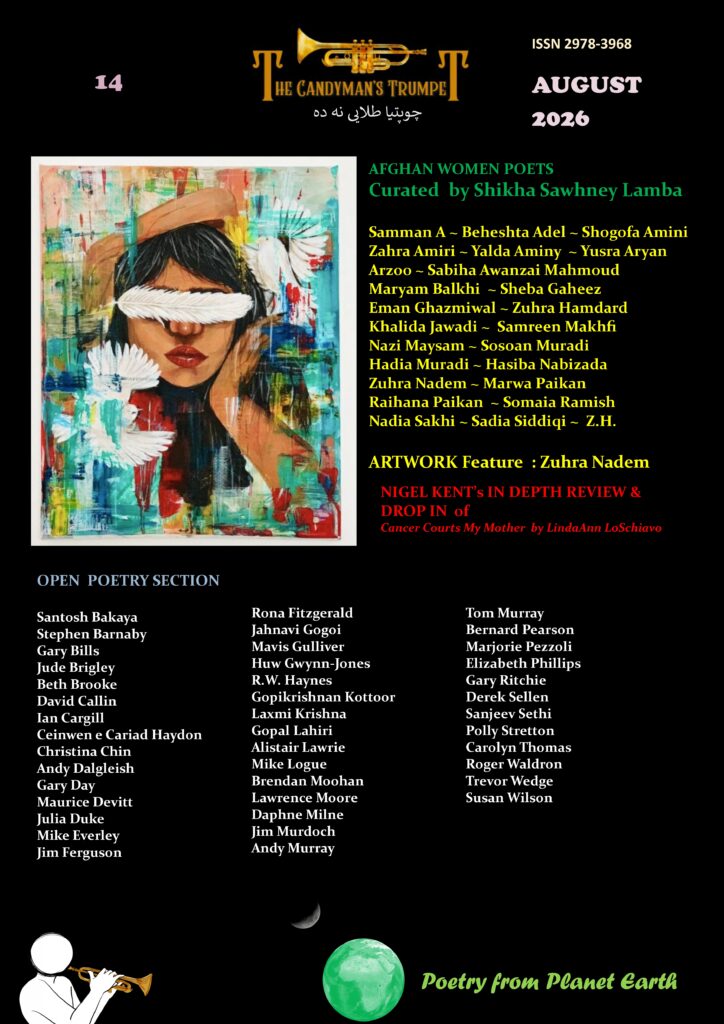
The Candyman’s Trumpet Issue 14 can be downloaded here.
Jan Lee is an award-winning writer and environmental journalist. She is the co-author, with Steve Willis, of Fairhaven – A Novel of Climate Optimism (Habitat Press UK), a winner in the Green Stories contest, and of its companion volume, Defying Futility – The Fairhaven Stories. Her work has also been nominated for a Pushcart Prize and recognized in the “Writers of the Future” contest. She is Editor-in-Chief of The Apostrophe, a quarterly literary magazine, and a Reporter and Book Reviewer for the magazine Earth.Org. She also currently acts as a senior advisor for a number of environmental and social activist organizations in Hong Kong and Lisbon. Prior to focusing on sustainability writing and activism, she worked in corporate affairs and sustainability in the Asia Pacific region from 1994-2025. She previously led ESG and communications in Asia Pacific for Lenovo, as well as Corporate Citizenship and External Communications Asia Pacific for BASF.