Apoorva Shekher
Disclaimer: This is a work of fiction informed by oral narratives inherited from the author’s Kashmiri Pandit grandparents. The characters, specific incidents, and places are not intended as representations of identifiable individuals or environs, but as a literary articulation of the historical experiences of the Kashmiri Pandit community and their shared tribulations. As such, any resemblance to actual persons (living or dead), events and places is purely coincidental.
‘Thud’ came the sound that woke Alok from his deep, sound slumber. In a state of somnolence, he started looking for his woollen slippers under the bed when another sound of a similar nature but louder in intensity cracked his ears and roused him rather forcefully. Alok rushed outside and found a few rowdy-looking youngsters throwing stones at a building in the precincts of the Sharda Temple. Upon realizing Alok’s entrance, the kids ran outside while hurling abuses and calling him names in Kashmiri. Alok rebuked them in return, all this while wondering if the mischief had led to any serious damage inside the building.
The building housed some of the ancient and most valuable idols of Sharda and other goddesses worshipped in the pre-Harappan age that had recently been discovered and subsequently stored and preserved inside the premises of Sharda Vidya Peeth in Srinagar in collaboration with the Architectural Society of India. Alok Kaul was the caretaker cum manager of the Sharda Centre and had only recently been given accommodation inside the premises so as to guard the immensely precious artefacts from the glorious past of a nascent nation. Since the tribal invasion of 1947 that had resulted in the decimation, pillage, and plunder of several ancient Indian valuables placed inside temples in Kashmir, the Society had been watchful to circumvent such breaches of security inside the few surviving temples in the valley. In spite of all this, some young radicalised locals did not leave any opportunity to cast vengeful attacks on Sharda Centre and sometimes even pasted threatening letters written in Urdu outside the Centre. Alok, however, had never learnt Urdu despite having lived in Srinagar all his life because his father had forced his enrolment in Sanskrit instead of Urdu classes in middle school and thus, he could never understand the content or the intent behind those letters.
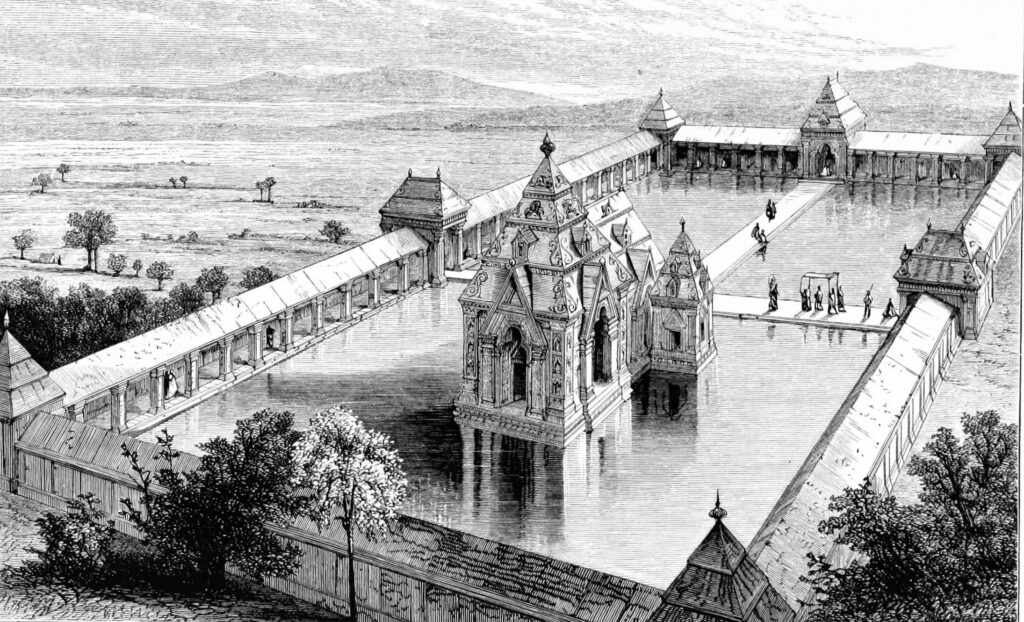
The Centre had managed to lay its hands on many of its prized possessions made of clay, gold, silver, and pewter by appealing to the Society to consider the rich heritage of Kashmiri Pandits and their ancestral preoccupations with preserving precisely such treasures of Hindu heritage. Establishment of one of the Society’s centres inside Sharda Peeth also meant greater funds and even more coverage in the press for Sharda Vidya Peeth. The SVP director Dhar Sahib could not forgo such a golden opportunity in his endeavour to safeguard the remaining temples in Srinagar and the other districts of Kashmir. The ruins of Martand Temple almost always brought him to tears as he contemplated the rich architecture of the temple which screamed the songs of a glorious past, even through dilapidation. He wanted a sagacious yet sensitive person as the guardian and there could be no one better than Alok Kaul for the job.
Alok’s childhood had been filled with the marvellous tales of Kashmiri Pandit wazirs who had undertaken the perilous task of driving tyrannical Afghan invaders out of Kashmir in collaboration with the Sikh ruler Maharaja Ranjit Singh. The sacrifice rendered by the wives of such heroes filled the young Alok with awe and admiration for his Pandit lineage. This was one of the chief reasons why he was primarily interested in earning his living through an occupation that would put him in close contact with the Pandit memorabilia. And so, when he went to Sharda Vidya Peeth for an interview, the interviewers including Dhar Sahib from the illustrious family of Birbal Dhar and Bal Kak Dhar were genuinely impressed and surprised by the vast knowledge of the young job seeker. After the death of his father, Alok requested Dhar Sahib to let him stay in the Sharda Centre quarters as he would be able to offer additional protection and security to the precious collectibles. Dhar Sahib readily agreed as he could see the desperation in Alok’s request and also because he had not even asked for a hike in his salary.
Alok’s task was to document the newly arrived statues and idols and note them down in his small yellowing journal, clean the dust accumulated on the more treasured possessions as he was the only one trusted with their careful handling, and guard the establishment at night from nocturnal trouble makers. And Alok was quite adept at the task as he never saw it as the burden of a new job, rather he felt emotionally invested in it. He often imagined the statuesque manifestations of Goddess Saraswati in clay and gold and silver conversing with him. He felt a human connect with the dehumanized portraits stored inside the building. The idols talked to him and made him aware of the times they came from — the nomadic lifestyle of the hunter gatherers as opposed to his sedentary living, the sophistication in the painting and sculpting of the so-called ‘savages’, and the numerous kings and princes who had all played their part in the long travelogue shared by these figurines. Alok revelled in being the sole recipient of such enriching, time travelling experiences.
A couple of decades after Independence, the furore around the funds granted to SVP began. It became even more difficult for Alok to safeguard the premises at night as angry locals often barged inside threatening him with dire consequences if he did not budge and resign from the post. Alok took them as hollow statements made by disillusioned people who would conform once the volatility in the atmosphere subsided. But their words became graver each day until one night the huge Gulmohar tree towering over the environs of the SVP was burnt by some unknown crepuscular delinquents. It broke Alok’s heart to witness the enormous tree writhing in pain with the massive fires engulfing it inside like a giant adder devouring its prey. Following this incident, it was considered unsafe for Alok to stay inside SVP at night and so, the Board of Directors decided to put some local guards on duty while Alok was instructed to find another place to stay.
Bereft of his only home, Alok’s dilemma was understood by Dhar Sahib who offered him his own outhouse to stay put. Alok could not fathom the reality unveiling itself before him. The history of Martand ruins was going to repeat itself but this time he had to undo the failures of the past. History had given him this chance, the only chance he had, to secure the treasure trove of idols and statues. He made up a hasty plan to transport all the collectibles to Dhar Sahib’s storehouse without the latter’s knowledge. He waited for Dhar Sahib to fall asleep and then went on his nightly adventure to shield what he thought was his only connection with his past and his Pandit heritage.
Upon arriving at the SVP gate, he noticed the guard was no longer there and a large number of miscreant teenagers were setting fire to SVP’s outer buildings that were already beginning to get singed. The guarded museum was still left and the troop of malefactors was going in that direction when Alok outran them at full speed and locked himself inside the building. Next were heard sounds of threatening, coaxing, menace but Alok was immune to all that. He just wanted to cast a last glance at every souvenir of the past before it was violently taken away from him. He took one of his most favourite idols of Pashupati in his arms and tried to imagine its expedition as a relic of the distant past. Soon the realization dawned upon him that he too shall have to go on a similar voyage, living or dead. His remains will also become a part of nature and become cyclically involved in engendering more lives and influencing their journeys. This was the last thought that crossed Alok’s brain before he fell unconscious in the smoke-filled room.
When Dhar Sahib opened the gates of whatever remained of a building, he found Alok on the floor clutching the Pashupati tightly onto his chest, his eyes looking as alive as in a dream. His lips were moulded in the shape of a content smile. Dhar Sahib did not snatch the idol away from its guardian. He understood Alok’s sacrifice and believed him to have gone away so as to become a part of what he cherished the most — his heritage, his culture, and his proud lineage.

Dr. Apoorva Shekher is currently an Assistant Professor in the School of Languages and Culture at Amity University Punjab. She holds a PhD from IIT Ropar and her research has been published in journals such as Critique and English Studies, with interests spanning neo-Victorian literature, memory studies, and historiography.
X: @ApoorvaShekher; FB: Apoorva S
Featured photo: “The Ruins of Martund” by John Edward Saché, 1873 (Getty Museum Collection)