Kathiravan Annamalai
“I don’t think writers are sacred, but words are.”
– Tom Stoppard, The Real Thing
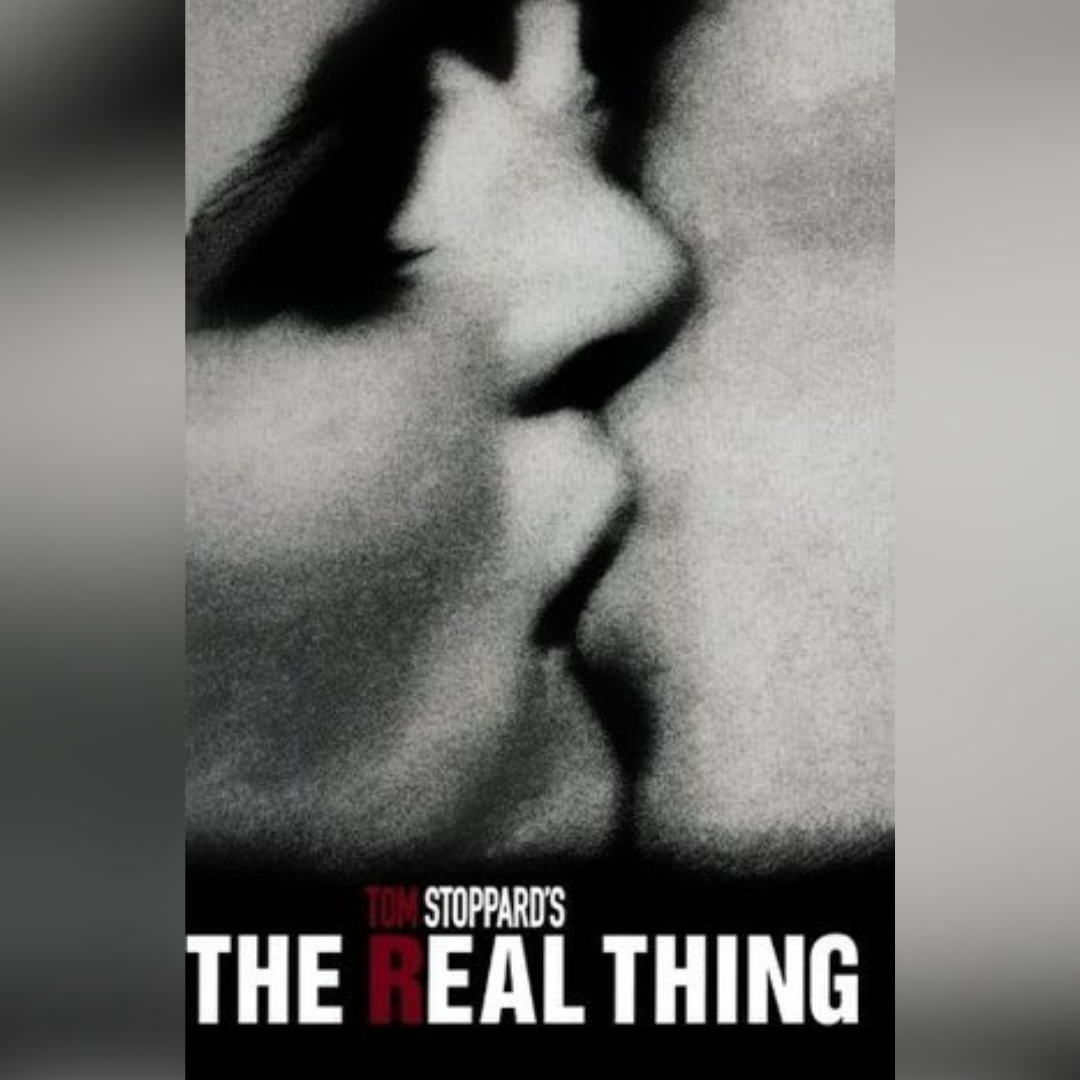
“When a line is good, it ceases to belong to any school,” writes Julian Barnes in his Flaubert’s Parrot (1984), suggesting the inherent capacity of a literary work to stand above the writer’s intentions, the reader’s received and perceived meanings, and critical lenses of the academicians. Many of Tom Stoppard’s works display such quality and evade labeling, and one such work is his riveting play, The Real Thing (1982). It is a play about a playwright, Henry, who struggles to write a play for those “who write for people who would like to write like (Henry) if only they could write” (Stoppard, The Real Thing 50). In other words, the playwright Henry falls in love with Annie, an actor involved in politics, who is married to Max, an actor who plays the role of a cheated husband in Henry’s ‘House of Cards’ alongside Charlotte, Henry’s actual wife. As ambiguity is inherent in any great artwork, this play is no exception.
The Real Thing challenges its audience to figure out what is genuine and real amidst different layers of theatricality and contrasting viewpoints. For instance, the very title of the play foregrounds a fundamental ambiguity. If we assume the ‘thing’ to be the idea of consummate love (as love is one of the important themes of the play), the question arises: can there be something called real love? If we shift our focus to the ‘real’, we may have to ask: how much real is real? Between such ambiguities, Stoppard meticulously constructs a world where every character is in pursuit of his/her own ‘real thing’.
Meta-theatrical Structures and the Fragmentation of Reality
Act 1, Scene 1 of the play opens with Max building a house of cards when his wife Charlotte enters the hall, slamming the door (with the same intensity that Ibsen’s Nora slammed when she walked away). He soon confronts his suspicion of Charlotte having an affair as he raids her bedroom and wonders why she left her passport when she is supposed to be abroad. Soon, we realise that the first scene is a rehearsal of the play ‘House of Cards’, written by Henry, who is actually married to Charlotte. By the end of Act 1, we learn of the affair between Henry and Annie while married to their respective spouses. Soon, Henry and Annie marry each other, but their relationship becomes strained when Annie becomes involved with a young actor, Billy, while working on a play in Glasgow. Meanwhile, Annie is also fond of Brodie, a former soldier and an aspiring playwright. With such complicated threads of relationships, The Real Thing explores the universal themes of love, loyalty, marriage, and artistic integrity.
At the heart of the play’s thematic complexity is the ‘plays within a play’ concept. The initial sleight of playwright’s hand in Act 1, Scene 1 establishes a meta-fictional framework where the line between staged performance and real life gets blurred. The act of Max (a character in Henry’s play, also played by an actor named Max) building a house of cards in this opening scene serves as a visual metaphor for the fragile and constructed nature of the realities presented. As the play progresses, Annie rehearses to act in another play, ‘Tis is a pity She’s a Whore, from where she falls for the young Billy. There is yet another play, Brodie’s political drama that intersects with the narrative by further multiplying the layers of performance and oppugning the ability of the audience to locate a single, objective reality. This technique constantly destabilises the audience’s perception of truth. Such stage directions add to the cyclicality of the themes handled in the play. The setting and mood of Scene III make it reminiscent of the beginning of Scene I, and Scene IV reminds us of Scene II. Scene VII’s living room is the same as that of the living room of Scene II, and it continues in the same fashion. Stoppard writes, “Scene 8 was spoken twice, once as a ‘word rehearsal’ and then again as an ‘acting rehearsal’” (Stoppard, The Real Thing, 67). Observing Stoppard’s expression of his “basic sense of disorder,” Gabriele Scott Robinson finds two ways in which it gets reflected. One, “by making it the subject of his plays and having his characters talk about and be thwarted by it,” and two, “indirectly, in the form of his plays, by a lack of development and coherence in his plots, which are constructed episodically of a chain of arguments and counter-arguments” (Robinson 37). One can notice both the methods being employed in The Real Thing.
As an extension of the lack of coherence, blurring identities and experiences among the characters is another way Stoppard discards any singular notion of ‘the real’. In the beginning, Charlotte critiques the artificiality of Henry’s dramatic dialogue and foreshadows events in her own ‘real’ life by suggesting that Henry would not be so witty if he discovered her with a lover. Interestingly, Charlotte’s situation (having an affair) is the same as Annie’s when she faces complications in her relationship with Henry. Such infidelity and emotional entanglement force the characters to repeat or inhabit similar roles. For instance, Henry and Annie keep asking “Are you alright?” to each other. This question takes on various shades of meaning as their bond evolves and reflects the ambiguous nature of their connection. Through such presentation of complex relationships, Stoppard asks the question of whether real love can exist outside these recurring patterns.
Conflicting Voices: The Debate Between Aesthetic and Political Art
As Stoppard observes, his characters engage in “a series of conflicting statements made by conflicting characters, and they tend to play a sort of infinite leap-frog… an argument, a refutation, then a rebuttal of the refutation, then a counter-rebuttal, so that there is never any point in this intellectual leap-frog at which I feel that is the speech to stop it on, that is the last word” (Stoppard, Ambushes 6-7). This is exemplified in Henry’s blind pursuit of aesthetic perfection by rejecting everything that is outside his beliefs and Brodie’s politically inclined, passion-driven writing. Stoppard’s genius lies in his ability to present conflicting viewpoints with the same conviction. Through Henry and Brody, he presents a multifaceted argument about the purpose of art and the nature of truth without advocating for one side over the other.
Annie defends Brodie, a soldier imprisoned for an act of protest, and his attempt to write a political play. She argues that Brodie’s writing should not be judged by the conventional standards of “Eng. Lit.” (Stoppard, The Real Thing 49). For her, Brodie is not writing to compete like Henry but for a bigger cause. He is writing to be heard. He has done it “on his own” and is a “prisoner shouting over the wall” with “something real” (51) to write about. This perspective stands for the powerful voice that emerges from genuine experience and political urgency, which suggests that the authenticity of the message outweighs its pursuit of literary aesthetic.
However, Henry finds Brodie’s work to be “no good” and “not literary”. He criticises Brodie’s “anti-intellectualism” and “complete lack of writing ability”. Henry passionately argues that words “deserve respect” and need to be used “right and in the right order”. He sees words as “innocent, neutral, precise, standing for this, describing that, meaning the other” (54). He also brings out a philosophical distinction: while objects like a coffee mug have a “real” form independent of perception, concepts like “politics, justice, patriotism. There’s nothing real there separate from our perception of them” (53).
Further, the cricket bat metaphor, articulated by Henry, is a powerful illustration of his philosophy regarding language, writing, and the essence of genuine artistic craft. Brodie’s writings, a “lump of wood” as he calls it, cannot achieve the same impact as a finely tuned “cricket bat”. Annie summarises the difference between the two characters in the following words: “To you, he can’t write. To him, write is all you can do” (54). Stoppard does not shy away from the complexities of these opposing views rather he embraces them. By giving both Henry and Annie (and, by extension, Brodie’s perspective) strong and compelling voices, Stoppard ensures that the audience confronts the nuances of the complexities of the human condition.
In conclusion, the play displays the concept of the real with all its inherent complexities and contradictions. When love enters this equation, it complicates the matters further. To showcase this complexity, Stoppard deliberately blurs the boundaries between performance and reality, between staged emotions and genuine feelings and situate his play in between the exteriority of societal conditions and the interiority of human connections. From experiencing such intricate exploration of realities, one can infer that the ‘real’ side of anything may be another house of cards that could collapse at any moment.
Works Cited
Stoppard, Tom. The Real Thing, Faber and Faber Limited, 2010.
Stoppard, Tom. Ambushes for the audience: Towards a high comedy of ideas. 1974.
The Real Thing: Essays on Tom Stoppard in Celebration of his 75th Birthday, Edited by William Baker and Amanda Smothers, Cambridge Scholars Publishing, 2013.
Robinson, Gabriele Scott. “Plays without Plot: The Theatre of Tom Stoppard.” Educational
Theatre Journal, vol. 29, no. 1, 1977, pp. 37–48. JSTOR, https://doi.org/10.2307/3206500. Accessed 6 Sept. 2025.

Kathiravan Annamalai is a Senior Research Fellow in the Department of English at Pondicherry University, with research interests spanning Social Movements, Subaltern Literature, Drama, and Translation Studies. An active literary translator working between Tamil and English, he has translated the works of C.N. Annadurai, Bama, and Imayam into English, and Langston Hughes and Zora Neale Hurston into Tamil. His forthcoming edited volume, Imayam: Beyond the Canon, co-edited with Prof. T. Marx, is to be published by Peter Lang.
Beyond academia, Kathiravan is a screenwriter whose work in independent cinema has earned significant recognition. His films — Sennai (2021), A Fly (2023), Yaazhi (2025), and The Tales of the Ukulele Man (2026) — have been screened at prestigious platforms including the Calcutta International Cult Film Festival (Sennai), the Cannes Indie Film Festival (Yaazhi), the International Film Festival of Kerala (A Fly), and several other reputed festivals across the world.
IG: @kathiravan_annamalai
LinkedIn: Kathiravan Annamalai