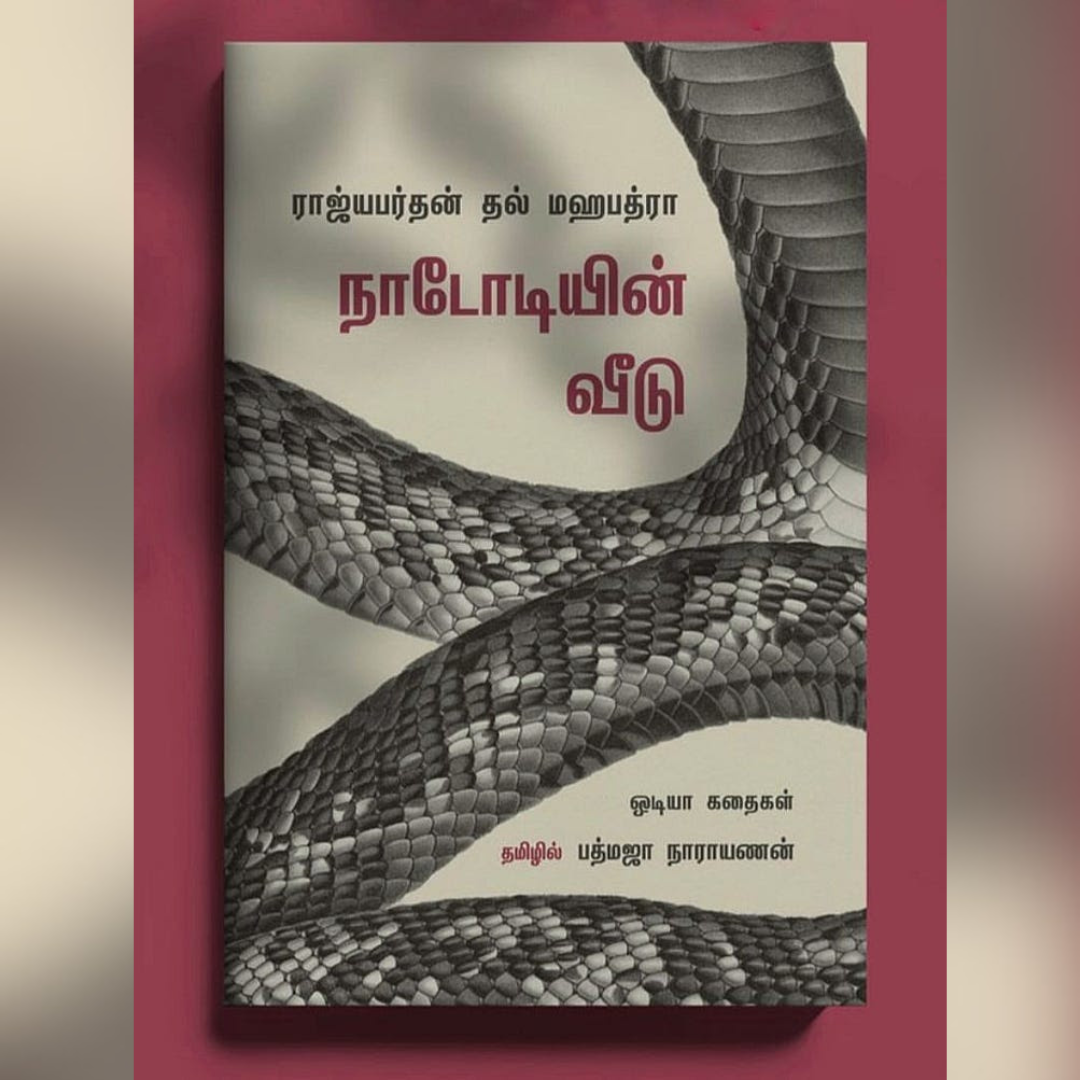
Nadodiyin Veedu (The Nomad’s House) is a riveting collection of ten Odia short stories by Rajyabardhan Dhal Mahapatra, each unique in its own way in challenging our conventional understanding of reality. Originally published in Odia as Sthayee Thikana and translated into Tamil by Padmaja Narayanan, these stories blend the everyday with the uncanny by capturing domestic spaces undergoing grotesque transformations, familiar social habits revealing their hidden absurdities and also the dissolving human–animal boundaries. To read Mahapatra’s stories is to experience defamiliarisation, a literary technique developed by the Russian Formalists. Defamiliarity occurs when the literary language disrupts habitual perception by making the ordinary appear extraordinary and the extraordinary disturbingly ordinary. Exemplifying this technique, the stories in this collection transform mundane elements, such as the trees, pet snakes, birds, family responsibilities, and marital bonds, into sites of profound strangeness upon which most of the narratives are mounted.
The Uncanny Familiar: Nature and Domesticity
The initial stories in the collection make the familiar defamiliar by introducing uncanny elements into domestic spaces. For instance, in the collection’s first story, “Kurukkappatta Maram” (“The Miniature Tree”), the narrator brings home a genetically modified miniature tree to which his mother protests. She questions the ethics of such manipulation. She says, “This is man tormenting nature. It is not just to keep cutting the roots of a tree and stop its growth by cutting off its nutrients.” The story’s horror unfolds as the narrator hallucinates about the tree begging for water which he correlates with his pregnant wife’s recurring dreams of their unborn child crying, “I am hungry, I am thirsty.” When she delivers a baby so small the doctor compares it to “a mouse from a mountain,” the narrator identifies it as the Vamana avatar of Vishnu, which was a dwarf. Mahapatra achieves defamiliarisation here by literalising the metaphor where the ethical violation against the tree manifests physically in his son’s body.
“Paambu Manaivi” (“The Serpent Wife”) pushes this boundary dissolution further by blurring the human and animal identities. Young Kaaku raises a snake named Baski, and they share a mystic relationship. Mahapatra writes, “Rather than sleeping inside the basket, the serpent slept outside in a corner of the house. If Kaaku stays home, it slithers towards him, keeps its head in his lap, and coils its tail around his back. Sometimes, at night, it sleeps next to him. Kaaku, too, sleeps curled up.” Eventually, the snake acquires human qualities while Kaaku’s behaviour becomes serpentine. The story’s most disturbing turn comes when Baski sexually engages with Kaaku, lays eggs, and finally devours Kaaku’s new bride. Mahapatra’s narrative tone makes this story unique. The grotesque events mentioned above unfold in a matter-of-fact prose, as though they were ordinary occurrences. This technique renders the horror banal and the banal horrifying.
In “Mynavum Oomai Kuzhandhaiyum” (“The Myna and the Mute Child”), the roles are similarly subverted. A bird magically acquires speech while a child remains mute. The story concludes with a strange familiarity when a cat attacks the bird and the child suddenly shouts, “Amma, Amma, come here fast.” Here, defamiliarisation operates through reversal: what should be natural (the child speaking) appears miraculous, while what should be impossible (the talking bird) has become normalised within the story’s logic.
The Hidden Absurdity: Family and Social Realities
The collection also examines how ordinary social practices carry their own unsettling strangeness. These stories appear as slice-of-life narratives but reveal greater discomfort beneath their familiar surfaces. “When Are You Going to Leave, Father?” is one such story that captures a family’s exhaustion as they wait for their dying father to pass. As days stretch into waiting, the family members’ vigil eventually transforms from their grief into impatience. The story ends with the question: “When are you going to leave, father?” Another story, “The Wish Was Fulfilled” inverts this family dynamic. Here, a father refuses to die and prevents his son from securing a government job on compassionate grounds. As the son contemplates patricide, the story concludes with the father asking him: “I am your father, do I not understand your feelings?” Mahapatra’s genius lies in exposing the unspoken aspects within the family obligations and the socially suppressed irritation that accompanies even genuine love. By revealing what kindness and love demand from us, he amplifies the obstacles that make such tenderness impossible.
“Confession” and “The Map of Illusion” deal with fathers and sons confronting emptiness. In the former, a dying father reveals he has no property to bequeath and asks his son to forget this truth and be happy. In the latter, an aspiring painter converses with a master who has spent years waiting to paint his final masterpiece. Both stories explore the spaces between aspiration and void. The title story, “The Nomad’s House,” is about a nomad marrying a beautiful woman, who soon climbs up the social ladder, acquires property and political power, and eventually leaves him. The nomad decides to return to wandering, asking, “Why would a nomad ever need a house?” Home becomes strange in these stories. Mahapatra enlarges the tensions simmering within families and brings the hidden absurdities to the surface. The ordinary occurrences of domestic life turn unfamiliar, and what should comfort begins to disturb.
These stories occupy the liminal space between the familiar and the defamiliar. They let the readers to constantly question how we perceive what we perceive and open up new interpretations. Through his unity of effect, every narrative element converges to destabilise what we assume to be real or normal. In a nutshell, Mahapatra’s stories uncover the uncanny that lurks around everyday life.


Kathiravan Annamalai is a Senior Research Fellow in the Department of English at Pondicherry University, with research interests spanning Social Movements, Subaltern Literature, Drama, and Translation Studies. An active literary translator working between Tamil and English, he has translated the works of C.N. Annadurai, Bama, and Imayam into English, and Langston Hughes and Zora Neale Hurston into Tamil. His forthcoming edited volume, Imayam: Beyond the Canon, co-edited with Prof. T. Marx, is to be published by Peter Lang.
Beyond academia, Kathiravan is a screenwriter whose work in independent cinema has earned significant recognition. His films — Sennai (2021), A Fly (2023), Yaazhi (2025), and The Tales of the Ukulele Man (2026) — have been screened at prestigious platforms including the Calcutta International Cult Film Festival (Sennai), the Cannes Indie Film Festival (Yaazhi), the International Film Festival of Kerala (A Fly), and several other reputed festivals across the world.
IG: @kathiravan_annamalai
LinkedIn: Kathiravan Annamalai