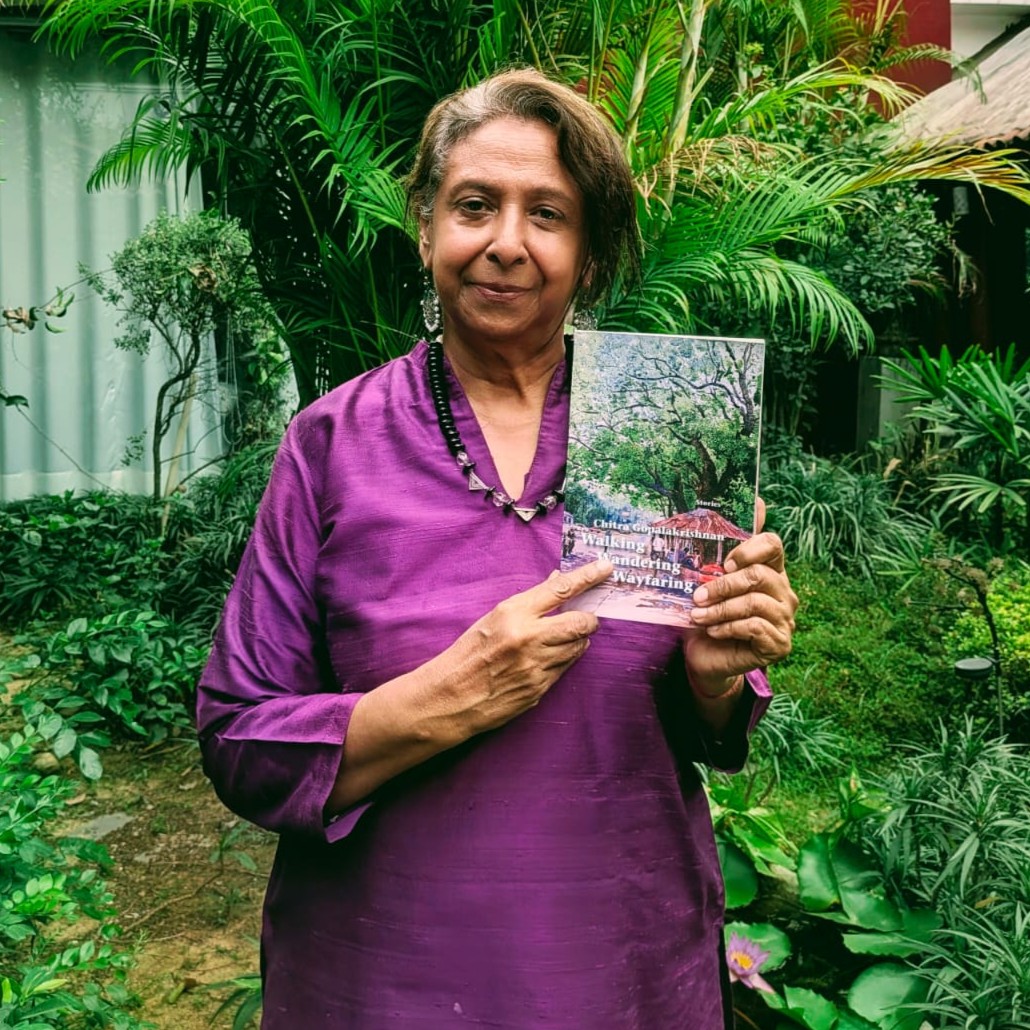
I have been following the contours of Chitra Gopalakrishnan’s writings for many years now, especially her short stories, in various Indian and international journals and anthologies. Her ability to tell a good story, to say a lot within a tiny story, making each word matter, her knack for bringing each of her chiselled characters to life, and her finesse in weaving an atmosphere real enough to breathe in are remarkable. Her stories have always made me wait for more. If she talks of the eternal and the ethereal in her stories, there is also a grittiness to them when she broaches social and economic issues, often riddled with inequities of all manner. I notice that she hears the voices of women who live on the margins with clarity and renders them with scrupulous honesty and the lucidity that these women deserve. Her writings are indeed an intriguing congruence of the earthly and the un-earthly. I talk to her about her just-released collection of short stories, Walking, Wandering, Wayfaring, published by Penprints Publication, June 2026.
Walking, Wandering, Wayfaring fills out the idea of human existence as an ongoing journey. How challenging was it to balance transient experiences, the essentialist view of personhood, and the dissolution of the self—what Buddhists refer to as ‘anatta’ or no-self—to take the earthbound journey beyond the edge?
This collection, which features thirty-two stories, draws from the established ‘literature of journey’ genre, in which journey, voyage, and pilgrimage serve as metaphors for the human experience and its search for meaning. It differentiates between navigation, which follows a predetermined route to reach a specific destination, and wayfaring, a mapless, compassless, unrestrained exploration of the unobvious. I think this variance, this difference to the norm, and the separation of ‘what to do’ from ‘who to be’ is telling in the title.
In these stories, the ‘way’—whether it is along roads, highways, mountains, fields, rivers, ponds, forests, cities, villages, village squares, mofussil towns, or even cremation grounds—serves as a vibrant stage where travellers, both men and women, leave behind everything familiar and sedentary, and step away from the illusory realities of their lives, to rely on providence in their pursuit of meaning. In a world that valorises a coherent self, a singular personhood, this collection trails its readers into yet another ‘way’, into a world of non-existence, into an incandescent, limitless world where the ‘I’ merges with the matrix of the universe.
My challenge lay in shifting the reader’s focus from the physical to the metaphysical journey and moving their cognition from visceral and visual to one that is markedly less so. As the stories continuously shift from the sensory, gritty, untamed and vivid physicalities of everyday treks to the elusive, fluid state of the ‘no-self’, as you lucidly identify it, one that involves an incorporeal, boundless inner travel, resurgence, and throws away the linear conception of time and a rationalist worldview, it became a tightrope walk to keep both paths interesting and believable.
Moving from the body’s travels to the mind and then to the soul, and shifting from knowledge to knowing from being, and allowing each of these stories to form a seamless continuum, required consideration. The shifting modes of communication in the book needed to reach the reader’s mind and heart through the text and style. So, in a deliberate quirk, the order of voyages is backpedalled in this collection to indicate that the quests of the body, mind and soul are not separate or linear but intertwined. I am grateful Penprints Publication saw merit in this book and its detours to make it travel-worthy.
Wanderers, free in their wilderness, are at the heart of your collection. Have you, as a writer, worked consciously with this premise, and have you needed these wanderers for your own self-exploration?
I don’t believe I have consciously put my mind to the idea in the course of my writings over the years, but it seems to have permeated my unconscious and become enough of an idee fixe, as well as a strange certitude, to serve as an umbrella for this book.
I would agree with you that these, in a way, are my own explorations into uncharted paths, unimagined territories, and the lives of strangers that have bled into my fiction now feel as familiar as my own. Interestingly, in Japan, these wanderers are referred to as the ‘people of the wind’ whose rootlessness is turned into an experience of seeing.
Socrates believed an unexamined life is not worth living. What do the characters in your collection examine, seek, question and strive for?
For most travellers in this collection, the search for a path aligned with their ideas and intuitions is not merely a choice but a necessity.
The diverse stories are categorised into Soul to Soul, People to People, and Women to Women. At the risk of sounding simplistic, I would say the stories in the first section deal with people on the lookout for personal reckonings as they embark on inner journeys, where their locus of awareness shifts from the body and mind to the soul, even as their self-conceptions and life stories fall away. The second section fits into community-driven narratives, of people’s quests to affirm human bonds and emotional associations, stories of mutual support and co-existence, and the last section accommodates women-centred renditions that chase down their truths and voices, as they step out of their expected roles to untangle the misunderstood versions of their stories to gain new resonance.
Can we examine these searches in detail, as they are central to your collection?
In the opening section, in “Waldeinsamkeit”, the narrator ventures into the forest to confront her inner darkness, ultimately discovering her waldeinsamkeit, or inner peace, along with her true destiny. “Moment of Embarking” illustrates the journey from the temporal world to the ultimate invisible reality—the inner quest for soul-sight or darsana. In “An Unlikely Alchemy with Song and Butter”, a granddaughter retraces her steps to connect with her grounding, through her grandmother’s perspective, which teaches that joy resides within us, not in external circumstances. For the narrator in “Parrot Prophecies”, her visit to a prophetic parrot offers an opportunity for self-discovery, allowing her to confront uncomfortable questions, find her own answers, and carve out a personal path to joy. In “Chitralekha”, readers ride alongside a ganika, a seductive courtesan, in the Mauryan Empire of eastern India during the fourth century BCE, as she pursues self-transcendence in a forest.
The second set of stories grapples with the uncertainties of fate and circumstance: be it poor development and the resulting poverty, marginalisation, unemployment, and immigration, or caste inequities, or an intolerance of difference and unspoken rules of patriarchy, or environmental calamities such as pollution, floods, earthquakes, and climate change. They, in particular, highlight the lives of the poor, transcending mere sentimental sympathy to get beneath the skin of their lived realities.
“Torches in Shadows” highlights the protest journey of makhana growers in the Mithilanchal region of Bihar as they reclaim their harvesting rights from a society that denies them their humanity; they find their answers within their alternative narratives. “Time to Sink Roots against Wind and Rain” follows the search for acceptance, solidarity and trust among migrants, and “A World Beyond Our World” tails the same theme. In “Praying for Rain, Drowning in the Floods”, readers trek with a journalist into a flood-ravaged village in Himachal Pradesh to seek answers to floods and climate change and their resultant aftermath that India struggles with. It questions, along with the community, why people-based sustainable water management practices, which have worked for centuries, are not considered progressive enough by development planners.
Women wanderers, who carry the raw weight of their pain and social anxieties, and who live between tradition and rupture, solitude and community, love and abandonment, and within societies that impose silence and intense suffocation, yet who travel, stepping out of their expected roles, without buckle or complaint, have a special place in this volume. Their voices from the margins have been made audible as their quests, choices and agency. More importantly, as they hear themselves, their stories become attentive to their interior lives, not so much to arrive at resolutions as to uncover them as sites where memory, endurance, resistance, and courage find place and strength.
In “Bail Denied”, Meera, an uneducated, frightened woman, uproots herself from her village to move to New Delhi, in pursuit of justice for her husband, charged with rape. The story both hears her cries in her strange, social situation and revels in her hope as new possibilities unfold, offering her a different way to approach her situation. “For a Home, A Port in the Storm” explores Reba’s hunt for a lasting home against the backdrop of the Bangladesh Liberation War in 1971, as her family leaves behind their past, and a part of themselves as they flee as refugees. In “The Goat Woman of Mandi Road”, the narrator forages for answers to her life by cross-questioning an itinerant woman goat herder. “Seeking the Colours of the Shadows” uses the inheritance stories of the narrator’s foremothers, their deep-rooted connection to history and traditions, for answers to present-day complexities.
The message that stays is the acceptance of the unknown as you draw a line on the outer limits of human knowing.
Even when journeys end, a lingering question remains: did the wanderer find the way, or did the way find the wanderer? This uncertainty, the infinite mysteriousness of life, is where human courage resides. There is a need for people to suspend belief and accept the strange and the inexplicable as they approach life, while also accepting that some questions in life may have no answers. “What This Life Is Meant to Be” tells the story of a woman who works as a corpse burner in Bihar. Marginalised by her community, she has been unable to fulfil her own dreams. Yet, she perseveres in creating a better life for her child. Does she find the way, or does the path reveal itself to her? We may never know.
Many readers could be uncomfortable with these unconventional wanderers. They might resist their outrageous journeys and the absence of straightforward roadmaps. Some may also be unsettled by the fragile aspects of humanity, the harsh realities of people’s setbacks, and the lack of easy resolutions. Some could be bothered by having to accept two conflicting truths at once. These narratives do not follow a traditional structure or arc as people know it, nor do they have tidy endings.
“A Gordelian Incompleteness” delves into the question of whether a complete life truly exists. A widowed math teacher probes the theory of incompleteness by mathematician Kurt Gödel to understand her own life. Ultimately, she realises that the only way to face life is to embrace its fragmented nature. “To Dance Like a Peacock” and “A Living Otherness” address morality and allow the characters to confront these issues in their own ways rather than offering clear solutions.
The hope is that readers will find meaning within the apertures in the stories—in what is left unsaid, in the silences—and that the absence of definitive answers will lead them to deeper listening, receptiveness, contemplation, interpretation, remapping, and acceptance, in ways meaningful to them, and, perhaps, even rejoicing as they progress in their learning and becoming, as the characters in the stories do.
Through such explorations, readers may even recognise the counterforces at play. They might observe the quiet ways individuals connect with one another through undeniable warmth, witness how women persist with remarkable strength, both alone and in solidarity, appreciate the interconnected dimensions of a city or village, and also how the inner and outer landscapes intertwine, despite their stark contrasts.
As far as inner knowing is concerned, many of the stories draw attention to the limits of human knowing, as you correctly point out. In such instances, where one encounters the illusions of knowledge, many counterforces come into play, forces that defy reason and the time-bound methods of thinking of modern culture, to allow the readers to embrace an expansive way of looking and thinking.
These countercurrents, hopefully, also make readers think against the grain. And the good part is that the kind of spirituality that these stories hold is not dull, but it builds up to a liveliness and a magnetism of sorts. A simple instance of such sprightliness is that these narratives do not see death as a cessation but dissipation into other forms of energy, less trickster in nature than the current state of living. So, it leads one to intriguing, subtler explorations.
Healing. This transformative power is a salve to human limits in your stories.
People’s strength emerges from embracing the messy, unsettled contours of their journeys, becoming one with their paths, embodying their experiences, and radiating self-assurance and joyous freedom, even with its imperfections. “Destined for a Different Path” best illustrates this. A history professor is forced to leave his classroom for a life on the road. He forsakes cherished social and political norms in search of faith, compassion, love, and an affirmation of human values. As he journeys, he becomes one with the people he meets and the experiences he encounters.
Ultimately, in the book, there is a more enduring healing in the restoration of harmony among mind, body, and spirit through spiritual awakening that many narratives in my book dare to approach, with success or not, is, of course, for the readers to decide.
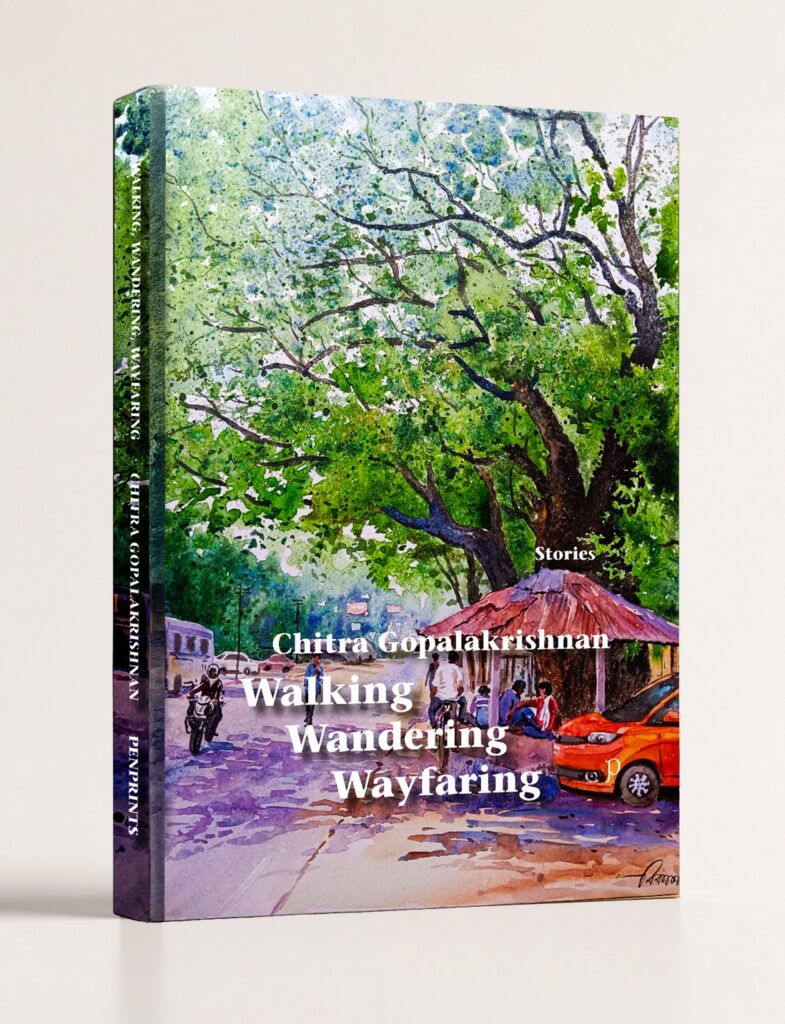
Finally, the cover of the book emanates an old-world charm. Tell us more about it. And also, of the photographs within.
Bikas Kundu’s watercolour is a spectacular image that bears all the elements of wayfaring, its quintessence as it were, roads, vehicles, salt-of-the-earth people, working-class muscle, and a resting and self-reflection place, things the book describes at length. Yet it stands quietly—unaware of itself, with no performance on show—doing instinctive and immersive justice to the idea of looking out and seeing within, much like the overarching tree, an enduring and unmistakable presence within it, that stretches one’s horizons from the earth to the sky. We could have gone for an abstract cover, but this was evocative of everything that the book says.
Similarly, Eklavya Prasad’s photographs placed within the volume were chosen with care from his wide repertoire to capture the essentiality of each section, its artistic vision and texture, as well as the beauty and complexity of human life reflected within the narratives. His visuals are of varying geographies make a statement yet they impel one to derive their own meanings till they become one’s reality.
Chitra Gopalakrishnan has built a long career as a journalist and social development communicator, specialising in environment, health, gender, and child rights. She now pursues fiction, creative nonfiction, poetry, essays, book reviews, and opinion pieces. Based in New Delhi, she uses her ardour for writing to break firewalls between nonfiction and fiction, narratology and psychoanalysis, marginalia and manuscript, and tree-ism and capitalism.

Mayuri Chawla Saini is a journalist, writer, former organiser of Hong Kong literary festival, and director Delhi Street Art, a premier art organisation.