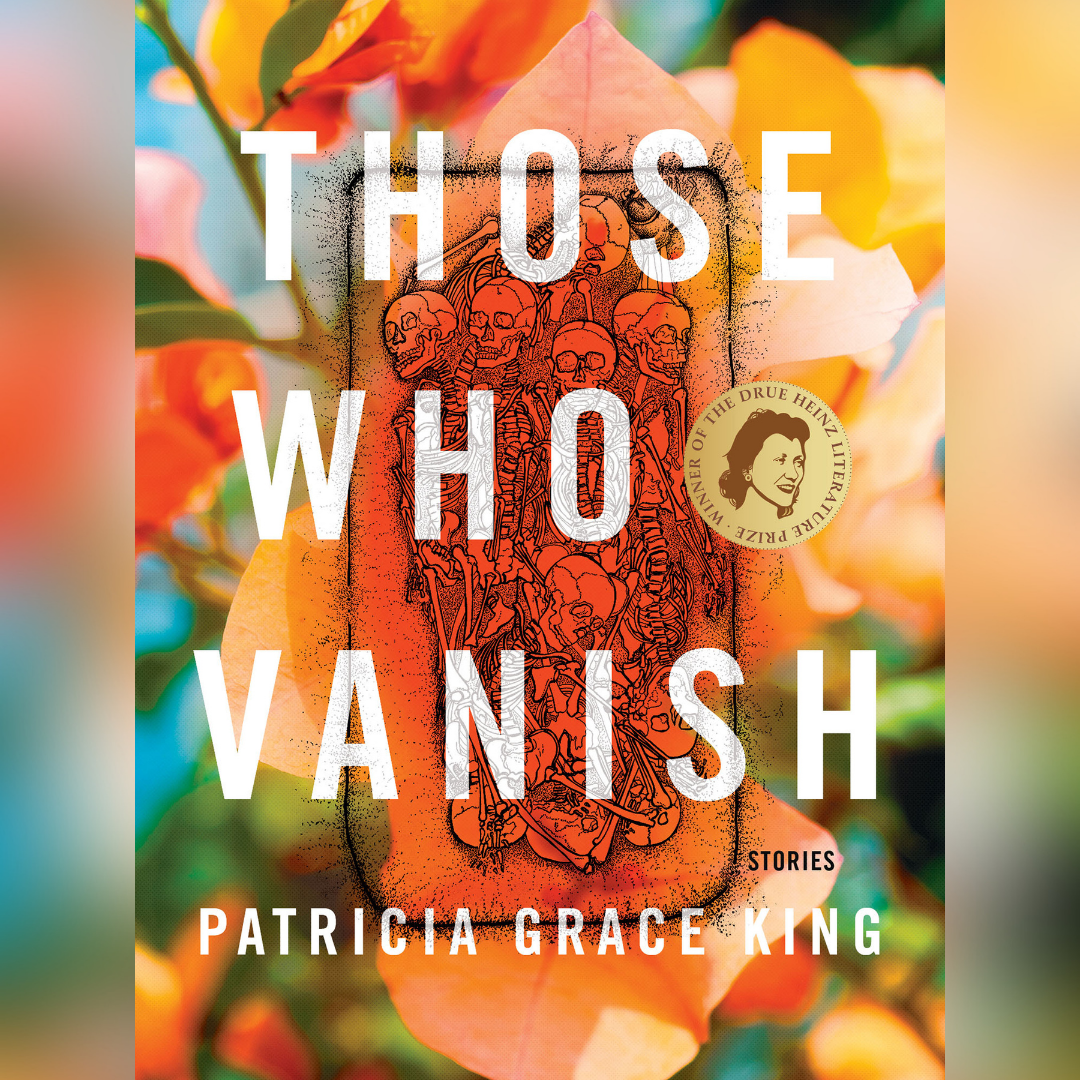
Too often, bad foreign policy in the U.S. becomes another country’s domestic nightmare. Never was this truer than in Guatemala, where, during the Cold War, a CIA-backed coup ousted the democratically-elected president and sparked more than thirty years of terror. From 1960 to 1996, an estimated 200,000 people died and countless more lost their homes and livelihoods due to state-sanctioned violence. Each piece in Patricia Grace King’s moving new collection, Those Who Vanish, plays out against this backdrop as young people seek love, normalcy, salvation, or saviorhood. For King’s characters, war is not just a flash on the nightly news, but ever-present and unavoidable, in real time or in recurring memory.
While King is from North Carolina, her obvious familiarity with Guatemala, and with Spanish – she interweaves the language so deftly that it never feels forced – means that many pieces read like mini-memoirs. Her spare, heartfelt prose brings the country to life (“It was early December, the weather so pretty you could break your heart on it”). I loved to read her writing about love, as in “Pax Americana,” in which Elsa and Eric, retell, at a dinner party, Elsa’s youthful escapades, driving home the point that we can never fully understand the ones we love. But King does not shy away from describing violence, the ugliness of battles fought not between equal opponents in neat formations but in villages where everyone, including children, are killed, where a handful of teeth are all that remain of a man who defied the government’s thugs. As the character Martín notes of his adopted neighborhood in “Day of All Saints,” “there wasn’t a house or a shack in the canyon where a family wasn’t missing someone.”
Of the eight short stories comprising Those Who Vanish, which won the Drue Heinz Literature Prize, roughly half are told from the point of view of a person who has come to Guatemala from the U.S. to, as they might put it, make a difference. In “Rubia,” one of the gems of the collection, Josephine admits, “There are some who say we shouldn’t have gone in the first place, that we had no business in Guatemala in the middle of a civil war,” though “I went to Guatemala to live because I liked myself better in this other country than in my country of birth.” In “Dogs in Guatemala,” Molly, a volunteer with a human rights organization, looks down upon the newer volunteers because of their sympathy for stray dogs: “They squeeze a week’s accumulation of horror and grief onto the dogs or the cats – objects of suffering that still make some sense. Whose pain is small enough to imagine.”
Through these characters – white, born in the U.S., and privileged enough to travel abroad – King captures the cringe of white saviorhood. She highlights the fine line between helper and trauma tourist, do-gooder and rubbernecker, and asks if well-intentioned foreigners can bring justice, or if they should make space for those who truly understand the country and its people. King’s intelligent treatment of the fundamental question, “Do we belong here?” also renders these stories the timeliest, since we are currently watching the U.S. engineer yet another war abroad, one that has already resulted in the deaths of innocent civilians.
Stories in the collection told from the point of view of Guatemalans are tender, comic, tragic, or terrifying, sometimes all at once. Martín was forced to build a new life from scratch only to fall in love with a rich girl from Chicago, who learns about the disappearance of his parents at a memorably uncomfortable family dinner. Ester confronts the bloody fate of her missing parents in “Already Gone.” The main character in “Small Country” experiences culture shock at a hilariously bizarre summer camp in the American South. And while these stories left me in anguish over orphaned children, reaching for my phone to research aspects of the terror that were new to me, and eager to know the outcome of a love affair frayed by trauma and distance, I kept returning to the question, “Do we belong here?” In other words, can the choice by a white American to write in these voices bring justice to their stories? Given King’s firm grip on this subject matter, and the beauty of her prose, I didn’t want to be thinking about narrative voice or authenticity. I wanted to be fully in, walking alongside these complex characters as they found their way through 1980s Guatemala, a place they love, even if they can never fully understand it.
Patricia Grace King’s Those Who Vanish (University of Pittsburgh Press, 2026) can be ordered here.

Joanna Theiss (she/her) is a former lawyer living in Washington, DC. Her fiction, poetry, and book reviews have appeared in The Penn Review, Your Impossible Voice, Peatsmoke Journal, Five South, and Best Microfiction, among others. You can find links to her published works and her mosaic collages at www.joannatheiss.com.
Bluesky: bsky.app/joannatheiss.com