Rakhima Imanaly
The Karatau Mountains are rather close to the city, and it takes an hour to get there by car. Despite their gloomy and lifeless outer façade, these mountains keep secrets. I was going to find out about them together with my friend Andrey who was an explorer by nature and a tour operator by occupation, and from time to time took me to explore different places to find a fine location for his tourists, where they could stay, have a rest, and enjoy the beauty of nature.
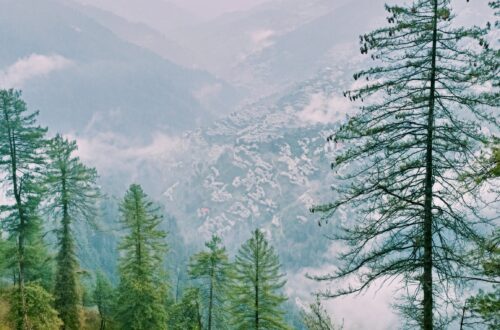
On that sunny April morning, the mountains looked gloomy, as always. They were deep violet, turning into graphite in some places. Still, they looked silent and lifeless. We travelled in Toyota Kruiser, an old car, which was very reliable and safe for mountain driving. The road was running straight up to the mountains. Andrey was a master, a professional driver who could follow dangerous mountain tracks confidently and securely. First, we went to the observation rock where we admired the view of the valley lying beneath us, at the hollow of which we could see the lake. It had fresh water of a dark blue color, and framed with reeds, that were white in the distance, looked like a gem. We enjoyed the view and took pictures from different angles, and every time, the pictures looked different and unique.
In half an hour, our travelling renewed. We took our seats in the car, and this time, Andrey asked me to fasten the belt and not to fear because we were going higher along the serpentine road that led us to the plateau on the top. The road was stony, narrow, and dangerous. Cut through the old cliffs of the mountains, it had sharp-edged stones through which the Toyota Kruiser made its way meter by meter. On the turns and abrupt places, the car nearly lay down on its side, and I experienced alarm and a sense of danger when I saw the stone ground quite half a meter below through the glass of the closed window. Quickly, my alarm and fear dispersed when Andrey distracted me, and I saw the beautiful views of velvet green hills and valleys heaving over us. Sometimes, the road became narrow, framed with walls of rocks and hills, where grew prickly shrubs and thickets of mountain geranium. When opening the window, I could smell wild mountain vegetation, among them both pleasant and pungent aromas of thyme.
“Is it thyme? Does it grow here?” I asked.
“Yes,” he answered. “On the way back, we’ll gather it. It’s good for tea.”
“How do you prepare tea with it?” I had little experience in making tea with mountain herbs.
“Very simple. You can take blackcurrant berries, just a bit of cane sugar, and add some leaves and soft twigs of thyme. You will have a wonderful tea.”
The conversation about tea diverted me from the road that the car was wading between cliffs. Even for a strong man who had decided to climb a mountain on his feet along that stone road, it could have seemed to be extreme. Miraculously, at the height, we achieved a flat plain that extended to the horizon. The road changed. Now, the car was rolling along the smooth winding road. We could see small herds of horses and flocks of sheep with shepherds on horses who greeted us raising their hands and smiling. The nature around us was beautiful. Green grass, wildflowers, and shrubs with pink and purple flowers covered the ground as a multicolored carpet.
Suddenly, Andrey stopped the car and waved his hand to the side. “Do you see anything there?” he asked. I looked in the direction he pointed to me. Far ahead, we saw red spots of flowers. There were numerous on both sides of the road, and at a distance, they looked like little islands surrounded by deep green grass. The sight was unusual, and we stopped to look through binoculars.
“They aren’t poppies, they look like tulips,” Andrey said. “I’ve never seen them in this place. Let’s go further.”
He was right. When we came closer, we saw tulips of a juicy red color intermingling with yellow-red tulips.
“By the way, I have learned interesting things about tulips,” he said.
“Tell them…”
“They have different types. They are distinguished by form, size, and color, and they blossom in turn. At first, the Turkestan Albert tulips, then the Kauphman and the Greig. In some places, where the heat of spring sun is not too strong, at the height of 2000 meters over the sea, where the snow and ice are lying and keep the ground wet and cool, all types of tulips can grow and bloom simultaneously.”
“Why Kauphman, Albert, Greig? They are foreign names…”
“The names of tulips are of German origin. They got their names after the German explorers. They found these tulips here.”
“Were they military men…?”
“I suppose so. Since then, their names have been preserved in scientific sources and are used for naming tulips by common people nowadays.”
“I presume they are under the guard.”
“Yes, there are thirty-five types of wild tulips and eighteen of them are in The Red Book. They are endemic. Greig and Kauphman gave birth to cultivated ones.”
“In Holland? Who knows about it?” I looked at Andrey inquiringly.
“Let it be our secret and the secret of these mountains,” Andrew said with a smile. We both laughed.
The next turn of the road opened the picture that stunned us. We saw the whole field of red-red tulips protruding up the horizon, as if Mother Nature wished to reward us for our silence and humility with her abundance. They were so numerous that they produced an impression of a red sea with waves of petals, shining in the sun. We got out of the car and went into the depths of that sea. They were amazing, gorgeous. Most of the tulips were of good size, about fifteen centimeters in diameter, and had strong green leaves and stems. They looked like lanterns, they burned with internal light. Their petals were bright crimson, and they swayed from the mountain breeze. I have never seen so many tulips in one place. They gave a sense of joy, happiness, and a riot of life.


We stayed there until the evening, and after having a delicious meal prepared on the open fire in an Afghan cauldron, we returned to the tulips, wondering at their beauty and luxury. In the light of a sunset, they looked fairy. Nowhere could I see such a catching picture which could leave an irrevocable deep impression on the soul.
It was a kingdom of tulips, a paradise concealed in a quiet place at the very height of the mountains. The road to it was hard and dangerous. Still, mountains opened their secrets to us, and we felt happy and grateful to Mother Nature for sharing them.
On the way back, we gathered thyme for tea, and I asked Andrey whether he would bring his tourists to the found location.
“No,” he said after some consideration. “I would rather not bring them … I want this place to be sacred and safe for all the tulips growing here.”
Still, when we visited the place some years later in April, we expected to see its beauty again, but we did not find the tulips there. Mountains are like people, they show their secrets only once. We are to be aware of it at a given time, otherwise, we lose this chance forever.


Rakhima Imanaly is a retired university professor from Kazakhstan. Her specialization is English. In her country, she teaches Style and Stylistics, and for the last few years, she has taught Creative Writing to senior students from the Philology Department. She is the author of the non-fiction book, Aspiring Me: A Memoir of Teaching, published by Darynbaspa in 2023 in Almaty, KZ. In her free time, she writes stories in English. She takes this seriously and understands that it is not an easy job. Some of her stories were published by online journals LiteZine, Reedy Branch Review, and YAWP. You can find her at @rahimaimanalieva
Photos by Rakhima Imanaly