Anjana Basu
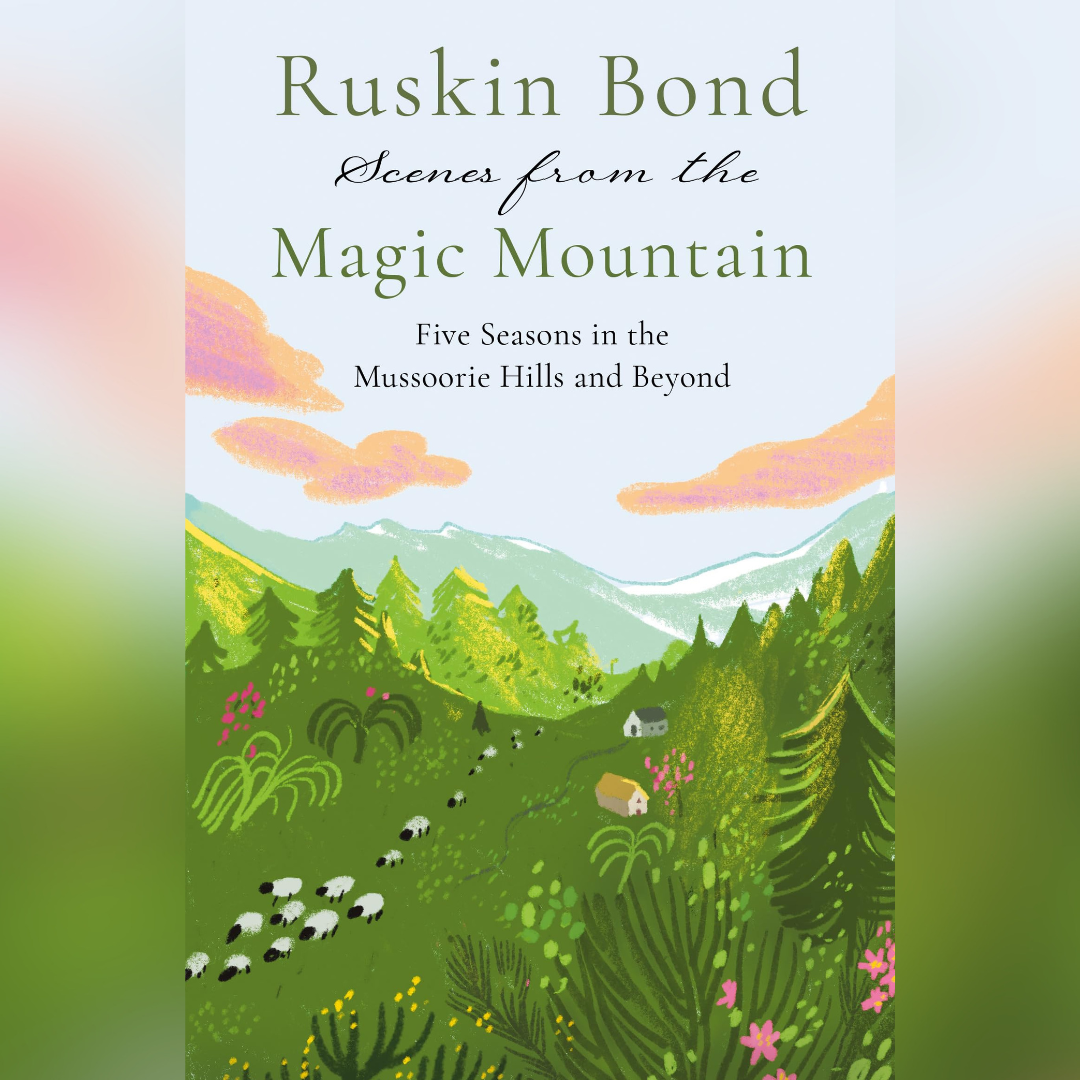
As he advances in years, excerpts of Ruskin Bond’s writing are being collated in anthologies with varying themes that put a different take on his work, giving those who may not have read the originals a chance to enjoy his musings as a guide to nature and living. Scenes from the Magic Mountain brings Bond’s love for the hills and its beauty in its different seasons to nature lovers and admirers of his work.
The book is a gentle, reflective collection, you might call it a memoir, that brings together a lifetime of observing the changing seasons in the hills. The drama in it comes from snow and thunderstorms, more importantly, it focuses on small, everyday things that take place the first hint of spring, the heaviness of monsoon rain, the quiet stillness of winter. Gathered, they bring up the call of the hills that has been brought up recently in Anuradha Roy’s memoir of shifting to Almora and setting up house though her style and experiences are of course different. Bond both sets up and moves house from hill to hill and the views from his windows change.
In this book, he traces the year through six seasons: spring, summer, monsoon, autumn, winter, and a final, almost timeless phase of renewal. His writing wanders through forest paths, solitary walks, storms and quiet afternoons, bringing together birds, trees, neighbours and memories. Nothing feels hurried; the prose unfolds at the same leisurely pace as the landscape it describes.
His musings are unmistakably Bond in character. The slow fall of a leaf, the flutter of a bird, the shifting light on the hills, these small details are observed with warmth and precision. Bond suggests that he can write nowhere else with quite the same joy, and that sense of quiet belonging anchors his revelations.
An interesting addition to the book is the quotes from John Lang, another Englishman who once wandered these hills. As the seasons turn, these excerpts echo and sometimes contrast with Bond’s own observations, creating a dialogue across time. The hills, it seems, have long mesmerised visitors to them from other countries, even while each writer brings a different sensibility to them. There is, of course, Kipling’s famous quote about the pull of the Himalayas, which Bond does not bring up here: “From the unseen villages the scent of damp wood-smoke, hot cakes, dripping undergrowth, and rotting pine-cones. That is the true smell of the Himalayas, and if once it creeps into the blood of a man, that man will at the last, forgetting all else, return to the hills to die.” Bond left the hills as little as he could, and the foothills of the Himalayas, with their myths and natural beauty, form the backdrop of his writing.
The book’s strength lies in its simplicity and attention to detail. Bond talks about the difference between the Himalayan maple and the other American maple from which his first home, Maplewood, got its name. There are glimpses of life in the hills: the milkman cycling up in the snow to sell him adulterated milk, the first flower of spring and a girl’s offer to pick it for him, rescuing frogs from a snake’s belly, and more.
Scenes from the Magic Mountain is a way of seeing, an invitation to slow down and look at the world around you. It is a book to browse through season by season as the seasons in life change, letting the readers take their time depending on inclination.
In the end, it offers a calm, meditative experience, capturing not just the beauty of the hills but also the enduring pleasure of taking in the lessons that they embody in the form of Bond’s memories.
Scenes from the Magic Mountain can be purchased here.

Born in Allahabad, schooled for a time in the UK, Anjana Basu has to date published ten novels and two books of poetry. Her novel Curses in Ivory was published by HarperCollins in 2003. In 2004, she was awarded a Hawthornden Fellowship in Scotland, where she worked on her second novel, Black Tongue, published by Roli in 2007. She began writing for children in 2010 when Roli brought out Chinku and the Wolfboy. Her Jim Corbett’s ghost series for TERI deals with big cat conservation for children—the fourth in the series, Hide and Seek Tiger, was published in June 2019. Conspiracy of Aunts, her first adult novel after years, was brought out by Readomania in the same month. Her byline has appeared in Outlook and Outlook Traveller. She has worked on the dialogues for the Amitabh Bachchan starrer The Last Lear, directed by Rituparno Ghosh. Anjana Basu lives and works as an advertising consultant in Calcutta.