Vijayluxmi Bose
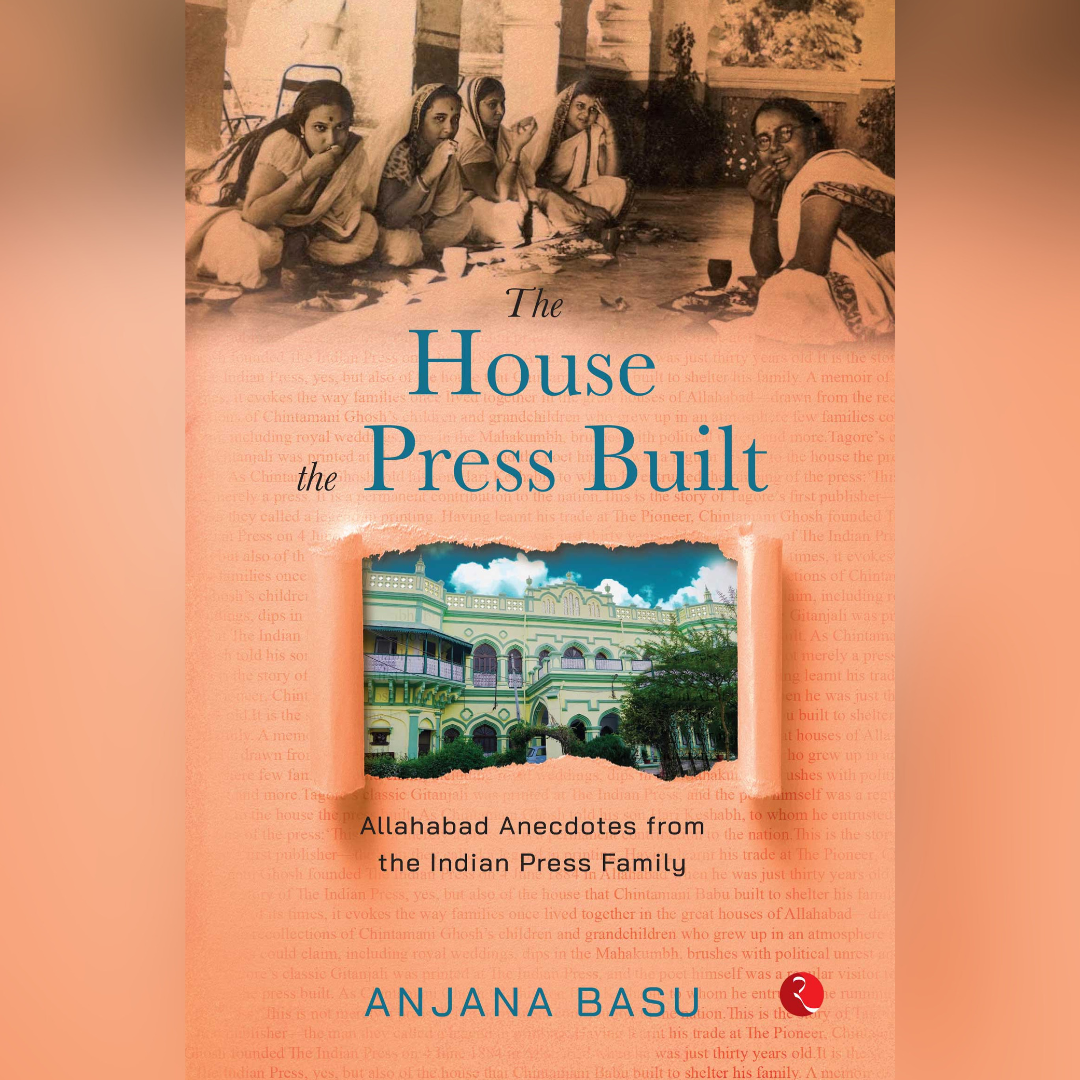
The House the Press Built is Anjana Basu’s memoir about her late mother, Aloka Basu’s maternal haveli, that once buzzed with three Ghosh generations and their servitors. Anjana was born in that famous home in Allahabad (now Prayagraj). The house was built in the year 1914, and the patriarch, Chintamoni Ghosh, founded the Indian Press (thus named to distinguish it from the British presses), which for many years was testimony to its founder’s fascination with machines and type. Among Bengali and Hindi literary works, the Press had the distinction of publishing Rabindranath Tagore’s Gitanjali, children’s books of knowledge, Shishu Bharati—the first of its kind in Bengali textbooks, and the magazine Saraswati. This iconic magazine gave rise to the colloquial Hindi that is spoken to date in Northern India. Eminent writers like Nirala, Dinkar and Premchand contributed to Saraswati.
The splendid house had long corridors, khus grass screens kept the rooms cool, there was a huge baithakhana (outer room for visitors), the andarmahal (inner rooms) where women reigned supreme, and four courtyards—each with a specific function. Antique furniture, including a large ornate grandfather clock, paintings and pictures added to the grandeur of the haveli. The gardens grew roses (which were watered by leftover buffalo milk and secretly by children who hated drinking it) and the magnolias that smelt heavenly for much the same reason. Seasonal flowers were given to the family for their pujas in rotation, leading to occasional squabbles.
Every girl born into the family had a pre-dawn ritual of bath and offering to the family deity Narayan. The chapter “Sunlight and Small Things” captures the security of a joint family system. There are other chapters narrating the routine of girls going to school in horse-drawn carriages, pranks and escapades, home tutoring, piano lessons, and customs ensuring that they got a husband like the Lord Shiva when they were of a marriageable age. Weddings of these young women (mostly in their late teens) were celebrated with pomp and splendour; the girl bent low with the weight of family jewellery and the humility that was the bride’s true ornamentation. Generations of women gave birth in the antur ghars (birthing rooms) quite early in life.
There are vignettes of the women of the household chattering while wielding the bonti (the curved sword-like blade set in wood), cutting vegetables with mathematical precision without missing a beat, making paans (betel leaves), or reading and gossiping on comfortable lounge chairs while the menfolk were at work.
Chintamoni Ghosh had the quirky habit of naming his sons after vegetables—the boys were nicknamed Potol, Mulo and Bhushi. Anjana Basu’s maternal aunts and uncles were affectionately called ‘Chocolate Pishi’, ‘Achaar Didu’ (the granny who created finger-licking chutney) and ‘Hyaath Jethu’ (synonymous for treats at Hyatt?).
Food was an integral part of the household, and the story of the khansama (male cook) who was hired by one of the author’s uncles as “statement of liberalism” to parallel those hired by several Governers-General, set the children agog and scandalized their mothers. A legend in her lifetime, Bamundidi who was a child widow, ruled the kitchen and dispensed advice and goodies in equal measure. There was a Jeeves, who acted as bartender to one of the younger sons and ‘tasted’ all the drinks that he served. Sweets were home-made—pantuas steeped in syrup were a speciality. Ranjita (the fair Rangakakima) made thin mango papads (amsattvas), and the cook who made jalebis had a special place in the household.
The home had many renowned visitors; addas (wide-ranging conversations) with Madan Mohan Malviya, Ramananda Chattopadhyay and Hindi writers. The piano that the great poet Rabindranath Tagore had played while singing one of his compositions was cherished until rendered tuneless by usage and relegated to a guest house.
The family businesses included a sugar mill and a sweet manufacturing unit, and raids on the confectionery factory were condoned by the garhwan (driver) of the horse-drawn carriage, but not Motorbabu, the stern motor car driver!
A fusion of cultural traditions is depicted in the Kumbh mela, celebrations of Holi, extravaganzas during Durga Puja (worship of the Mother Goddess and her family) and the Saraswati puja—dedicated to the Goddess of knowledge and music. The memoir captures life in pre-Independent India—at a time when entertaining the British with wine and cake was giving in to swadeshi sentiments. The memories linger like the smell of fresh ghee, of magnolia flowers, and the resonance of laughter and occasional tears, in the house the Press built and the family that nurtured it. And of course, the Indian Press that lived up to the founder’s offering as a “permanent contribution to the nation.”
The House the Press Built can be purchased here.
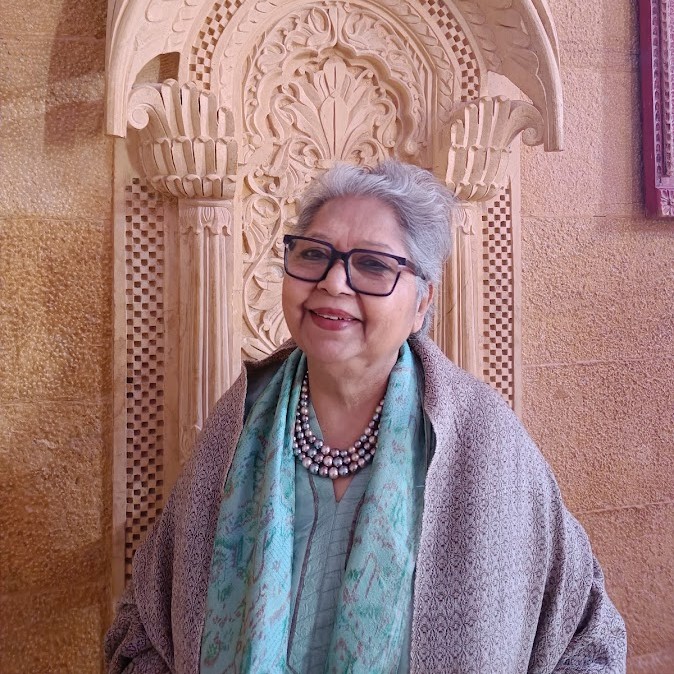
Vijayluxmi Bose is an academic and Communication Specialist by profession. She began writing short stories late in life after time spent in what was then a little hamlet called Bhauwala (also known as Bhagwanpur) in rural Dehradun district, where she has a little cottage. Written during a period of intense grief for her late husband, her stories have a touch of nostalgia, happy memories of families, and are mostly about pahadi (hilly regions) beliefs and practices. For the last five years, she has lived and worked in villages in Talla Ramgarh, Nainital district, and travelled across Uttarakhand by road and walked some pilgrim trails in the Himalayas. Apart from technical publications in peer-reviewed journals on public health, heritage and climate change, she has published slightly spooky short stories featuring very ordinary people who have extraordinary experiences, mostly in villages and small towns in the Western Himalayas. Vijayluxmi’s publication credits include An Ancient Curse, Vol. 2 (Culture Cult, 2023), Tell Me Your Story (2023), Kahaani Koncerti, etc. She is the voluntary Coordinator of the Khushali Cooperative in Talla Ramgarh district and has authored three publications on the cultural and developmental narratives of women and children in eight villages in the district. Her latest publication, co-authored with Dr. Anju Khanna and Dr. Anjali Capila, is titled A Tapestry of Ecology, Culture and Food Traditions in Talla Ramgarh district, Kumaon Hills (2024-25).
Facebook: Vijayluxmi Bose
Instagram: @vj.bose
X: @vj.bose