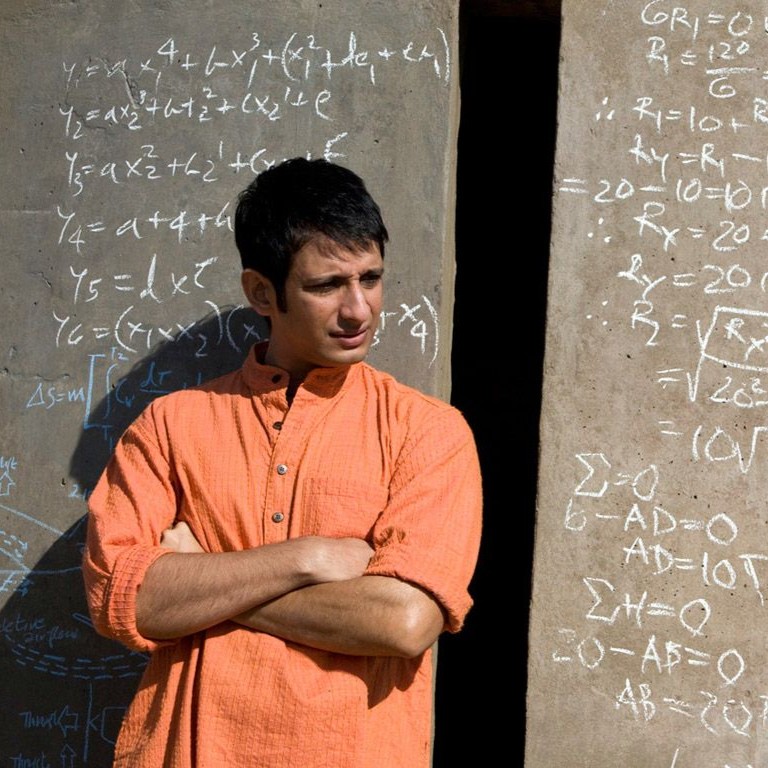
When I speak of a sick father lying on a bed in an almost two-room house with no bathroom in sight; open springs of a chair once called sofa; leaked water dropping from the ceiling tap, tap, tap into a steel bowl kept directly under the leak; one window with iron bars on it and a forlorn elder sister looking into the void; a coughing, overworked, and anxious mother telling the kid the price of bhindi in the market; I am not talking about Raju Rastogi’s house.
I am talking about my house when I was an eighteen-year-old freshly minted college student, like Raju Rastogi was when Virus sent an “atom bomb” letter to his house. The only difference was that my father wasn’t paralysed and my mother didn’t make “khujli wali roti”. (In this scene, Raju’s mother is cooking roti and uses the same hands to scratch an itch on her paralysed husband’s body.) Although she did give some tuition to the neighbourhood kids.
The similarity between my life and Raju’s was uncanny. I, too, was a consistent topper in my class, a scholarship student. I was supposed to eliminate the curse of poverty from my family with my brilliance and hard work. So, when I watched the movie, 3 Idiots, for the first time, I realised I was born Raju Rastogi, but I was too young to have that crippling fear he carried around with him every moment.
Yet, the aftertaste of every black-and-white scene of his house was bitter. I was inexplicably annoyed.
Farhan’s monologue about Raju’s house begins with the line, “Raju ka ghar 1950s ke black-and-white filmon ki yaad dilata tha. (Raju’s home reminded one of the black-and-white movies from the 1950s.)”
Every time I stepped out of my house, I looked back at it and asked myself if my family and I were stuck in a bygone era. Why can’t we be considered modern in the popular culture imagination? To be considered modern was important for my fourteen-year-old brain.
That one line and one cinematographic choice were enough to transport me back to a conversation I had with my uncle who had moved to Delhi from Kanpur. After spending two years in an MNC in Delhi NCR, he had come back with an air of superiority that was emblematic of metropolitan privilege. When he visited my house with a derisive smile on his face, he pointed at the 1×1 ft. mirror hung on a wall (the only one we had for years), and said, “Abhi tak kuchh badla hi nahin? (Nothing changed so far?).” I gave a nervous chuckle and sat down with a coiling mass of anger in my pit. He was climbing up the social ladder, whereas I felt my family had slipped down into an abyss.
The age-old mirror symbolised the stagnation of my family for him. But my sister (who was also there) and I knew that the same mirror symbolised the persistence of survival for us. It meant we had avoided a new burden on the budget month after month, even if the mirror distorted our faces when we moved right. We had found the appropriate spot so that the expense could be delayed, which was a sheer necessity.
We see Raju’s house through the eyes of Farhan Qureshi, an urban middle-class boy from Delhi, and Rancho, a millionaire’s son from Shimla (at that point). The climactic reveal of Rancho’s childhood life didn’t explain much of his behaviour, though. The fact that the-1950s-era-could-still-be-someone’s-reality-in-the-21st-century is a punchline in a comedy movie has the stink of the same arrogance my uncle had. Raju’s house introduces them to a different Delhi, which doesn’t even have a properly functioning fan, let alone an air conditioner. But the filmmakers turned that into a source of seemingly innocuous laughs.
Apparently, actual poverty is fun for those who don’t have to worry about the rates of bhindi and paneer. The country, whose HDI rank stood at 140 in a basket of 190 countries in 2009, has a hard-working family fretting over the prices of staples, this appeared to be a source of humour and vulgar entertainment for the Hindi filmmakers.
Subhash Ghai, known as the “showman” of the industry, once said this about the Hindi (Bombay) cinema:
We are making films for an audience of a billion people. Over 80% of these people don’t have enough food in their bellies. Our country doesn’t provide its people with pool halls, basketball courts, and video parlours, so we make films for them that will let them forget their lives for three hours. We create total fantasy, not the polished reality that Hollywood portrays. Never forget that, never forget that we are making films that allow people to believe for three hours that they are not poor and hungry.
But in those three hours, can we remember that fighting and surviving day after day with the measly resources isn’t funny? That humiliating Sisyphean labour of survival must not be reduced to a script for chuckles.
The glittery modern India is built on the breaking backs of countless construction workers. The workers who know they would never be able to live in those steel and ivory towers if they kept adding brick after brick to those walls. The ones who can afford to live in those buildings and participate in the modernity of India, I wonder what gives them the audacity to visualise that back-breaking manual labour as an amusing scene, the butt of the joke? That modernity comes through their underpaid labour and overlooked exploitation. Having wealth must be an undiagnosed source of amnesia.
Subhash Ghai also asks the Indian critics to never call Bombay cinema Bollywood because they are not copying Hollywood.
In Gully Boy, white tourists are brought inside Murad’s house to give them an “actual” but voyeuristic look into the “real India” in exchange for Rs. 500. The tourist is shocked to know a Dharavi boy could be into rapping and even could sing Lil Nas’ rap on the drop of a hat. Hollywood has never pretended to drop that voyeuristic lens. Their white gaze brings their crew and cameras into the hovels of pauperised India while failing to see the poor of India as humans. It’s a sadistic sepia-tinted, dust-coated aesthetic in the guise of realism for them.
But what Bollywood, being an Indian film industry, does is far more demeaning. The elite gaze of Bombay-wale also fails to see the poor of India as humans with real and complex emotions. And a class and caste struggle of the people of the suburbs of metros, tier-2, tier-3 cities, and rural India becomes another monochromatic, colourless aesthetic, which can be used for laughs or as a subject of simplified pity.
Raju was a hard-working scholarship student, his mother was a retired school teacher, and his father was a retired postmaster. The resilience of that family is being wasted every day because the exorbitant prices of medicines for a paralysed father is draining away their “family income”, as reminded by Virus before he dropped the letters. Yet, Rancho’s logical insouciance is expressed through this question later in the movie, “Ek saal mein kitni saariyan reasonable hoti hain? (How many saarees are reasonable in a year?).”
The dignity of the matriarch of a poor family takes a hit in the garb of logic now. But the definitions of “reasonable” happen to change with class and caste in this country.
A new saree might only mean a way of asserting a right to consume for someone from an upper-class family. But for someone from a poor and lower-middle-class family, it might mean a little more respect from the peers when parents are called to the school or university. The ethics of consumerism are not the same for a millionaire and someone who lives on a monthly pension of Rs. 2000. After all this, are we still surprised that Raju attempted suicide when left with no option?
In her essay, “Affective Histories: Imagining Poverty in Popular Indian Cinema,” Esha Shah discusses the depiction of poverty in the Hindi movie, Deewar: “My claim is that the affective investment in the images of humiliation and shame caused by the destitution is a ploy, merely a reference point, to legitimise the unfolding of the fantasy space of material prosperity as the mainstay of these films.”
Is the laughter, the black-and-white filter, a convulsing yet paralysed father with bulging eyes, the unemployed elder sister waiting for the younger brother to be rich and pay her dowry, for inciting laughs and mockery, a ploy to take Raju’s character growth towards the elite circles of renowned and rich engineers where he won’t be mocked anymore? Is the poverty not enough? Does his character need to have a broken sitar music play in the background whenever he tries to talk about his family’s struggles? Why does the movie egregiously run short of empathy for Raju time and time again?
Poverty doesn’t manifest only in the inability to afford paneer.
Often, parents who are scrambling to manage three meals a day have an unsaid deal with their kids. We are trying to give you an educated life, a life with the means to create an affluent end. But please make sure that you never do anything in the world where we have to apologise or suffer even more anxiety and humiliation. A brilliant student works harder, keeping her head down, making sure that not even a single mark evades her answer sheet. The time for putting up a voice against any systemic problem becomes irrelevant. The image of a paralysed father and a coughing, exhausted mother haunts every time the teacher scrunches her nose. Even if it means no danger to that promising student. The anxiety builds up. The more success comes, the closer the future of poverty alleviation seems. What’s left is a scared student like Raju Rastogi competing for a seat in a job interview against those who laugh at his “1950s” house, who never have to think about whether their parents’ sarees or safaris, whose one incorrectly answered question won’t mean they’ve begun to degrade morally.
In such a scenario, Raju watches Rancho telling people, “school ke liye fees thodi na lagti hai, uniform lagta hai, uniform (It doesn’t take fees to attend school. It just takes a uniform.).” But only Raju knows the stakes of defying school authorities and doing whatever he wishes to. Submission is a part of his curriculum even if it wasn’t for others. He can’t risk being kicked out of school, which is the only means for him to reach an end where he would have a leak-proof ceiling in the future.
We applaud the bravery of Rancho, even more when we find out he was actually an orphan who did odd jobs and loved to study. We are supposed to empathise with this prodigy only. But what about Raju who defied all the deprivations and still landed in the same prestigious institute?
Maybe, we all feel we could’ve been Ranchos once. Ranchos are rare. But scared Raju Rastogis are not. The world, especially a competitive country like India, is replete with them.
When we are taken into Raju’s world, the director puts up his life to make us laugh. Rather than making us understand why Raju could not afford to question the system unless he was drunk, we are reduced to Rancho’s and Farhan’s point of view: “Badi duvidha thi, dost ko sambhalte, ya dost ki maa k ansu ponchhte, phir hamne socha hatao yar, matar paneer pe concentrate karo. (We were in a fix. Should we look after our friend? Or should we wipe his mother’s tears? Then we thought, leave it dude, let’s focus on matar paneer.).” Despite knowing what makes Raju the way he is, we focus on the simple feeding of “comedy”.
When faced with uncomfortable and complex questions brought up by poverty, the one thing they could focus on was the food, which ironically explained how Raju and her mother must have spent their entire life. Focusing on how they will arrange a meal for four three times a day. It can never be funny.
Those two young men’s (the characters) apathetic behaviours are excused by them being privileged urban nineteen-year-olds. What excuse do the filmmakers have? What excuse does the audience have? Is absurdity enough?
I didn’t have to jump from a building to realise the importance of being alive. And I still am afraid of letting my family down. But I wish the Hindi film industry would show the world of rags beyond the arc of rags to riches. That poverty wouldn’t be reduced to a springboard for the plot or a demeaning ploy. That no more Raju Rastogis’ homes will be considered funny relics of 1950s.

Rijuta Pandey is a writer based in India. Her works have appeared and are forthcoming in The Chakkar, Active Muse, MeanPepperVine, GOYA, Roundglass Sustain, The Quasar Review, Cutleaf journal, Monograph Magazine, and so on. She is currently working on her first novel.
Instagram: @storyofapicklejar
Featured photo: Sharman Joshi as Raju Rastogi in 3 Idiots (2009), IMDB. Used for representative and educational purposes under Title 17 U.S.C. § 107 (Non-Profit Fair Use).




Your point about Bollywood’s elite gaze being ‘far more demeaning’ than Hollywood’s voyeurism is one I won’t stop thinking about. Proud to know the person who wrote this., keep writing, Rijuta.