Chitra Gopalakrishnan
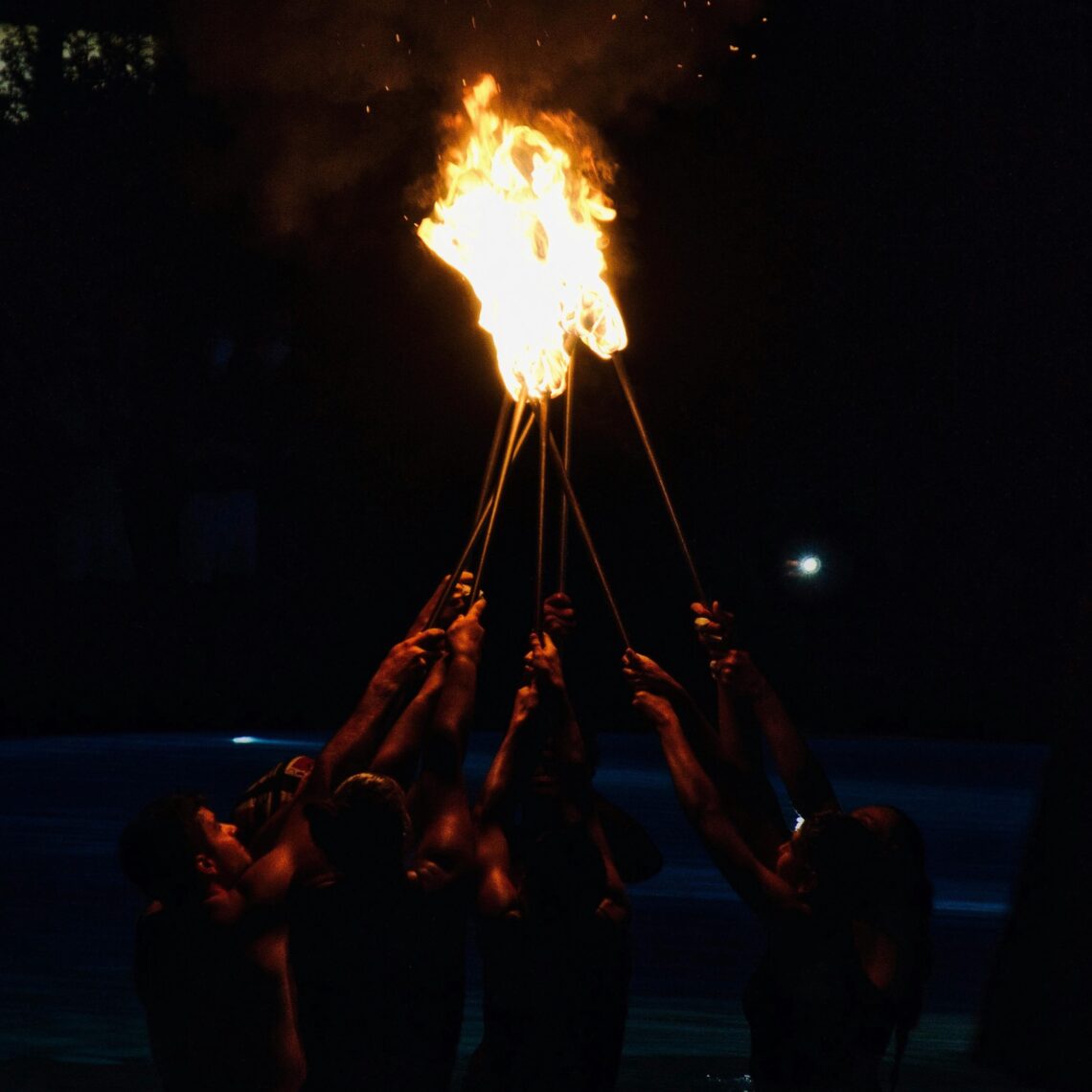
Flames rage through oil-soaked cloths, casting circles of crimson light around the conically arranged bundles of dry branches tied together with wooden handles. The fire rises upward and then spreads outward. The sound of crackling twigs echoes.
In the deep darkness of the pre-dawn hour, a hundred men, each holding lit handmade torches, struggle against the December chill and the elongated silhouettes that dance around them. Are these shadows mere reflections of the nearby fields, trees, and numerous water bodies, or are they figures from unknown dimensions? Beneath the glow of the firelight, the men are filled with uncertainty. As I am.
I, Ankit Tiyar, a sixteen-year-old boy from Kolkata who is visiting my uncle in this village, accompany them. I see a world like this for the first time and I see it through the eyes of these village men and feel what they feel. It is hard not to. Or feel otherwise.
This is my first trip back to this village since my family migrated from here for work twenty years ago. I am fascinated by the sights around me, having never experienced anything like this before—the village life, the food, the surroundings, and treks like this. The men have invited me to join them, as they are both awed and curious about my urban background, my knowledge of English, and my experience in college.
The men tell me they are heading to a pokkar, which is the term used for a pond in Jhanjharpur village, where I am and which is located in Bihar’s Madhubani district—a region known for its many ponds. This particular pond is considered common property, intended for shared use by everyone in the village, and it is the cleanest one nearby. “We want our pond back and we will take it, one way or another,” they say. I am still to understand the whole story of what they are doing and why but I am determined to find out.
“Jaldi bado, jaldi bado, pokkar ki or chalo,” some men softly urge, inviting others to hurry. Their calls feel like whispered incantations, as if they are hesitant to disturb the darkness and the natural world around them. They seem as afraid to awaken their sleeping gods, goddesses, and spirits that inhabit and protect their village. I know this as Billava, a boy my age, whispers this into my ear.
It is a long walk for these men from their huts made of mud, hay, sticks, and cow dung to the pond. For me, the distance is killing, unused as I am to trudging through fields and wildernesses. I trip and tremble by turn but something within me tells me to persist, to not give up. I think part of my resolve comes from the men I am accompanying.
Kripanath Mallah, a thin, dark, middle-aged man with a balding head and a thick moustache, impulsively breaks into a song in Maithili, a language known for its melodic tones. My hold over this language is faltering but I know this language is spoken in Madhubani and many neighbouring areas of northern Bihar, collectively referred to as Mithilanchal. My uncle Vetturan chacha has told me this. He has also told me that a common saying in this region is, “If anyone needs proof of our dialect’s musicality, just try saying ‘Jhanjharpur’. The sound evokes the jingling of small bells attached to anklets.” I could not help but laugh when he said this and repeated ‘Jhanjharpur’, ‘Jhanjharpur’ over and over again and loved how it sounded.
Kripanath Mallah sings a story of his forefather Kevat, a low-caste boatman who once rowed Lord Ram, his wife Sita, and his brother Laxman across the Ganga. To me, this song sounds as a form of protest and an expression of grievance against the Creator himself. Strangely, I understand every word.
The lyrics convey Kevat’s demand: “I, Kevat, a low-caste boatman, will only carry you across the river if you, Lord Ram, allow me to wash your feet. By doing so, I will be considered part of the family. Until now, you have granted this honour only to Laxman and Sita. If you bestow this privilege upon me, my people and I can break free from the constraints of caste.”
Kripanath pauses for effect, looks around, and continues, “If I, Kevat, am the ferryman of the river, then you, as a God, are the ferryman of the people. I implore your help.” He concludes the song with the line, “In response, Lord Ram granted him his request.” He repeats this line over and over, becoming overwhelmed with deep emotions. The men around me who belong to the Mallah caste and its sub-castes, resonate with his emotional plea. Gathered to fight both for a similar and a larger common cause, as I believe, they join in to sing the lyrics together, their voices low but filled with passion. Their chorus remains unbroken, their repetitions emphatic, and morale high. I, too, am impelled to sing along. I am no longer a witness, I am one of them.
In the dim light, the men and I walk past fields recently sown with wheat, lentils, potatoes, chickpeas, and mustard to reach the pond. Upon arrival, we all form a circle around its edges and wait for instructions.
Kusheswar Nishad, a slender man with tawny arms, raises a flute to his lips, producing melodic strains. His notes are as fragrant as the surrounding reeds and rise above the squelching mud beneath the men’s feet. However, the angry cries of red-wattled lapwings, now awakened, drown out the symphony. The birds strut and take flight, dipping in and out of the tape grass that grows at the pond’s edge, their screeches sharp and prolonged.
These men, I witness, much like the lapwings, are determined not to let anyone silence their stories—whether it’s the waters, the birds, the government, upper-caste individuals, wealthy landowners, or anyone else who tries to seize control of the ponds under various pretences. They have come together to claim this pond as their own.
As the sun rises behind us, in an orange disc, the men extinguish their handmade torches and break the silence. Together, they shout slogans such as “Apni awaaz utao” (raise your voice), “Virod karo” (protest), and “Halla bol” (make some noise), their voices resonating like thunder. They urge me to join in. I raise my voice with them.
“Let’s get to work before everyone in the village starts their activities,” says their leader, Suresh Sahani. “There is no time to waste; let’s begin our mission to make this pond ours.” He is a man with cropped hair and a lean, lined face that gives the impression of a life lived outdoors.
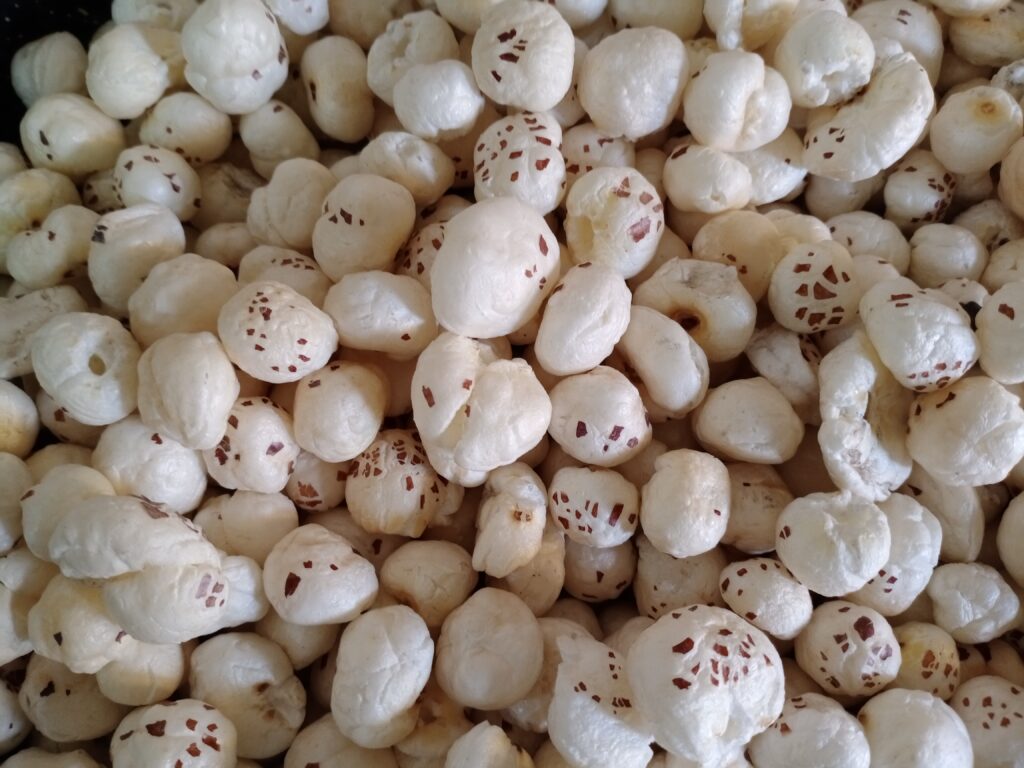
A quarter of the gathered men, who I know belong to the Kol community—a subcaste of the Mallas—quickly begin to remove their footwear and upper garments, sweaters, shawls, shirts, t-shirts, vests, and kurtas. They replace their lungis, long rectangular cloths wrapped around their waists, with shorts or loincloths and strap bamboo baskets and small fishing nets on their backs to collect leftover seeds of makhana, also known as fox nuts, from the bottom of the shallow pond. The cold does not deter them.
I see some others carry aluminium pots to gather the prickly fruits left over from last year. Gradually, they make their way into the pond, navigating through the reeds and weeds. At times, they keep their heads above water, while at other times, they fully submerge themselves. They brush against snails, crabs, water weeds, grass, large tortoises, and even snakes. Decaying leaves, fish waste, and algal blooms create bubbles in the water and emit a foul smell, but nothing deters these men from their quest for makhana seeds, which they tell me is also known here as kala heera, or black diamonds.
Meanwhile, the other men from the Chaain and Vanpars communities remain fully clothed and stand along the edges of the pond to keep watch. They are armed with lathis (sticks) to defend against any potential threats. “You all know how to wield a lathi, so use them as weapons; defend yourselves rather than attack,” instructs Suresh Sahani.
What are the men doing underwater?” I want to know. The sun is above us now.
“They are collecting leftover makhana seeds from the previous season and transplanting them to the bottom of the pond, along with a batch of fresh seeds. These seeds will germinate in forty-five days,” explains Sitaram Sahani, a prominent protester.
I listen intently to this man with a thin body and strong muscles, and ask, “Then what happens?”
“From March to May, the seeds will grow into plantlets, and their large, thorny leaves will rise and spread across the pond. Between April and May, these plants will bear prickly fruits, which will be ready for harvesting from August to October. During this time, the fruits will burst underwater, allowing their seeds to sink to the bottom,” Sitaram explains to me.
My curiosity is insatiable. “How many fruits does one plant produce?” I ask.
“About ten to twenty, and each fruit can contain between forty and seventy seeds. So, each plant typically yields between 450 and 750 grams of makhana,” Sitaram replies with a patient smile.
Still, I persist, “Will you have to keep watch over the pond throughout this entire process, for ten months or longer?”
“Yes,” comes the response.
I am wide-eyed with shock, and can hardly fathom the effort it will require. “Why are you doing this?” I ask, puzzled. “What will it achieve?”
Ramvriksha Sahani, another protestor, equally strong and sinewy, says, “We are among the poorest of the poor. For generations, we Mallahs and our subcastes have worked as boatmen, but due to our ongoing poverty, we now take any available work, whether as labourers or fishermen. This may be the reason your father migrated. You have seen how our village, located at the confluence of two rivers—Kamala Balan and Dhaus—makes us vulnerable to their unpredictable behaviour, despite our daily prayers for well-being and safety.”
Ramvriksha falls silent, lost in his thoughts about the past. “During garma (summer), the rivers dry up, leaving our fields parched. As labourers who till, plant, and harvest the land, we are left without work unless the fields are connected to canals. When the rains finally arrive, the rivers can change course without warning, and their torrents often break the embankments meant to control their flow. This results in floodwaters inundating our plains, transforming them into marshlands. Consequently, we lose many lives, our homes and livelihoods once again. In this state of helplessness, the only reliable occupation we can turn to is makhana cultivation. Although this work requires long, gruelling hours in neck-deep water, along with dealing with the prickly leaves and even pricklier fruits, it ultimately allows us to produce a resilient crop that can endure flooding.”
“Do you now understand why we need to create our own ponds and protect all our fragile jheels (wetlands), whether they are lakes, ponds, or even ditches?” asks Sanjay Teli, looking at me, as he joins the conversation. “It is a matter of our survival. Not just ours, but our children and theirs.”
I nod.
My father has often told me, “People in our village work a hundred times harder than those living in cities, even harder than people who live in slums like ours. Our work here may be tedious, but it is nothing compared to the toil of these men and women and the hardships they endure.” Now I begin to see what my father means.
I notice Sanjay Teli has more to say and look up expectantly. “Do you know that many of these ponds were created on lands unsuitable for agriculture, providing people like us the opportunity to earn a livelihood with dignity and without the threat of starvation? They were also intended to reduce the dangers of flooding by collecting water in their hollows. However, the wealthy deny us access to these ponds, claiming them as their own and obstructing our use. They wilfully fill them with soil or allow them to become overgrown with weeds, rendering them unusable. The upper castes also instruct us to stay away from these waters, and we have to obey both their whims and demands. And if these people employ us to harvest makhana in their ponds, they pay us a pittance. The authorities, too, are guilty of neglecting their maintenance and failing to support our claims to them. It seems they have no intention of granting us rights over these ponds, many of which fall under the samanya sampati sansadan (common property resources), or of providing us with nets, equipment, and machinery for harvesting and processing the seeds.”
I am confused. “I don’t understand what this means,” I say.
“It just means that these resources should be owned and managed by the community, and no individual can have exclusive property rights as per law,” says Sanjay Teli.
“What about the police, courts and local panchayats? I have read about their roles in my political science syllabus,” I say with mounting agitation.
“We are hesitant to approach the district court because it is far away. Moreover, we are illiterate and do not understand the legal system or how lawyers operate. Furthermore, we cannot afford to pay for their services. In our area, Jhanjarpur, there are several blocks, each divided into village-level administrative units called gram panchayats. While we bring our complaints to various panchs, whom we elect, and call upon many sarpanchs, the heads of the gram panchayats, they are as helpless as we are. They may have good intentions, but they lack the power to address our issues and the courage to stand up against upper-caste landlords. As for the police, their effectiveness is questionable at best,” says Sitaram Sahani.
“Do the people in the village and surrounding areas treat us this way because we belong to a different caste?” I ask.
“Yes,” replies Ramvriksha Sahani.
“Even though we are the only ones preserving our village traditions and heritage, everyone avoids us. Caste refuses to disappear from our society and politics, and is a living wound. We face humiliation and contempt at every turn. We feel the pain of our powerlessness every single moment, one that festers in everyday silences. We feel it when we are denied our humanity. We feel it in the quiet devastation of being made to feel lesser, unworthy and unwanted. We feel it in our touch being stigmatised. We feel it in our labour rendered disposable, available for the taking. We feel it when our experiences are dismissed as non-existent. We feel like the grahan eclipsed all the time. But how do you prove pain?”
His words leave me deeply disturbed. I sweat in the winter chill.
“Some people even call us Maoists, which we are not. And the government is unwilling to consider giving us the status of Scheduled Caste, choosing instead to keep us categorised as Scheduled Tribes, which has a lower chance of accessing reserved facilities and representation,” Ramvriksha adds.
Punya Kewat, a wiry man whose frame denotes physical strength and stamina, like the others, moves forward. “Consider the production process of makhana. We, the Mallahs and our sub-castes, collaborate in this endeavour. The Kols are responsible for growing and harvesting the seeds, while the Chaains clean them by trampling on them with their feet. Four or five of them work together for hours on end, holding each other’s shoulders for support. The women—their wives and daughters—then dry the seeds in the sunlight on mats made from date palm leaves. Once the seeds are dry, they are sorted using metal sieves and categorised by size. Next, the seeds are roasted at 250 degrees Celsius in earthen pitchers placed on clay stoves. Wooden sticks are used to stir the mixture continuously. After roasting, the seeds are set aside for seventy-two hours to allow their kernels to loosen. The tempered seeds are then reheated in iron vessels at temperatures ranging from 290 to 340 degrees Celsius. When they begin to crackle, the workers remove them and crush them on wooden platforms using wooden hammers. This process causes the makhana to pop while the seeds are still hot. The Vanpars collect the popped makhana and sell it to merchants. The money that is earned is split amongst us. It’s demanding and exhausting work yet our labour remains invisible, undervalued and disrespected,” he says.
My mind is in a tizzy with his words spoken in a rush. If his words leave me dizzy, I feel faint just picturing the labour of these people. So much work and so little in return. It makes me angry and sad at the same time.
A deep, uneasy silence settles around us.
After a while, Ramvriksha Sahani speaks again. “We makhana farmers are the only ones who truly understand how significantly the changing climate will impact us. The villagers are unaware of the situation. Makhana requires a temperature range of twenty to thirty-five degrees Celsius, a humidity level between fifty and ninety per cent, and an annual rainfall of one thousand to two thousand millimetres. However, temperatures in our area have risen to forty-two degrees, and our humidity levels have decreased. Additionally, the rainfall has become erratic, often concentrated over just a few days, leaving the rest of the time hot and sunny—conditions that are unsuitable for cultivating this crop. If this continues, makhana cultivation may face extinction, leaving us with nothing to survive on, and the community will also lose its traditional knowledge and wisdom we have kept alive. It will come to a stage when our children’s children will ask us what makhana is.”
Hearing him makes me enormously unhappy.
“Are you all going to take over just this pond or many others?” I ask expectantly. I want these men to. I want them to break their silence, their invisibility.
Suresh Sahani shakes his head, a gesture characterised by its up-and-down motion. “We plan to capture a few more, but they are all in a state of disrepair, and we will need to invest a lot of effort into fixing them. Nevertheless, we will assert our identity. We want to show our people that we are the backbone of makhana production. After all, our understanding of rivers, lowlands, lakes, and ponds is both intimate and vast. We will take pride in who we are and demand respect and equality. We will shine like torches in the shadows, keeping the flame of equality alive and maintaining faith in our own capabilities.”
As they talk, the men on watch call out, “The villagers are approaching in a crowd.”
I watch in fear and stupefaction. I am unsure of what will follow.
“Who gave you permission to enter this pond?” demands one of the villagers. Another asks, “Can you show us your permit to harvest makhana in this pond?” A third villager observes, “I see that you have all come prepared for a fight with lathis. We will strip you of your skins.” Meanwhile, a member of the gram panchayat tries to negotiate, saying, “Come out of the water. Let’s talk about this. We don’t want any bloodshed.”
The men in the pond continue their harvesting, unfazed, while those tasked with keeping watch form a line. They stand their ground, unaffected by the violent words and threats directed at them, remaining largely unbothered by attempts to ease the situation. I, on the other hand, shiver in trepidation. I have never seen violence let alone faced it.
Suresh Sahani speaks up, saying, “This pond belongs to all of us. While you have the means to survive, we do not. Therefore, we intend to take control of this pond and others to ensure our survival. We have lived in fear and listened to you for far too long, but that ends now. We will reclaim the resources that rightfully belong to us, and we are prepared to fight for this, whether it takes months or years. We will not allow our existence and rights, as those of our ancestors, to be erased. And we will tell our stories aloud to the world, for this is our home as much as it is yours.”
I notice that the villagers are perplexed. They are uncertain about how to deal with this situation.
“They have never encountered such a revolt in the village before. See how they are huddled together to figure out a plan,” says Billava to me.
Ravi Shankar, a landowner with twenty acres of land, speaks to the villagers, gesturing to them to move to a distance. I edge closer to listen. The villagers pay no heed to me.
“Having been denied their rights for generations, we now know violence will not deter these men. In a way, we have turned them into questioners, into revolutionaries. From now on, we can expect only questions, dissent and defiance from them, rather than loyalty and obedience,” he says. “The Mallahs may not use their lathis against us, but their revolution is here to stay. And we all know that a passive revolution can be far more powerful than an active one. It is in their peace that their message lies, one that will bring them victory.”
Uday Prasad, another landowner who has recently started farming fish as a side business, says, “Makhana may have been considered a poor man’s snack for years, but now it has become a rich man’s source of protein. Perhaps it’s time for the Mallahs to receive their due, as Ravi bhaiyya says.
Looking around, he pauses, and says, “I will go a step further and say that we should allow them to access markets beyond our village and even our state. Over the years, we have lost touch with the realities around us. We have allowed resentment to fester, and this has contributed to widespread discontent, one that has turned wild and feral. If I have taken up another occupation to earn more, as many others within our community have, we should allow them the opportunity to earn better as well.”
The villagers murmur amongst themselves. They are confused with these new ideas. To many, they are unacceptable. Others seem to think Uday Prasad’s and Ravi Shankar’s words make sense.
Uday Prasad persists. “Listen to me, this way, we can prevent anger and dissatisfaction from brewing in our community and within the lives of people like us in our socially complex world, which is vital for maintaining peace in our village.”
Encouraged by the nods of some villagers, he continues, “I know that in many other states, tribal people are fighting for their rights to gather resources as they have done for generations. It is in the interest of our community and the peace within our village that we do not leave these men isolated and brotherless in their struggle. We need to understand the concerns of the Mallahs and see the world from their perspective.”
I see the group of village men break up their circle. I see them walk back to the village resigned, their shoulders slumped. I know they are confused by how distances that had been kept for centuries have shrunk in just one day. However, since those with power and influence believe this is the right direction, they feel they have no choice but to accept it.
I join the makhana farmers. They continue to transplant makhana seeds. I know their work and vigil will continue for months, even after I have gone back to the city.
(Photo by Facets of Nonstick Pans on Wikimedia Commons)

Chitra Gopalakrishnan, a writer based in New Delhi, uses her ardour for writing to break firewalls between nonfiction and fiction, narratology and psychoanalysis, marginalia and manuscript, and tree-ism and capitalism. Website: www.chitragopalakrishnan.com
Featured photo by Ollie Craig (Pexels)