
Sayan Sarkar
“So, where’re you taking me today?” I looked eagerly at my wife, R.
“Eastland,” she replied with a mysterious air.
Putting on our walking shoes, we stepped out onto the narrow alley in front of her house.
This was the first time I had come to stay over at my in-laws’ place after marriage, and R — well aware of my proclivity for morning walks in new neighborhoods — had promised to take me to an exciting place. Being an ardent fan of suspense stories, she had chosen to keep the name of the place from me till the last moment, and only gave it away due to the look of desperation on my face as we got ready to walk down the alley.
While we navigated our way through the interconnected maze of narrow lanes and bylanes in the quiet locality of Palta, Old Barrackpore, R revealed further details about our destination.
“You see,” she explained. “The Eastland Defence Estate lies between Palta and Ichapur.”
“There are numerous residential quarters along the route which once housed hundreds of workers — who worked in the nearby rifle and metal factory — and their families, forming a bustling locality. But due to some unknown reason, the quarters were eventually abandoned.
Today, only the concrete structures remain — mere empty shells of their former selves. The place seems haunting, even in daylight. It feels like a ghost town. You’ll see soon enough.”
“Wow,” I remarked, trying to imagine the antediluvian buildings standing ominously and basking in the sun.
After a ten-minute walk in the chilly winter morning, we finally reached the entrance, which marked the beginning of the estate.
“Welcome to Eastland,” my wife spoke theatrically in a spooky voice.
“Very funny,” I nudged her cheekily.
But jokes apart, the place had a profound effect on me.
A wide asphalt road — in pristine condition — led the way through the landscape, turning and branching like a capricious river changing its course now and then. Trees and bushes of various sizes and shapes stood along the road in irregular intervals, greeting every passerby with their undulating green plumages.
Rusty old lamp posts and electric poles — once providing current and light to the bustling locality — stood like ghosts of the past, devoid of any purpose.
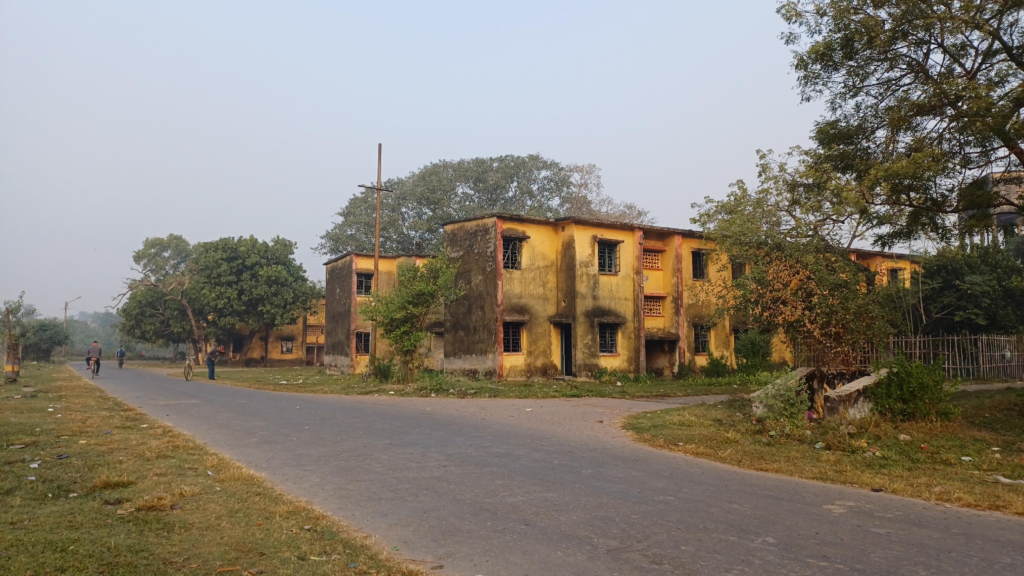
But the most eye-catching features of the landscape were the two-storied yellow buildings with red vertical borders. They stood in regular intervals like tired soldiers with dirt-stained clothing waiting in line for their commander’s signal to launch one final ambush.
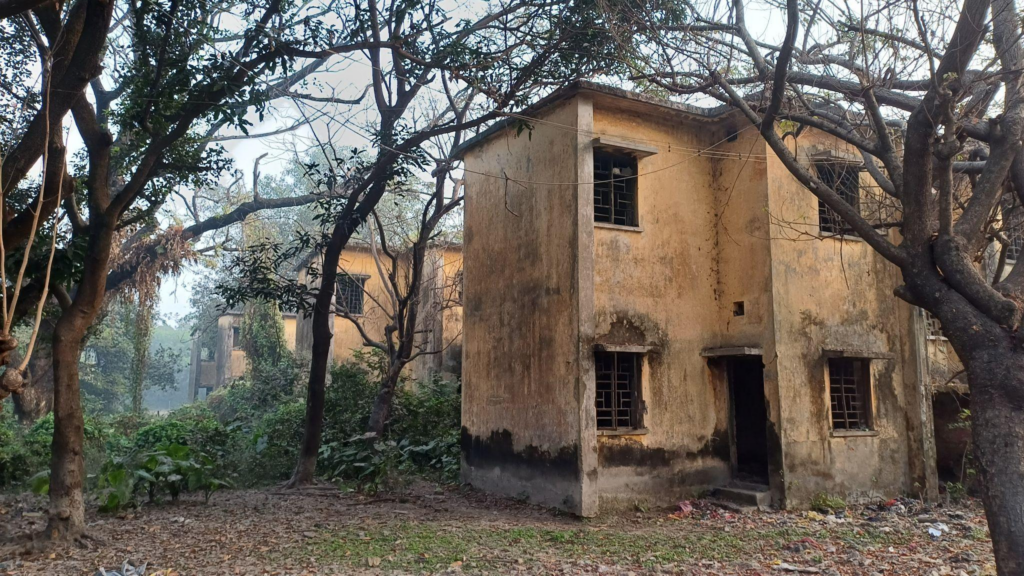
Most of the windows were broken, and none of the doors were present. Only the skeletal remains of their frames hung awkwardly from rusted hinges. It appeared as if the buildings, devoid of windows and doors, smiled toothlessly and tried in vain to hide their embarrassment.
The whole sight felt surreal.
It seemed like each building had a story to tell — of kids playing on the front porch, of wives looking out the windows awaiting the arrival of their husbands, of husbands sipping tea and reading the morning paper in the light filtering through the grills. Countless moments — filled with life, filled with vigor — etched into the very fabric of the brick and mortar that once sheltered lives that mattered and hearts that beat in hope and anticipation. The people had all gone, leaving behind their memories, and the quarters stood defiantly, sharing their stories with the world.
Now, the buildings belonged to nature, and she had already started reclaiming her land. Strangler figs grew from the cracks and crevices, heralding the non-violent takeover.
We moved past several such buildings until we reached a large playground to our left. A group of young kids was playing cricket, reaping the benefits of the sunny winter morning. A couple of elderly people were jogging along the periphery, keeping an eye on the batsmen lest a wayward shot should inadvertently find its way towards their heads. A few autorickshaws, motorbikes, and bicycles passed us by from time to time, ferrying adults to work and children to school.


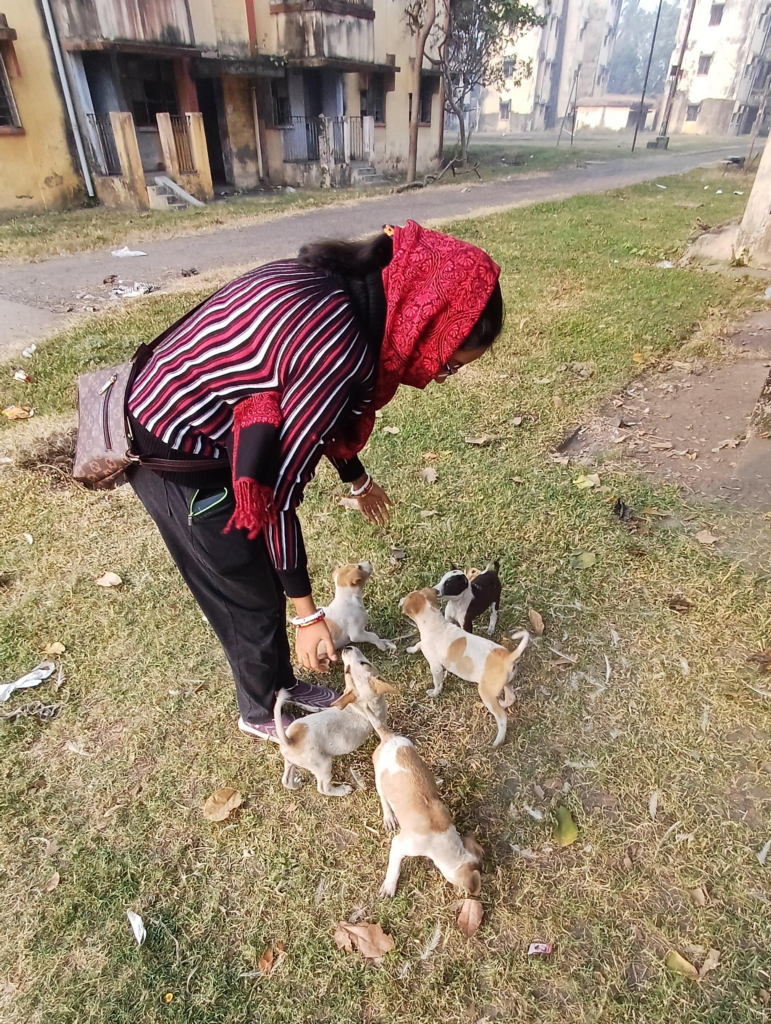
Suddenly, a litter of very enthusiastic puppies emerged in the distance. Bubbling with excitement, they were running in circles and chasing each other playfully — their tails wagging faster than their legs could carry them. As we approached the furious five, they shifted their attention to us and started orbiting around our legs. R, unable to handle the overdose of cuteness, bent down and patted them to her heart’s content. The puppies relished her caresses — evident from the increasing rapidity of their tail wags — and barked happily. But their patience ran out quite soon, and they disappeared out of sight as abruptly as they had emerged.
Twenty minutes down the road, we found a Kendriya Vidyalaya to our right. A few students were already entering through the gates, and some were seen in the background – standing out in their spotless white uniforms and steel-grey pants.
What attracted me the most about the scene was not the school, but an enormous dilapidated water tower just opposite the entrance. The cuboid-shaped tank on the top of the tower, with rusted railings, was held up by an intricate network of horizontal and vertical beams. The access stairs and landings on its side were mostly covered with vegetation, which had reached all the way to the top. The climbers had also grown on two of the water tower’s vertical legs, adorning them with green embellishments. The structure looked like it had appeared straight out of the pages of a post-apocalyptic science fiction novel — standing tall as a reminder of happier, and more normal times.
“Ethereal,” I exclaimed, as I took out my mobile to capture the scene.
R gave me an I-told-you-so smile.


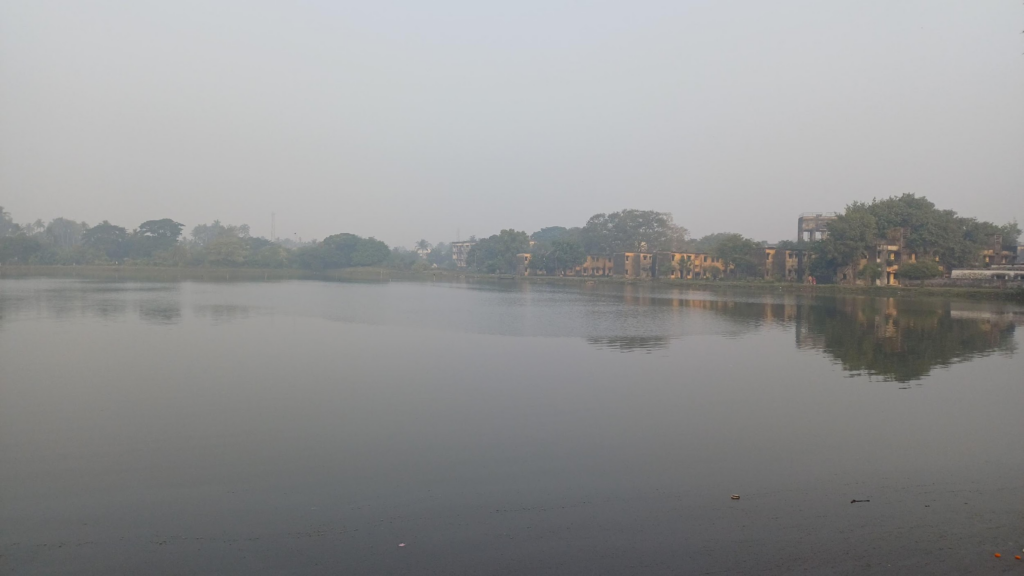
A little further down the road, we came to a clearing which opened to a massive pond surrounded by greenery on all sides. The greyish-blue water, mostly still, was lined along the edges by herons standing patiently for their morning snacks. On the shore opposite to where we were standing, the railway tracks peeked from behind the shrubbery. As soon as we took up a good position to enjoy the view, a train whistled onto the scene and advanced with measured pace towards the Palta railway station. The advent of the train through the green cover made me think about the famous scene from the movie Pather Panchali where Apu and Durga run joyously through the Kaash fields towards the steam engine train. Maybe it was a similar joy in my subconscious that invoked the memory of that evergreen sequence.
“Shall we go back?” R enquired softly as the train slowly disappeared in the distance.
I looked at my watch. Half-past seven.
“Yeah, let’s go,” I replied.
As we reached the entrance of the Eastland estate, I looked back one final time to bid goodbye to the yellow army and assure them of a second coming. They whispered their goodbyes and promised to wait patiently till my next visit.

Sayan Sarkar was born and raised in Kolkata. An engineer by profession but a storyteller at heart, he is a passionate reader and lifelong learner who spends his leisure time immersed in books and new ideas. He primarily writes fiction, seeking to entertain and inspire readers through his narratives. His short stories have appeared or are forthcoming in Twist & Twain Magazine, Muse India, MeanPepperVine, 101 Words, Borderless Journal, and The Hooghly Review.




Grew up in a quarter. This does bring back memories.
Great read
A place where time stands still.
Vivid and beautiful.
Beautiful photo essay.
Makes me want to go there myself.
The descriptions are so vivid that I felt that I was walking down with you. Carry on dear ….
Take me back to the good old days!
Good read.
Wow, this was indeed a vivid and refreshing read!