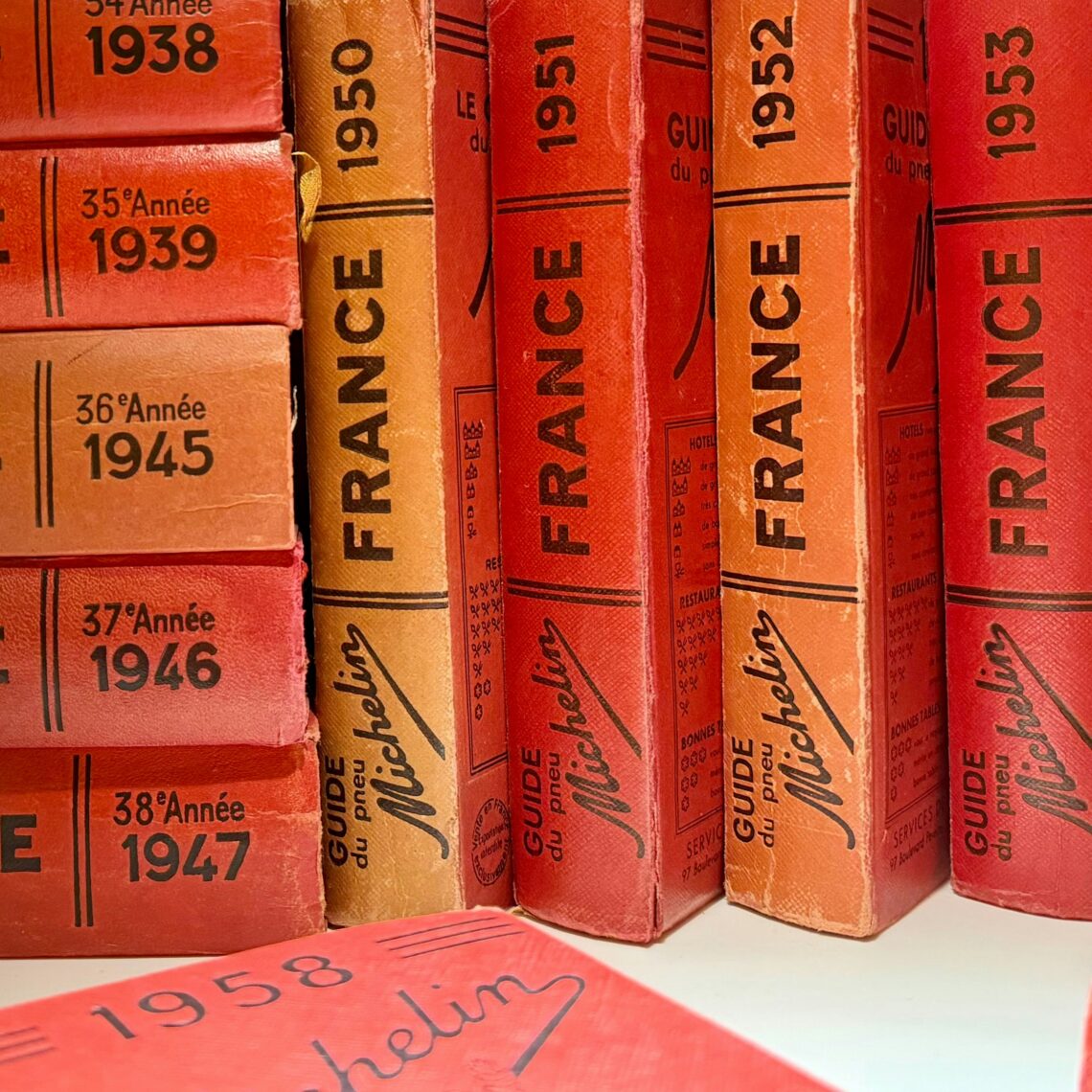
On our honeymoon in 1971, my wife and I made a pact. A restaurant worthy of three Michelin stars was out of the question — an impossible reach on a young couple’s budget. Two stars called for more lucre than we were prepared to part with. But one star, once, if the circumstances aligned and the stars in both heaven and on the ground in France shone beneficently — that we would attempt.
The Michelin Red Guide covered restaurants. The Green Guide covered everything else — sights, roads, what was worth going out of your way for and what was not. Between the two of them, they were the finest way to navigate Europe. Three red stars for restaurants meant worth a special journey. Two meant worth a detour. One meant worth a stop. Useful information, delivered without apology.
The summer of 1965, I had spent in Dijon, and a French teacher had had us to dinner one evening in a working man’s part of town. The meal lasted three full hours — wine, cheese courses, more wine, more courses, the whole glorious architecture of a French dinner on a Wednesday night. I filed this information and promptly failed to act on it.
The third week of our honeymoon found us in a rather swankish hotel in Le Mans. Juan Manuel Fangio, Stirling Moss, Phil Hill — the great drivers of the era had raced at the circuit nearby, and for all we knew had dined in these very corridors. That evening, my wife and I made our entrance into the hotel restaurant, which carried its single Michelin star with quiet confidence.
The menu was entirely in French. This presented considerable difficulty, as I had taken French seven times. Alas, those seven years were French One, repeated six times. Guinness Records should take note of my futility. Whether this less-than-extensive preparation was evident to the staff I cannot say. They were more than gracious, and if they snickered while we navigated their native tongue, they hid it with professional thoroughness.
The courses began to arrive. A consommé, clear and precise. A terrine, followed by pâté. Then a whole trout, presented with the solemnity the occasion demanded. We were, it must be said, eating in the American manner — which is to say efficiently, perhaps too efficiently, clearing each plate with an enthusiasm that the French would regard as somewhere between charming and barbaric. By the time the trout was gone we were, in the most pleasant possible way, full.
We looked around for the check.
Instead, with a Gallic flourish, we were presented with, tra la, da ta: The Main Course. Voluminous meat, potatoes, accompaniments. A full production. Fantastic Mr. Fox had nothing on us — we girded our loins and ate. It was French, and it was sublime, and it was also, by this point, a genuine physical challenge. We finished. We were green at the gills.
The waiter returned.
“And what will monsieur be having for dessert?”
“Non, non — c’est complet,” I said, with what I hoped was finality.
“Mais non, monsieur — il faut absolument goûter notre tarte. C’est la spécialité de la maison.”
Resistance was futile. The apple tart arrived with a flourish. We packed it in. Several kilograms heavier, we retreated to our chambre for a well-deserved rest.
I had been warned in Dijon in 1965. I had not listened.
Fifty-two years later, Beth and I are in France — my new bride, on a Grand Tour that has taken us through Ice-land, Eng-land, and now France-land. I have learned things in the intervening years. One of them is how to dine under the stars.
I promised Beth the exquisite pleasure of a Michelin one-star, to cap the journey. We selected Le Chalut in Saint-Malo. Lobster is the spécialité de la maison — they are right there in a tank in the middle of the dining room, going about their business. We selected two personally.
For Bruce and Alice, their natural life had come to an end. They were prepared three ways. Homard en trois façons. The claws, the tail and the body each contributed to separate courses.
For twelve tables there was a staff of just two, but they were consummate professionals in the fullest sense. At no point did anyone approach our table to inquire, nasally, whether everything was allllll riiiight. They continually surveyed the room. At the least sign of want, they were instantly present, dealing with everything with quiet competence, then gone again. We were not rushed. We ate at the pace the meal demanded. We left both filled and fulfilled.
It had taken fifty-two years, but we had finally passed the test.
In another fifty-five, we reckon, it will be time to aspire to star number two.

Curtis C. Morgan, 83, spent forty years in IT contracting across the US, UK, Saudi Arabia, and Australia and ran a commercial beekeeping operation in Pennsylvania. He taught at sixty schools across Australia and New Zealand. His work has appeared in Mother Earth News, Responsible Statecraft, Drift and Dribble, and American Bee Journal.
Featured photo: Vintage Michelin Red Guide, by John Cameron (Unsplash)