Shome Dasgupta
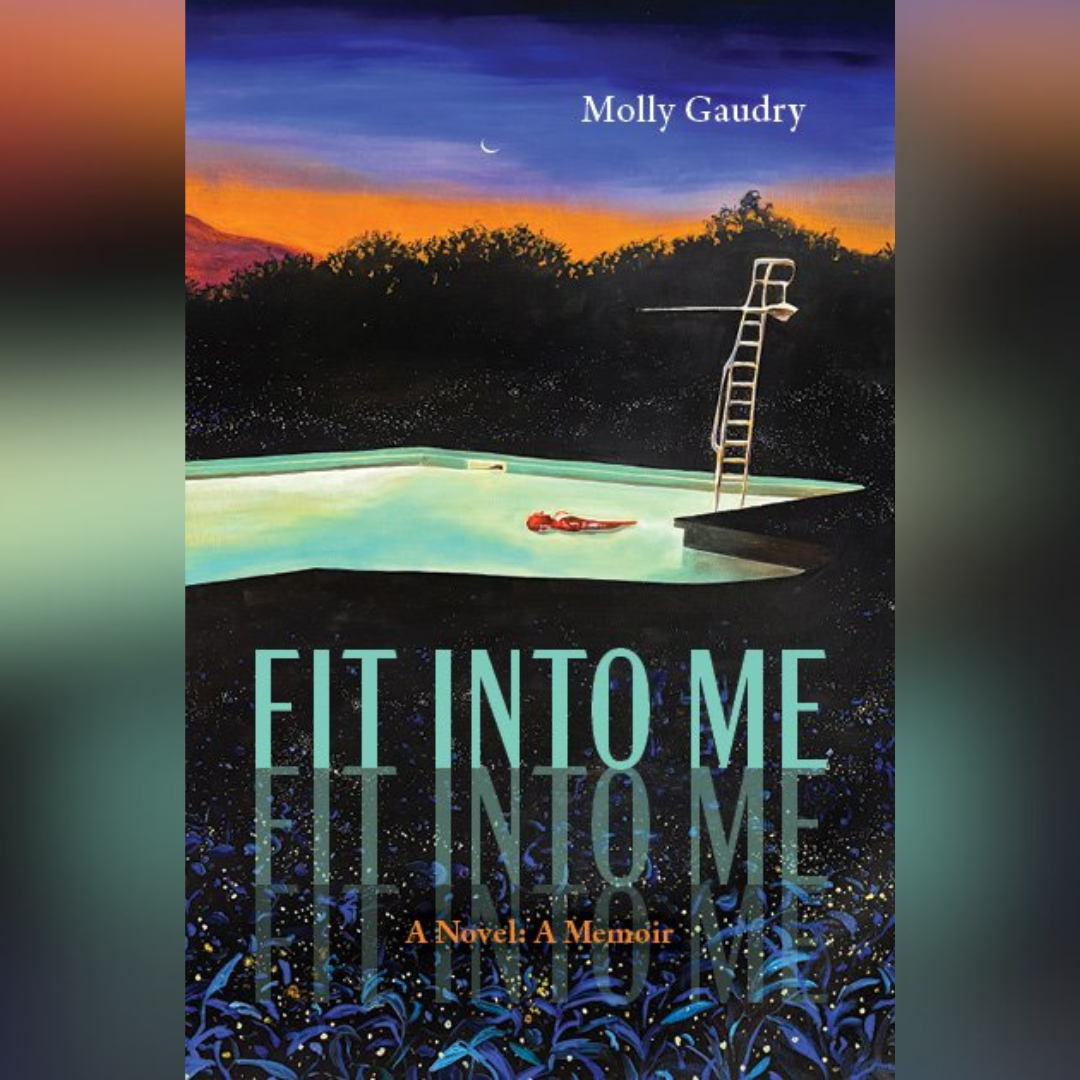
Molly Gaudry explores the boundaries of literature in Fit Into Me, a novel and memoir in which she narrates time and memory through both mediums of writing. What is fiction? What is nonfiction? Can both be the same? How does each form influence the way readers relate and engage and does it matter? Where does one end and the other begin and vice versa?
Perhaps Gaudry doesn’t purposely impose these questions, but they feel inherent in such a reading of her latest book. Indeed, literary works, whether fiction or otherwise, can hold a mirror to the reader—one that goes into the depths of being, far deeper than what readers see on the surface of such a layering of glass and metal. Maybe, it’s a window instead, but either way, regardless of glass or looking glass, the striations of storytelling, from writers to narrators to characters all stem from one single source, the mind or minds of Gaudry, who fantastically creates multiple worlds traversing genres, styles, plots—linear or nonlinear, in which philosophies and realities meet at various intersections, and the one of many significances of this book replies to its readers that direction finds its purpose in her journey of identity or identities.
After all, writing produces personalities, founded purposefully or unintentionally—just by the nature of the act, and here, Gaudry, plants a myriad of beings, both on the pages and in the author herself, or rather, authors herself. The readers are just serving as witnesses to it all.
Memory itself—a character, a being, a soul—becomes clear at times, other ways, hazy in an attempt to discern meaning from past experiences, and Gaudry is able to give life, not only to the events within the memory—fiction or nonfiction, but to the concept of memory, and it becomes ever so complex as there’s a constant push and a pull between the novel and memoir, symbolizing, maybe, the brain trauma Gaudry experienced, as she, the author or narrator seeks to define either her own realities, as remembered in her own life, or, as she (and who is she, here?) attempts to clarify her own realities through the characters and people, or people and characters in her novel and memoir (or reverse that, perhaps).
So, what is real? Here readers experience the life of a tea house woman in the novel while the readers are also immersed into Gaudry’s memoir, both wandering through loss and love and isolation. The book itself is an orphan, maybe, as Gaudry relays her life as an adoptee and the narration of the tea house woman, who, let’s say, plays an orphan to love or to loss or to herself. What arises, additionally, is which world is a part of which world when it comes to reading Fit Into Me, meaning, which reality fits into which reality?
Throughout the book, the author, in a most natural way—smoothly, glitters the entwining narratives with her writing life, which adds a whole new depth to Fit Into Me, a potion of meta-writing, perhaps, where her anecdotes on writing also serve as another story as it relates both to the fictional and real worlds. Mentioning her previous books such as We Take Me Apart and Desire, in turn, adds new lives to her earlier publications—fairy tales upon fairy tales, which proposes the idea, did these two literary accounts really end at their respective page; does “The End” really mean the end, or is this just the beginning—elements of such magical words forming a larger volume, seemingly concluding in Fit Into Me. This is where the possibilities of literature become infinite, endless, when thinking about journeying from one word to the next, sentence to sentence, page to page, and book to book. Furthermore, the references to various authors and their works also provide a whole new medium for storytelling. Time traveling across a field of planes all concurrently.
Reading Fit Into Me is like walking into a profound fun house of heavy magnitude, one full of illusions and magical tricks and philosophical realities and musings, all intersecting and dissecting at multiple crossroads and journeying through all the different ways literature can expand, exhaling and inhaling the endless seas and oceans of narratives, however fictional or otherwise. Gaudry forms boundaries and breaks them with ease, guiding its audience to fathom what it means to exist in this world, and with the whirl of the wand, just like that, there is no hat, but just a rabbit and a carrot and a nostalgic familiarity.
Molly Gaudry’s Fit Into Me (Rose Metal Press, 2025) can be ordered here.

Shome Dasgupta is the author of The Seagull And The Urn (HarperCollins India), and most recently, the novels The Muu-Antiques (Malarkey Books) and Tentacles Numbing (Thirty West), a prose collection Histories Of Memories (Belle Point Press), a short story collection Atchafalaya Darling (Belle Point Press), and the poetry collections Cajun South Brown Folk (Belle Point Press) and Iron Oxide (Assure Press). His writing has appeared in McSweeney’s Internet Tendency, New Orleans Review, The Emerson Review, Jabberwock Review, American Book Review, Arkansas Review, Magma Poetry, and elsewhere. He lives in Lafayette, LA, and he can be found online at www.shomedome.com and on Substack at @shomedasgupta.


fdp9w1
c3421o